| Tagline: | festival for art and digital culture |
|---|---|
| Venues: | Haus der Kulturen der Welt (HKW) |
| Date: | 31.01. - 05.02.2012 |
| Organisation: | Kulturprojekte Berlin GmbH |
When everything fails
Incompatibility is the condition arising when things are not working together. Given the current worldwide proclamations of crisis, be they political, financial, technological or environmental, it may seem as if incompatible elements and situations are everywhere, that everything is failing. Ironically, it is the supposedly ever-more compatible media-scape, where everything connects, that render such crises instantly visible. This raises the question if connective media and all-present data collection are even complicit in the production of crisis itself? Where do incompatibilities arise and how are they integrated in a world-order built on the paradox that it is predicated on convergence, but is in fact also constantly leading to divergence?
curatorial statement
Incompatibility is the condition arising when things are not working together. Given the current worldwide proclamations of crisis, be they political, financial, technological or environmental, it may seem as if incompatible elements and situations are everywhere, that everything is failing. Ironically, it is the supposedly ever-more compatible media-scape, where everything connects, that render such crises instantly visible. This raises the question if connective media and all-present data collection are even complicit in the production of crisis itself? Where do incompatibilities arise and how are they integrated in a world-order built on the paradox that it is predicated on convergence, but is in fact also constantly leading to divergence?
These are among the difficult questions we aim to tackle at transmediale 2012. With the theme in/compatible, the festival probes the productive and destructive sides of incompatibility as a fundamental condition of cultural production. To be in/compatible means to refuse a quick return to business as usual. It means to instead dare an investment in the unusual: aesthetic, ambiguous and nervous expressions of politics and technology that are contingent with the dark sides of network culture.
The too old and the too new are two sides of the same coin: nothing ever works perfectly.
Since years we have heard about the coming "promised land" of convergent technology, culture and economy as proclaimed by new media entrepreneurs, neo-liberal economists and development experts. Instead of a smooth operation, it is increasingly clear that processes of convergence bring about new tensions in everyday life,economy, politics and technology. Tensions and states of crisis are not contradictory to convergence which is instead a process that should be understood as dependent on the production of the incompatible.
"The media age proceeds in jerks, just like Turing's paper strip," Friedrich Kittler wrote, and in this he could just as well have been talking about technological development in general where the production of incompatibilities is central to having any development at all.
The simultaneous monumental failure and global ubiquity of technology seems to move us beyond the polarity of utopia and dystopia. Instead we are entering the blurred environments of the unadapted, monstrous and “uncorporated”. The increasingly unclear tension-states between open and closed, freedom and control, idealistic and commercial are giving rise to a new kind of “techno-cultural uneasy”. The in/compatible in this context is a singular moment of transversal reflection. Artists, hackers and tinkerers engage the imperfect nature of technology. They give it a cultural shape, developing a modular reflexivity that responds to the ever-changing social and economical terrains of the networked world.
transmediale 2012 is an in/compatible being, moving not necessarily forward.
More than a failed operation, incompatibilities lie at the heart of the governance of the inherent differences in network culture. This means that the incompatible is not the outside of networks but it is an internal and constant state of disruption which is necessary in order to enable the “open” state of a never completed system. Capitalism evolves according to the principle of "creative destruction", as Joseph Schumpeter once formulated it. Allowing for incompatibility is central to the capitalist logic of always being “open to business”, the constant integration of new areas of production. But this does not necessarily mean that incompatibility always leads to co-optation. The in/compatible moment produces a gap in capitalist production, a temporary moment of stasis which may be used to reflect on where we are going, if anywhere at all, and on what conditions.
As an in/compatible being, transmediale 2012 highlights projects and cultural phenomena that saviour this stop in the incessant flow of things and posits it as a moment of tension that allows for a redefinition of our initial terms of engagement. The in/compatible being is one that moves with the particular rhythms of this tension, but not necessarily forward. Contrary to the fear of the incompatible, so prevalent in the age of cloud-computing, the festival raises the question of what happens when incompatibility is brought to the fore rather than hidden away in the dark underbelly of digital culture?
festival preface
Unwieldy, intelligent, uncomfortable, entertaining
These were the precise words used to describe the VideoFest ‘92, the festival later to be known as transmediale. The sentence comes from a preface written by the then two festival directors Hartmut Horst and Micky Kwella. Their description marked the first anniversary of the festival. This year, the transmediale turns 25. It is an exciting challenge and a great honour to take part in the future shape of transmediale as its new Artistic Director, following the visionary leadership of its founder Micky Kwella (who directed the festival until 2000, assisted by Horst until 1994) and the creative reshaping undertaken by Andreas Broeckmann (transmediale 2001-2007, assisted by Susanne Jaschko from 2001 until 2004), and Stephen Kovats (transmediale 2008—2011). In respect to this legacy, and its 25-year anniversary, I can guarantee you that in 2012 the festival has NOT come of age. As an event in-between art, research and media culture the transmediale remains devoted to transdisciplinary cultural production: to its unwieldy scope, to its intelligent explorers and to its uncomfortable as well as its entertaining visions.
The 2012 festival, in/compatible, is acknowledging that in times of crisis, there is equally the need for creative hacks and modifications as there is a need for a refusal of the quick re-integration into business as usual. This is also reflected in some of the structural changes. Instead of an award competition, a thematic approach was adopted early on, aiming at curatorial coherence across the programme. In addition our new project platform, reSource for transmedial culture, aims at facilitating events throughout the year. Another example is that the Vilem Flusser Theory Award has been transformed into a residency programme for artistic research jointly organised with the Vilem_Flusser_Archiv at the Berlin University of the Arts.
Since the 2005 edition, transmediale has received funding from the German Federal Cultural Foundation, a key factor in the festival’s development. Today, it is recognised worldwide as one of the leading festivals within art and digital culture. The continued support of the foundation will allow for a sustainable position and to maintairn high quality programming. Apart from this base funding, the festival would also not be possible without its many other funders, partners, sponsors and supporters of all kinds. Special gratitude goes out to all the staff at our main venue Haus der Kulturen der Welt. We also thank the Federal Agency for Civic Education for providing vital support to this year’s conference programme. The marketing and Berlin presence has been strengthened by the increased support of the Medienboard Berlin-Brandenburg. For the considerable technical challenges of the festival, serve-u is a long-standing supporter that is thankfully aboard once again. Special mention also goes to Kulturprojekte Berlin GmbH for providing the essential institutional home of the festival.
As the new Artistic Director I also personally want to extend my gratitude to all the old and new team members who have courageously embarked with me on this great adventure. The level of engagement and professionalism of the transmediale team is simply incredible. Finally, I want to honour the transmediale advisory board who have entrusted me with the task of steering the festival through the many uncertainties and opportunities that the future has in store.
Kristoffer Gansing, Artistic Director
25 years of transmediale
transmediale is 25 years old. But how should such an anniversary be marked? Instead of blowing out the candles on a birthday cake, we have decided to makevisible the incompatibilities within the festival. Over the course of its history the festival has strived to promote the perspective of contemporary cultural phenomena – in opposition to mainstream and institutionalised limitations. The diverse programmes making up transmediale 2012 therefore reflect the story of a productive incompatibility that has defined the festival. Indeed when transmediale was established 25 years ago as VideoFilmFest, it was in order to provide a platform for media forms and formats marginalised by the established and standardised culture of film festivals and the cultural production of the time. The programme will feature, amongst other things, a re-presentation of rare video programmes from the 1980s and ‘90s, net art installations, and media-archaeological performance programmes; areas of conflict between old and new media will be thus be exposed, and forms of political (counter-)culture, both of the time and of today, will be discussed.
In addition, and counting amongst its most critical responsibilities and challenges, is the archiving and documentation of artworks, projects and programmes from the past decades of the festival. Together with partners in a European network, we are currently reprocessing our archive digitally, in order to make it more accessible in future years. We invite you over the next few days to discover the old and the new of transmediale – and to celebrate together with us its productive incompatibility.
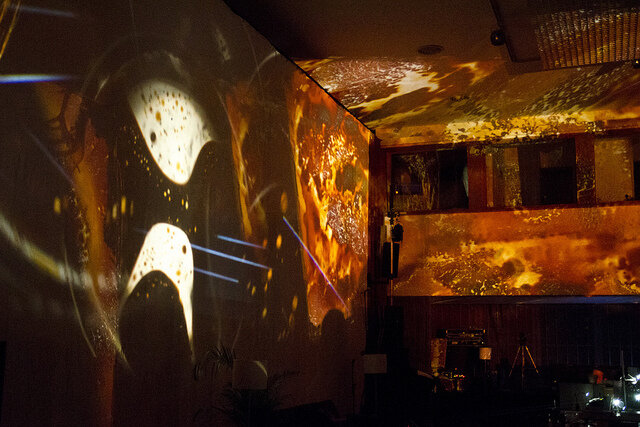
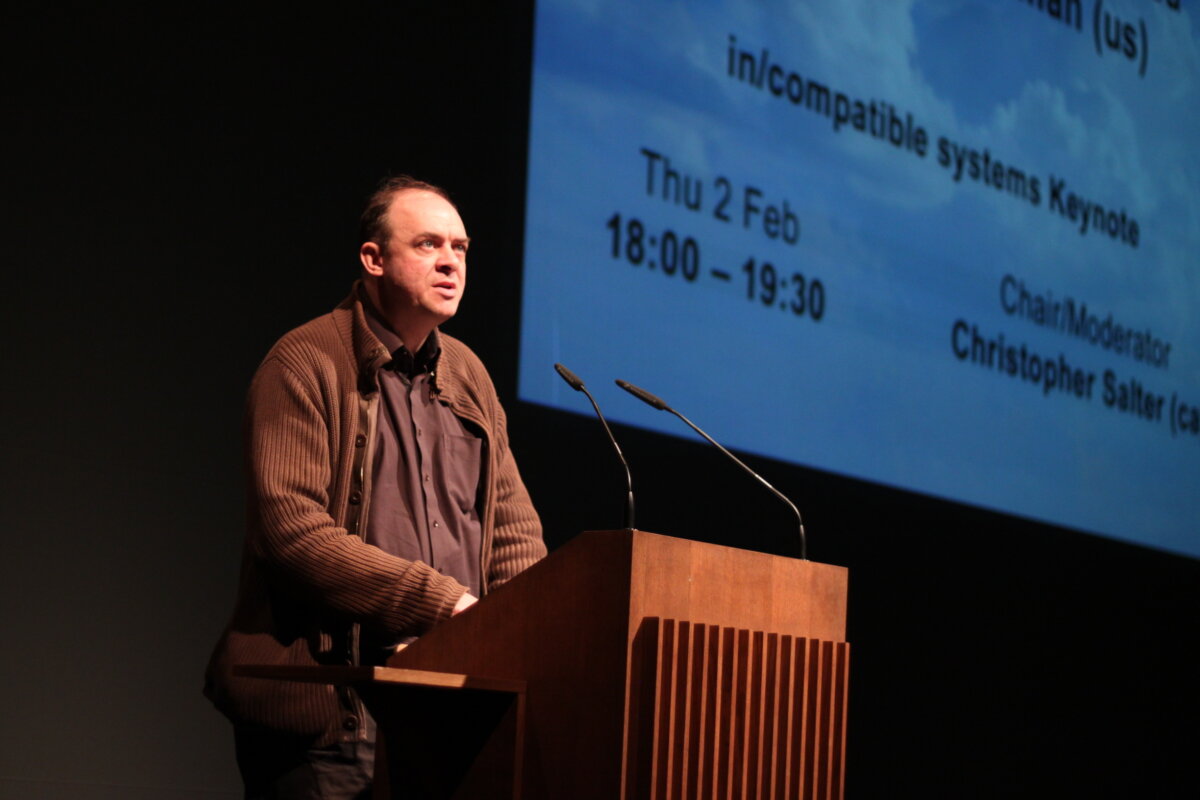
The wide programme of transmediale 2k+12 encapsulated the different approaches to the theme through its sections: the Symposium focused on in/compatible systems, publics & aesthetics; the Video & Film programme Satellite Stories pointed to the question of who actually orbits around whom: is it technology around humans, or humans around technology? The performance programme The Ghosts in the Machine reflected the relationship between “old” and “new” media, bringing together the past and the present of the festival. Dark Drives. Uneasy Energies in Technological Times was the title of the exhibition, which responds directly to the overall in/compatible theme of the festival. The collaborative initiative reSource for transmedial culture included a series of events focused networking methodologies.
IN/COMPATIBLE presented the complementary Program Reader and Day Planner for the audiences to navigate the festival's programme. Adding to the theme, World of the News – The world’s greatest peer-reviewed newspaper of in/compatible research presented cutting edge in/compatible research in an accessible free tabloid format.
For the 2012 festival there will be no general transmediale Award. This change reflects our new ways of producing the festival: adopting the thematic approach early on we aim at curatorial coherence across the different programme sections and at the same time we wish to engage more directly in our community. Consequently, the call for tm.12 is tied to a thematic rather than an Award competition and the Vilém Flusser Theory Award now takes the form of a Residency Programme for artistic research. For 2012 there will be no Open Web Award, but the critical discussion of the politics of open and closed systems will continue in new formats. The decisions to cancel the transmediale and the Open Web Award are also connected to the development of a new project, reSource, an all-year project working as a form of distributed project residency for transmediale's local, regional and international community.
team
Kristoffer Gansing Artistic Director, Tatiana Bazzichelli reSource Curator, Sandra Naumann Performance Curator, Marcel Schwierin Video Curator, Jacob Lillemose Exhibition Curator, Syelle Hase Assistant Curator, Christine Bernauer Administrative Manager & Finance, Susanne Bernstein Administration & Fundraising Coordinator, Markus Huber Festival Program Manager & Research, Filippo Gianetta Communications Manager, Michelle O'Brien Project Manager Talks & Partner Events, Daniela Silvestrin Assistant resource, Lukas Grundmann Assistant Exhibition & Performance, Doreen Löwe Assistant Video, Sibylle Kerlisch Production Manager, serve-u: Phillip Sünderhauf, Andreas Buchholz, Marc Klische Technical Direction, Maria Rößler Event Management, Giannina Lisitano Head of Press, Katrin von Kotze Press Assistant, Sophie Springer Editor, Lina Zuppke Editorial Assistant, Sophie Springer, Dave Ball, Lina Zuppke Translation, Katharina Galla Community Manager, einskommanull: Laura Oldenbourg, Sebastian Göbel, Micz Flor Website Development, Laura Oldenbourg, Manuel Bürger, Timm Häneke, Till Wiedeck Web Design & Design Concept and Development, Tanja Katharina Lindner, Martin Genz Photo Documentation, Sophie Joos Guest Services, Ann-Christin Görtz Info Counter, Barbara Campaner, Sabine Kulik Arts Education, Ruth Kemper, Baruch Gottlieb DCA/Archive, raumlaborberlin: Andrea Hofmann, Markus Bader, Florian Stirnemann Festival Architecture, serve-u Live Streaming
Advisory Board Alex Adriaansens, Marie-Luise Angerer, Dieter Daniels, Jan Edler, Marie Cathleen Haff, Saskia Sassen
supporters
Funders: Kulturstiftung des Bundes, Medienboard Berlin-Brandenburg GmbH, Bundeszentrale für politische Bildung, European Union Culture Programme.
Partners and sponsors: Mondriaan Stichting, Embassy of Canada, Kingdom of the Netherlands, Kunst Danish Arts Agency, Norden Nordisk Kulturfond, Infinite Opportunities Germany+India 2011-2012, Public Affairs Program of the Embassy of the Embassy of the United States, Aarhus University, Google, serve-u
Media partners: Neural, arte Creative, Berliner Fenster, die tageszeitung, der Freitag, radio eins, 2010 Lab, Deutschlandradio Kultur, DRadio Wissen, De:Bug, Zitty Berlin, Digicult
Supporters: Werkleitz Gesellschaft e.V., SAT Albatros Dubai, Merz Akademie, Kgl. Norwegische Botschaft, Schwedische Botschaft, Italienisches Kulturinstitut Berlin, Kgl. Dänische Botschaft, Collegium Hungaricum Berlin, IN-BERLIN , Echoo Konferenzdolmetschen, Pro Helvetia, amiando GmbH, TOPIX Informationssysteme AG, Arab Shorts, Geier-Tronic Videotechnik GmbH, Goethe-Institut Kairo
Related Programmes
- Alessandra Renzi
- Aliya Rakhmetova
- Andrew Prior
- Autor unbekannt
- César Baio
- Cornelia Sollfrank
- Dagie Brundert
- Eva Fischer
- Florian Wüst
- Gabriel Menotti Gonring
- Georg Russegger
- Hortensia Völckers
- Jonathan Kemp
- Júlia Marí Bernaus
- Julianne Pierce
- Kate Ehrhardt
- Lasse Scherffig
- Liad Hussein Kantorowicz
- Luise Reitstätter
- Marcel Schwierin
- Marie Thompson
- Martin Hug
- Morten Riis
- Nicholas Knouf
- Nicola Angrisano
- Nina Wenhart
- Oliver Baurhenn
- Paolo Podrescu aka Podinski
- Prayas Abhinav
- Roberta Buiani
- Sandra Naumann
- Sergio Messina
- Shintaro Miyazaki
- Stéphane Bauer
- Steve Lambert
- Sydney Ogidan
- tante “Jürgen Geuter”
- Tatiana Bazzichelli
- Tero Karppi
- Thomas Bjørnsten
- Victoria Estok