transmediale 2027 invites applications for the Lattice Labs, a series of experimental working groups dedicated to rethinking and testing alternatives to technological monocultures of extraction and surveillance. Building towards the festival, the Lattice Labs introduce a process-based approach to collective learning and knowledge dissemination.
Each Lab is formed by about five participants and guided by an experienced artist or technologist. Together, participants develop a project that is presented and activated through public events during the festival week in Berlin.
Application deadline is June 7, 2026 (23:59 CEST).
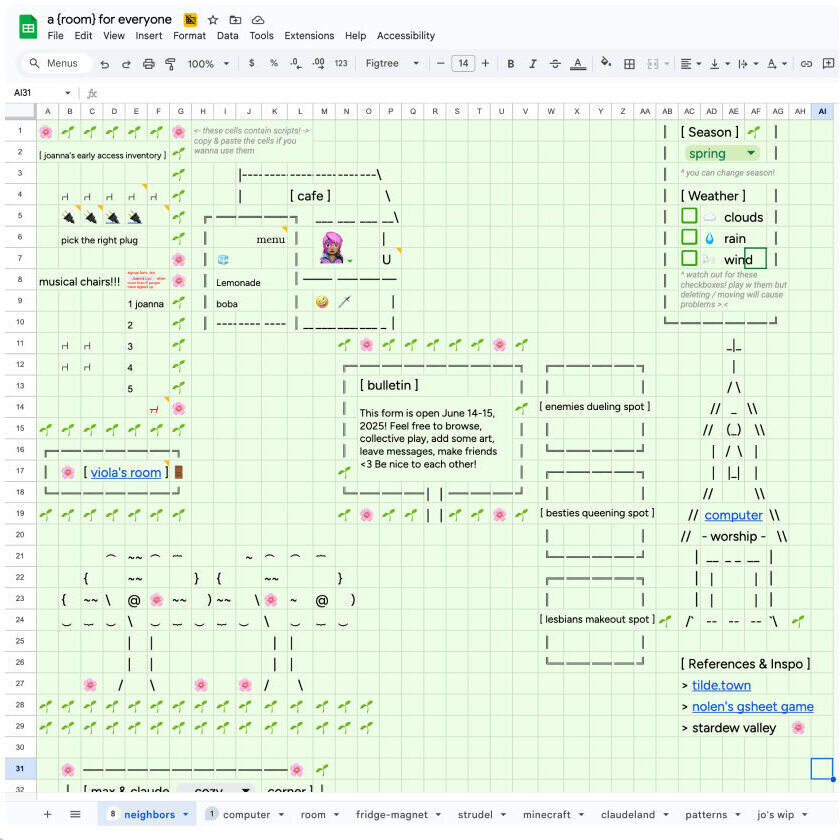
How do we rediscover joy and agency, and foster live experiences with the software we already use?
Google Suite, Slack, email, LLM assistants, social media... Everyday software is where we live most of our digital life. These mundane tools, designed for administrative tasks and productivity, carry a capacity for creative misuse. This lab is an invitation to build a more direct and playful relationship to software, by reappropriating existing tools as instruments for collective performance and play.
We draw a lineage of desktop performance, live-coding, and screen-as-venue practices, and ask how those forms travel across the wider terrain of ready-made tools. Somewhere between performance and game, these practices share a commitment to literacy, liveness, and playing together. In a moment where technology often feels opaque or imposed, the lab explores how intentional playful engagement can rebuild a sense of agency, and how we can learn to love the computer (and through that, trust each other) again.
Goals
▫️ Peer-to-peer learning and prototyping: research, prototype and design games, systems, and performance formats using ready-made platforms, and test them with each other. Together, the lab participants develop a shared repertoire of playful interventions.
Weaving theory and lineage with practice.
▫️ Introduction to history, theories, and lineages of desktop performance, live coding, and creative misuse. Through thematically structured sessions, the lab works towards a shared articulation for our practice.
▫️ Developing collective outputs: the lab culminates in a public performance or participatory event that puts the developed formats and tools in front of a live audience.
Candidates
This lab is open for artists, performers, and technologists who are curious about how digital systems work underneath their surfaces, and want to play with that knowledge publicly. Ideal participants should be confident in using technical tools to express creative ideas (programming, game engines, audio-visual tools, etc.). Programming proficiency is valued and prioritized. You should love computers and the labor, process, and structures behind them. An interest in performance, liveness, and collective practices is also essential.
Technologies involved
The exact technologies used will depend on the participants’ expertise and interests. These may include:
▫️ Web browsers and browser-based tools
▫️ Protocols and networking systems (HTTP, web sockets, bluetooth, etc.)
▫️ Scripting within existing ecosystems and platforms (AppleScripts, Google Apps Scripts, etc.)
▫️ Messaging apps, email, and social media
▫️ LLMs
▫️ Other software tools you already use in your practice
▫️ Participants should be comfortable working with technical systems, but don't need expertise with all of the above
what to expect
Part I: Sharing practice. Participants present their tools, methods, and research for peer-to-peer learning. We will discover our interests as a group and learn from each other.
Part II: Working group: Experiment with unfamiliar tools and develop collaborative prototypes through mini game jams and structured workshops.
Part III: Public output: Finally, develop and rehearse a collective participatory experience for a live audience, alongside written documentation of the lab’s process.
lab location
Fully remote, with presence in Berlin during the festival (January 26 – February 1, 2027)
Support & participation ponditions
▫️ transmediale covers travel costs for each participant to attend the festival in Berlin. Train travel is prioritised where possible; otherwise, round-trip economy flights will be provided.
▫️ Accommodation is provided for the duration of the festival and the installation period.
▫️ Travel and accommodation arrangements are coordinated by transmediale.
▫️ transmediale supports visa applications by providing letters of invitation.
Participant responsibilities
▫️ Participate in all meetings.
▫️ Commit to develop a collective project.
▫️ Availability to travel to Berlin during the festival (26–31 January 2027).
Lead
viola he is a Shanghai / NYC-based multimedia artist, educator, electronic musician, and creative technologist. They create audio-visual performances, installations, XR theatre, and experimental games, exploring alternative structures, systems, and interfaces across digital and physical mediums. viola is an Assistant Professor of Interactive Media Arts at NYU Shanghai, an organizing member of Livecode.NYC , and co-runs translocal game collective [[rect]] repair . Their work has been presented at SXSW Music Festival, Under the Radar Festival, Onassis ONX, Festival Tsonami, Gray Area, as well as various underground venues and nice corners of the internet.
▫️ May 18: Open Call announcement
▫️ June 7: Open Call deadline
▫️ June 29: Participants announcement
▫️ July 13: First meeting
▫️ July-Aug-Sept: Bi-weekly meetings
▫️ Oct-Nov-Dec: Weekly meetings
▫️ January 26–31: Festival
Application deadline: 7 June, 2026 (23:59 CEST)
▫️Applications are only accepted via transmediale’s submission form. The applicants’ information will be stored only on our own servers in Berlin.
▫️Only one application per candidate across all labs will be accepted.
▫️No collective applications.
▫️Authenticity matters more than perfection, please use your own voice.
▫️Results will be announced in June.
▫️For further questions, please contact: submit[at]transmediale.de