
Julian Oliver und Crystelle Vu schreiben kollaborativ, reflektieren und berichten über ihre künstlerische und aktivistische Praxis. Everything Not Saved entstand aus dem Bewusstsein einer Multi-Spezies-Realität in Aotearoa Neuseeland. Von diesem Ort aus bringen sie ihre Arbeit vorwärts, damit sie angepasst und weitergetragen werden kann. Denn so können aus dem infrastrukturellen Widerstand, an dessen Aufbau sie lange gearbeitet haben, Ermächtigung und Hoffnung entstehen.
01
It is possible to know a place for a lifetime but not what went before.
This shifting baseline is a syndrome often cited in environmental studies, where with each new generation comes a world full and anew, a ‘normal’ that speaks little of what was lost. Only when visiting the ancient forest of Białowieża in Poland, which flows deep into Belarus, did we learn what Europe has lost – a vast and thriving mixed-forest biome that once extended across the European Plain from the British Isles in the west, east, to the Ural Mountains of Russia. Prior, we had extensively hiked and explored many primitive forests in Europe – those of Germany in particular – but none were the un-gardened and teeming place-world that is Białowieża.
There, by pure chance, we met activists, some of them scientists, up against the fist of the Polish state’s siege against this last remnant of ancient Europe. The state’s support of the logging industry has driven ongoing rollbacks of environmental protections. With years having assisted environmental defenders in information and operations security, this was our first contact with true frontliners in their operational setting. Their urgency, determination and humility, their stories of raids, device seizures and surveillance, echoes in us still.
02
“As extinction spreads, some of the lost forms prove to be keystone species, whose disappearance brings down other species and triggers a ripple effect. The loss of a keystone species is like a drill accidentally striking a power line. It causes lights to go out all over.” —E.O. Wilson1
The most difficult thing when talking about the mass extinction crisis is not the horror of it all, but, that it is unfathomable. We are wired to perceive the unfamiliar more than the fading of something we know; the appearance of an exotic bird in our yard would catch our attention, whereas the sudden decline of white butterflies may not. Like global warming, mass extinction is not an easy object of thought, a silent march seemingly deliberating without event, until it does, and does so catastrophically.
For those in cities, that we have entered the Sixth Extinction event on this planet,2 the last being 65 million years ago, is perhaps a reality even more abstract than climate change: remote, with less direct or compounding experience. Weakening bird call, quieter dawns, vanishing butterflies, fungi or lizards are often beyond the urban horizon.3 One could say that the baseline is weaker in cities.
On extinction’s own terms, it is not events like wildfires that will raise its spectre, but the collapse of food systems, medications disappearing from shelves (approximately 50% in active clinical use come from irreplaceable natural sources4 ) and freshwater depletion, to cite a few.
Yet as warming ‘comes home’ to the foreground of Western experience through heatwaves, floods and ashen skies, the doomscrolls of social media are increasingly situating climate change as our primary existential lot. And so, in just a few short years, it is warming, and not other symptoms and projects of civilisation, that has come to be popularly attributed to the extinction crisis itself.
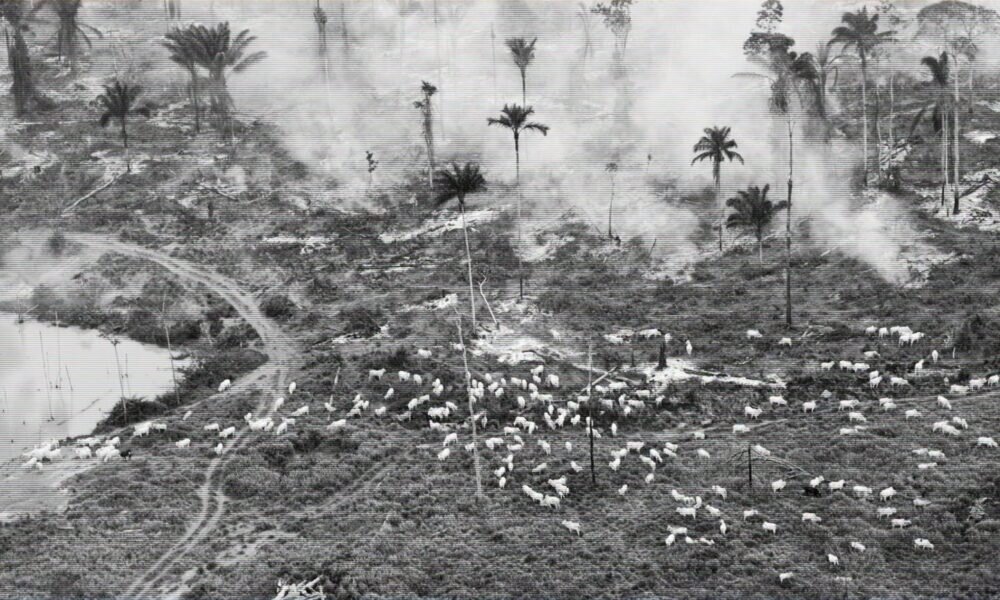
In truth, and as the far less-platformed biological community will assert, warming is (presently) not near being the primary driver of the mass extinction crisis. On land, disappearance is dominated by habitat destruction and degradation due to animal agriculture,5 where wild animals now total just 4% of global biomass, with livestock 60%.6 At sea, species decline is predominantly attributed to industrial-scale fishing.
An urgency to raise awareness of the impacts and brutal reality of biodiversity collapse led us to create the Extinction Gong in 2017,7 a ceremonial automaton for the Sixth Mass Extinction in the form of a large, traditional Chao gong. The rear face of the gong element is fitted with a mechanism that beats to the computer-controlled rhythm of species extinction, estimated by the eminent biologist E.O. Wilson to be about 27,000 losses a year – or once every 19 minutes.8 The front face of the gong bears the Extinction Symbol, created by East London artist Goldfrog ESP in 2011. A stylised hourglass within a circle representing the Earth, the symbol serves as a warning that time is running out for many species.9
It was just twelve months after the first exhibition of the piece that we came to find ourselves very much involved in environmental defence with a climate and ecological movement bearing the same symbol, but whose call was predominantly for the climate. It was through infrastructure and community platform architecture that we developed and formulated our contribution.
03
“Privacy is the power to selectively reveal oneself to the world.” —A Cypherpunk’s Manifesto10
In October 2018, Extinction Rebellion (XR) launched and quickly started to amass and organise on platforms like Slack and Discord, whose terms of service XR expressly broke. It was here we chose to offer something different; a server solution for XR groups to host entirely free and open-source productivity and organisation platform solutions, all running on renewable energy. These first servers were deployed in Iceland, on geothermal energy, and later in Switzerland on hydroelectric energy from Alpine meltwater (the poetry of which did not escape us). We referred to this as a ‘mission coherent’ platform for environmental activism, and so the rollouts began – soon, dozens of servers were deployed and secured, with group-nominated sysadmins trained to run them over countless hours in full. This push for ‘infrastructural sovereignty’ was motivated by more than just administrative flexibility and energy ethics. It continued years of our existing work, advocacy, and teaching across operational and information security spheres, with a focus on at-risk groups and individuals.
Throughout the world, people continue to be arrested, jailed, harassed and killed for their defence of nature.11 The environmental defenders murdered – mostly indigenous, our planet’s foremost conservationists – increases year after year as the impacts of anthropogenic climate change and extinction rates continue to escalate. In some parts of the Western world, the act of peacefully organising and protesting in the streets is characterised as a threat to national security, leading environmentalists to be targeted in domestic terror investigations.12 And so, it follows that to protect the environment, its defenders must first be protected, and to do so effectively, they must mitigate and be aware of strategies deployed by intelligence agencies that seek to surveil environmentalists both online and on the ground.
Even with that telling legacy, asserting a need for data privacy, information and operations security within a movement founded by some 13 white and privileged activists in the UK (a country famously lenient in regards to civil disobedience) – whose operational antic was as ‘an above-ground movement’ – has been challenging. It was, after all, to be an open-hearted movement where “we organise in the open”. We took this somewhat naive ‘regime of openness’ as something that would soon manifest as a bottleneck in the movement’s growth. Seasoned activists abroad knew very well the surveillance stakes – or were at the least productively paranoid. And for those in far less privileged countries, where activists are stalked and dragged from their homes, an ‘above ground’ strategy was – and continues to be – simply untenable. Further, at the time, Slack had voluntarily chosen to adhere to then-President Trump’s digital embargo, which meant those in many off-list countries, from Cuba to Iran and other MENA (Middle East/North Africa) states, could not join the movement. Chinese activists could not reach Google Docs, where the UK branch of Extinction Rebellion was publishing so much of their initial formation material.
Here, platform independence – community-owned and operated infrastructure – did more than signal sovereignty. It sought to enact inclusiveness, a refusal to perpetuate and participate in the very same alienations that have so harmed this planet. There would be no global movement without infrastructural resistance. There needed to be a safe place to work and to build anew.
In the months that followed, as the movement bloomed into North America, Africa, Latin America, Asia and Oceania, the community-owned and operated infrastructure we deployed soon became the migration target for a vast movement. Proprietary platforms were all but left behind, with social media used solely for public outreach. That infrastructure – from team chat to forums, cloud storage and collaborative editing tools – now supports some of the largest populations in the world, with over 1100 local groups in 83 countries and has become both central and critical to the movement’s functioning and work.
But deploying them was not enough. They needed to be secured. And, as high-value targets, they have proven themselves against some of the most capable and resourced adversaries in the environmental defence space, attacked day and night. It soon became clear that activists themselves needed training and education to protect themselves in the field. Across the global ‘rebellion waves’, a troubling pattern emerged, of arrestees reporting that “cops seem to want our phones more than us”, and so, beyond platform deployments, an operational security culture was needed – slow work in a decentralised and expressly leaderless movement. Throughout, it felt as if the movement was being mined from the outside, with counter-terrorism divisions being invoked in some countries, including the UK. Forensics divisions were at work on XR activist devices, many of which left their pockets unencrypted. These lessons were learned late by some and resulted in catastrophic waves of ‘pre-arrests’ based on earlier intel, with raids of family homes, interrogations, and spot arrests on the street.
It is worth noting that much of this could not have been done even just two years earlier, at least at such geographic distribution and scale. Software platforms were either too immature for large scale community deployment, while others barely existed. Mattermost replaced Slack as Discourse became the movement’s choice of forum; Nextcloud and Cryptpad replaced Google Drive and DropBox; Limesurvey met the needs of Google Forms while Mailtrain brought thousands from Mailchimp; BigBluebutton and Jitsi Meet finally made headroom against Zoom, the incumbent video conferencing solution known to work with the PRC against Chinese dissidents, and more recently in collaboration with Indian Federal Police in pursuit of Extinction Rebellion activists.
All the while, cross border collaborations and friendships were blooming on the team chat platform and forums we had deployed, and a vibrant and social darknet was spared from the toxicity and pervasive surveillance of corporate-owned platforms. Some groups grew to sizes eclipsing that of the founding group, XR UK – and all self-governed. It is testimony that open source and community-owned infrastructure can meet needs at such a scale to become the thriving haven of a global movement.
However, our own safety soon came into question, as the French government’s ultra-violence against activists in Paris – a branch of XR with which we have a long connection – signalled an escalated risk for our well-being. Our own identities had more or less escaped. We were worried for our child and so planning for our arrests.
04
“Anything Not Saved Will Be Lost” —Nintendo Wii Help Screen13
This wasn’t, however, why we moved to Aotearoa New Zealand in early 2020. It was long-planned to embed ourselves in a multi-species reality, out and away from cities, perhaps to denuded land we could assist to regenerate. Through family, we came to be introduced to local forest regeneration and conservation work in rainforest country lower North Island, deep in the valleys north of Te Whanganui-a-Tara, or Wellington. With this work came a strange unburdening of planetary boundary dread, bearing less weight of planetary collapse and its anxieties; action was indeed the best antidote to despair.
It became clear that healthy biodiverse and intact biomes are the key to resilience on a changing planet and that there was a vast and diverse community of dedicated people across the country focusing on exactly this. We found the fight for our climate here, too, with estimations that converting 30% of existing farmland back into forest ecosystems while preserving remaining natural habitats could remove almost half the carbon dioxide surplus humans have emitted since the start of the Industrial Revolution.14
Beyond this tangible connection to fighting extinction and warming at once – a welcome balance to server administration, community platform architecture, platform integrations and firewalling – we have come to see this work as part of a broader decolonisation here in Aotearoa New Zealand, a refusal to sit and watch indigenous flora, fauna and funga collapse into extinction. It is the eating march of the actual extinction crisis, seen out our window, a view we knew only in the abstract from our windows of Paris and Berlin.
When taking a ‘biome first’ approach, conservation can be emotionally challenging work. Here, like many lands settled by Europeans, it is the often ugly but always rewarding work of protecting ancient habitats from the symptoms and escapees of biocolonialism. Here, that list is long; a species of clematis cherished in England that here strangles and suffocates the canopies of regenerating forest; Australian possums that eat the eggs of defenceless native birds and strip young shoots of the canopies; rats and stoats that raid nests for eggs and chicks;15 goats and deer and that wipe out the under-canopies of whole forests, effectively ending all new generations of trees until they themselves starve to death. All such species – none of whom are to blame – were introduced to either farm or adorn this archipelago in the image of Europe, islands whose only mammal prior to human settlement was the bat, and which today are pushing countless native species to the brink as they breed unchecked, free from natural predation.
How we bridge these two spheres of engagement in environmental defence, or whether they need to be bridged at all, are questions we’re in no rush to answer. What is clear is that our work in both will be adapted and shared in the hope that it can empower others in their fight against that which must be refused.
Julian Oliver und Crystelle Vu schreiben kollaborativ, reflektieren und berichten über ihre künstlerische und aktivistische Praxis. Everything Not Saved entstand aus dem Bewusstsein einer Multi-Spezies-Realität in Aotearoa Neuseeland. Von diesem Ort aus bringen sie ihre Arbeit vorwärts, damit sie angepasst und weitergetragen werden kann. Denn so können aus dem infrastrukturellen Widerstand, an dessen Aufbau sie lange gearbeitet haben, Ermächtigung und Hoffnung entstehen.
Julian Oliver and Crystelle Vu come together to reflect, taking and sharing the long view on their art and activist practices. Everything Not Saved is co-written from the position of their multi-species reality in Aotearoa New Zealand. It is from this place that they bring forward their work so that it might be adapted and shared, and from the infrastructural resistance they have worked long to build there may come empowerment, and hope in the “fight against that which must be refused”.
Crystelle Vu is a conservationist based in Aotearoa, New Zealand. She co-founded and co-organised BLACKLIST, an event series in Berlin addressing the greatest environmental and societal challenges of our time. From late 2018 to early 2021 she dedicated herself to community platform architecture for environmental defenders, alongside activist coordination in various national and international capacities. She is now actively involved in on-the-ground conservation efforts to protect animal and plant species from extinction in Aotearoa, New Zealand. Crystelle studied Fine Arts at L'Institut des Arts Appliqués and Psychology at the University of Paris 8 Vincennes-Saint-Denis in Paris, France.
Julian Oliver is a New Zealander, Critical Engineer, systems architect, educator, electronic artist and activist. His work and lectures have been presented at many conferences, museums, festivals and international electronic-art events including transmediale, the Chaos Computer Congress, Ars Electronica, Tate Modern, FILE and the Japan Media Arts Festival. Julian has received several awards, most notably the distinguished Golden Nica at Prix Ars Electronica 2011 for the project Newstweek (with Daniil Vasiliev). He is the co-author of the Critical Engineering Manifesto, member of the Critical Engineering Working Group. He is an advocate of Free and Open Source Software and is a supporter of, and contributor to, initiatives that reinforce rights of privacy and anonymity in networked and non-networked domains. He has often donated his time and experience in these areas to the support of activist initiatives and at-risk groups, with a focus on environmental defense.
- 1 From E.O. Wilson’s The Diversity of Life, Cambridge, Harvard University Press, 1992; the excerpt can also be found at the E.O. Wilson Foundation website: https://eowilsonfoundation.org/the-diversity-of-life/ (accessed 1 October 2021).
- 2 G. Ceballos et al., ‘Accelerated modern human–induced species losses: Entering the sixth mass extinction’, Sci Adv, vol 1, no. 5, 19 June 2015, https://www.ncbi.nlm.nih.gov/pmc/articles/PMC4640606/ , (accessed 28 September 2021).
- 3 C. Hallmann et al., ‘More than 75 percent decline over 27 years in total flying insect biomass in protected areas’, PLoS ONE, vol 12, no. 10, 18 October 2017, https://journals.plos.org/plosone/article?id=10.1371/journal.pone.0185809 , (accessed 1 October 2021).
- 4 C. Veeresham, ‘Natural products derived from plants as source of drugs’, J Adv Pharm Technol Res., vol 3, no. 4, October-December 2012, p. 200, https://www.ncbi.nlm.nih.gov/pmc/articles/PMC3560124/ , (accessed 20 September 2021).
- 5 Our global food system is the primary driver of biodiversity loss, United Nations Environment Programme [website], https://www.unep.org/news-and-stories/press-release/our-global-food-system-primary-driver-biodiversity-loss , (accessed 14 September 2021).
- 6 Y. M. Bar-On, R. Phillips, and R. Milo, ‘The biomass distribution on Earth’, Proceedings of the National Academy of Sciences, vol 115, no. 25, https://www.pnas.org/content/115/25/6506 , (accessed 1 October 2021).
- 7 The Extinction Gong, The Extinction Gong [website], https://extinctiongong.com , (accessed 1 October 2021).
- 8 The United Nations Convention on Biological Diversity puts it at one species disappearing every 10 minutes.
- 9 Info: The Extinction Symbol, The Extinction Symbol [website], https://extinctionsymbol.info , (accessed 1 October 2021)
- 10 A Cypherpunk’s Manifesto, Activism [website], https://www.activism.net/cypherpunk/manifesto.html , (accessed 1 October 2021).
- 11 ‘Last line of defence’, Global Witness, 13 September 2021, https://www.globalwitness.org/en/campaigns/environmental-activists/last-line-defence/ , (accessed 2 October 2021).
- 12 A. Federman, ‘Revealed: how the FBI targeted environmental activists in domestic terror investigations’, The Guardian, 24 September 2019, https://www.theguardian.com/us-news/2019/sep/23/revealed-how-the-fbi-targeted-environmental-activists-in- domestic-terror-investigations, (accessed 01 October 2021).
- 13 “Everything not saved will be lost,” was adapted by T. Michael Martin from the Nintendo Wii ‘Quit Screen’ message that read: “Anything not saved will be lost” in the epigraph to his 2013 book, The End Games, New York: Balzer + Bray, 2013.
- 14 B. B. N. Strassburg et al. ‘Global priority areas for ecosystem restoration’, Nature, vol 586, 14 October 2020, https://www.nature.com/articles/s41586-020-2784-9 , (accessed 1 October 2021).
- 15 Land, Forest & Bird [website], https://www.forestandbird.org.nz/what-we-do/land , (accessed 1 October 2021).