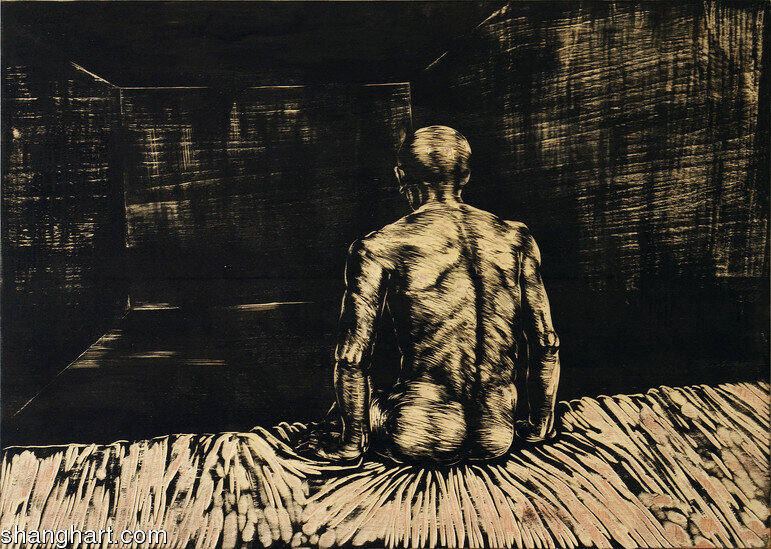
Chinese woodblock printing – a technique that was in early use on both paper and cloth – was an important tool of the Cultural Revolution. This printing technique was used as an important means of communication to quickly convey information. It transported the revolutionary spirit and remains its legacy today. Some actions at the time and even later were not defined by the revolution. This is when the film begins. A strange day. A strange place. Fundamental ideological tenets meet surreal politics. A place, set apart and yet familiar to everyone, is revealed to the viewer. A space in which time and surface become one; where crows and cats alternate and give way to a view of classrooms and burning clouds, the image of a teacher and an ordeal in a hospital … The events are not at all specific and could take place anywhere in the world. And yet the memory of the historical event, repeated in the present, is made visible by these images.
Director Sun Xun: “We exist within such controlling rules. How to find ourselves? Will time allow us to use our own behaviour clearly in this historical process?
…
Die Technik des Holzschnitts, die in China schon früh zum Drucken sowohl auf Papier als auch auf Textilien verwandt wurde, war ein wichtiges Instrument in der Kulturrevolution. Diese spezifische Drucktechnik war als kommunikative Waffe, die schnell Inhalte vermitteln konnte, Träger des revolutionären Geistes – und ist bis heute ihr Erbe. Einige Aktionen sind in jener Zeit und auch danach nicht von der Revolution definiert worden. Der Film beginnt. Ein merkwürdiger Tag. Ein merkwürdiger Ort. Ideologische Grundsätze treffen auf surreale Politik. Ein von allem entfernter und doch allen bekannter Ort öffnet sich dem Zuschauer. Ein Raum, in dem Zeit und Fläche eins wird. In dem Krähen und Katzen sich abwechseln im Blick auf Klassenräume und brennende Wolken, das Porträt eines Lehrers, eine Tortur im Krankenhaus … Das Gesehene entbehrt jeglicher Spezifik und könnte überall auf dieser Welt passieren. Und doch, es ist die Erinnerung an die Geschichte, die sich in der Gegenwart wiederholt, die diese Bilder erst sichtbar macht. „Wir existieren innerhalb dieses, uns kontrollierenden Regelwerks – wie sollen wir uns darin finden? Wird uns die Zeit erlauben, unser Verhalten im Spiegel des historischen Prozesses zu reflektieren?“ (Sun Xun )