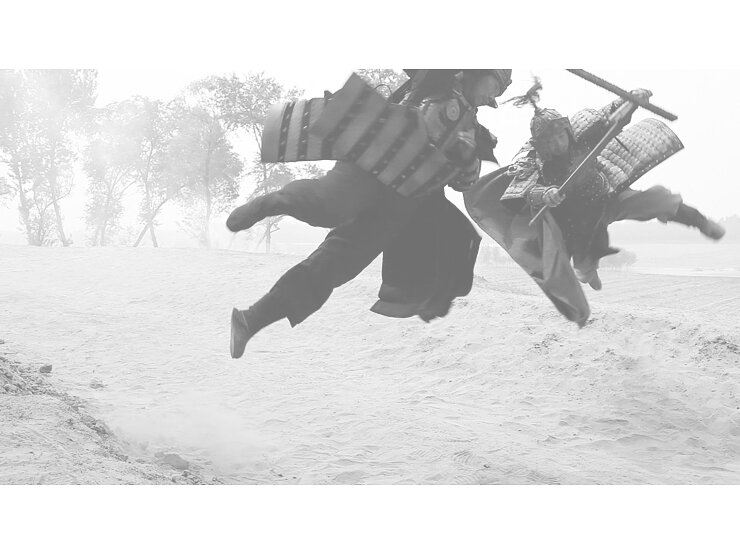
It opens with a traditional Chinese sword fight. Two men in armor carefully exchange choreographed blows while twirling elaborately through the air. Upon closer inspection, the chords with which their bodies are lifted into the air become visible. The illusionary character of this martial arts scene is, in general, more than transparent. The camera wanders back and forth between the intently acting players and those who watch them or record the game on camera. Ella Raidel’s video Play Life Series exposes its own methods right from the start. We see film shoots and film sites where Chinese soap operas are produced. As the camera pans to film teams and cameramen, the fictional content of the rehearsed scenes is interrupted and revealed as the process of making-of. At the same time, through editing, Raidel replays particular movements, handholds, and gestures of the characters, thus intensifying their serial level. The repetitions make clear the extent to which sword fights, wine, love, and revolt are part of a medially represented repertoire of gestures. In the chapter Play Life Cry, a young woman applying for a job at a firm called the Anti-Fake-Factory cries at the interview. As proof of her qualification, she holds up in the air certificates in the form of red books. The books vaguely recall the Mao bible, the signal color red — which is generously represented in the coloring of the mise-en-scène — refers to the color of socialism, but also to blossoming love and melodrama. The next chapter, Play Life Love, is illustrated by a pop singer’s performance and his schmaltzy love songs with a video clip in which a young woman hurries broken- hearted through the streets. Both episodes are offensively concerned with the soap opera’s very own mechanisms: making private feelings public and public spaces private. This process often brings de- politicization along with it, but not in Raidel’s work: the observing camera continually moves into the picture as a documentary agent, intruding into intimate scenes with an observing, correcting gaze. In the concluding episode, in which a recalcitrant employee leaves the office fuming after an argument, the motif of the observing eye repeats. In the midst of anonymous urban architecture and its countless, blank windows, an advertising clip of a staring panda bear appears on an outer façade. Ella Raidel’s work deals ironically with the Chinese soap opera as fake-factory of collective desires, which in the interplay of fiction and making-of, forces its way through reality, scrutinizing it—as site of image making and image controlling.
…
Es beginnt mit einem traditionellen chinesischen Schwertkampf. Zwei Männer in Rüstung tauschen sorgsam choreografierte Schläge aus und wirbeln dabei kunstvoll durch die Luft. Bei genauerem Hinsehen erkennt man die Schnüre, mit denen ihre Körper in die Höhe gezogen werden. Überhaupt ist der Illusionscharakter dieser Martial-Arts-Szene mehr als durchlässig. Die Kamera wandert zwischen den konzentriert agierenden Schauspielern und jenen, die ihnen dabei zusehen oder das Spiel mit der Kamera aufnehmen, hin und her. Ella Raidels Videoarbeit Play Life Serie legt von Anfang an die eigene Vorgehensweise offen. Wir sehen Dreharbeiten und Drehorte, an denen chinesische Soap Operas entstehen. Der fiktionale Gehalt der jeweils geprobten Szene wird durch Kameraschwenks auf Filmteams oder Kameramänner aufgebrochen und als Prozess des Making-of sichtbar gemacht. Gleichzeitig wiederholt Raidel mittels Editing bestimmte Bewegungen, Handgriffe oder Gesten der Charaktere und forciert dadurch deren seriellen Gehalt. In den Repetitionen wird deutlich, inwiefern Schwertkämpfen, Weinen, Lieben oder Aufbegehren Teil eines medial vermittelten Gesten-Repertoire sind. In Kapitel Play Life Cry weint eine junge Frau beim Vorstellungsgespräch, während sie sich bei einer Firma namens Anti-Fake-Factory bewirbt. Zum Beweis ihrer Qualifikation hält sie Zertifikate in Form roter Bücher in die Luft. Diese Bücher erinnern vage an die Mao-Bibel, die Signalfarbe Rot – die großzügig in der Farbgebung der Mise-en-Scene vertreten ist – verweist auf die Farbe des Sozialismus, aber auch auf die der blutenden Liebe und das Melodram. Das nächste Kapitel, Play Life Love, bebildert den Auftritt eines Popsängers und seiner Liebesschnulze mit einem Videoclip, in dem eine junge Frau verzweifelt durch die Straßen eilt. Beide Episoden beschäftigen sich offensiv mit jenen Mechanismen, die der Soap Opera ureigen sind: der Öffentlichmachung privater Gefühle und der Privatisierung von öffentlichen Räumen. Dieser Prozess zieht oft eine Entpolitisierung nach sich, nicht aber in Raidels Arbeit: Immer wieder schiebt sich die beobachtende Kamera als Agent des Dokumentarischen ins Bild und dringt in intime Spielszenen mit einem überwachenden, korrigierenden Blick ein. In der Schlussepisode, wo ein renitenter Angestellter nach einer Auseinandersetzung wütend das Büro verlässt, wiederholt sich das Motiv des beobachtenden Auges. Inmitten der anonymen Stadtarchitektur und deren unzähligen, blicklosen Fenstern findet sich in einer Außenfassade das Werbe-Clip von einem glotzenden Pandabären.
Ella Raidels Arbeit verhandelt ironisch die chinesische Soap Opera als Fake-Factory kollektiver Sehnsüchte, die im Wechselspiel zwischen Fiktion und Making-of die Wirklichkeit prüfend durchdringt – als Ort von Image-Making und Image-Controlling.