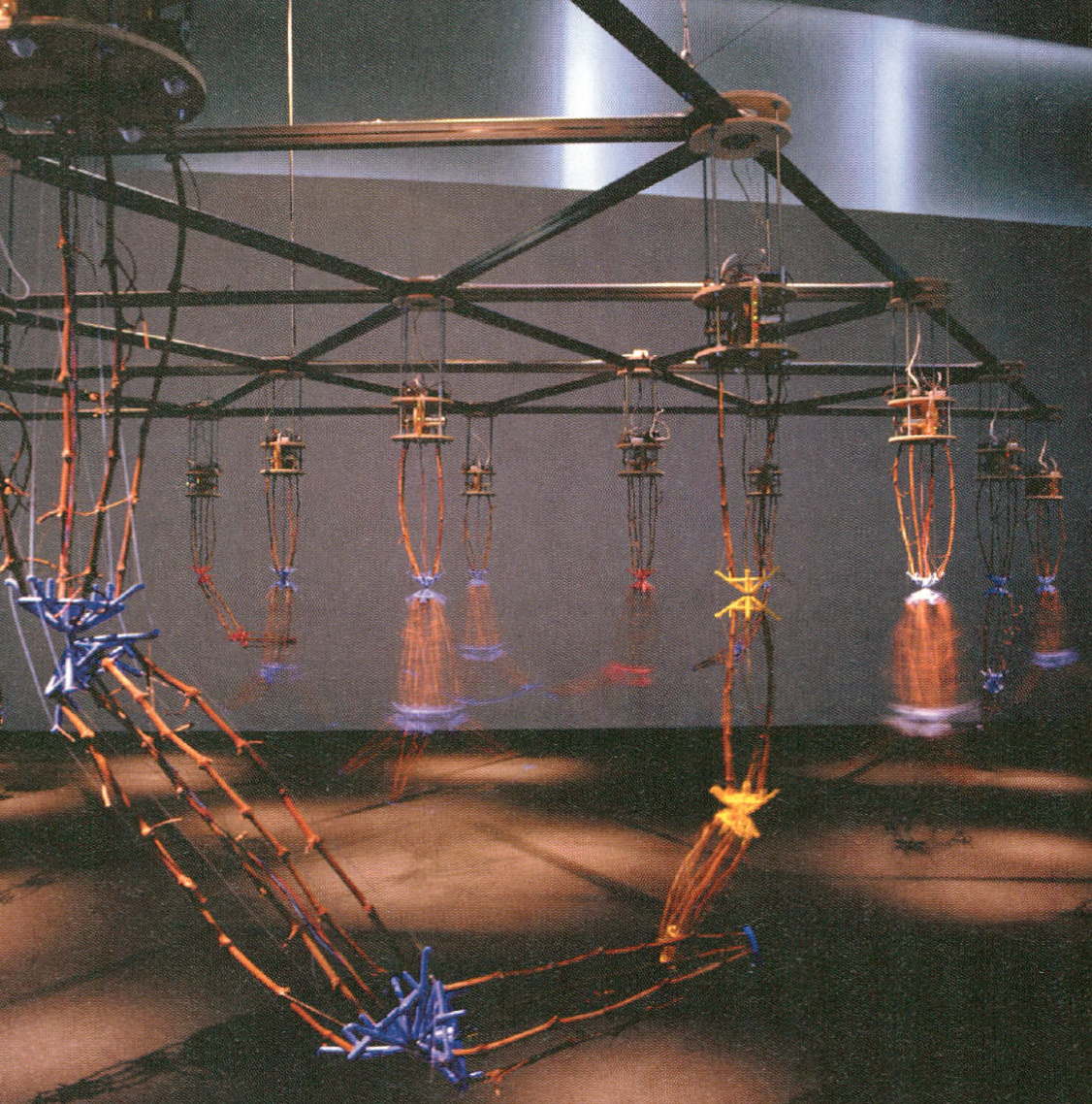
Humans continuously navigate through life and the environment, without constantly realising their actions as a chain of conscious and unconscious decisions. Rinaldo’s installation Autopoiesis invites the visitor to reflect on both levels of decision by inducing robotic sculptures to develop their own, artificial ‘life, seemingly related to human behavior. An intense communication between visitor and sculpture is generated, a complex web of action and reaction on both sides, the human and the technical. Autopoiesis consists of ten musical robotic sculptures, interacting with the audience and incessantly adapting their behavior in response to the visitor’s reaction. The notion of “Autopoiesis”, as defined and developed by Francisco Varela and Humberto Maturana, describes “self-creation”- characteristic for all living systems and suggestive of the artificial intelligence contained within the installation. Lipstick cameras and infrared sensors, mounted in the fragile sculptures made of Cabernet-Sauvignon-vines and polyurethane-joints, record the presence of a visitor. The sculptures react on position of and activity by the viewer, while also including the perceptions and reactions of the other sculptures by implementing a built-in group- consciousness. The group of robot sculptures communicates amongst each other by an electric wire system and audible telephone beeps, representing a kind of musical language. Together with the audience, they create a unique audiovisual concert of reaction and counter-reaction, totally non-reproducible and endlessly variable.
…
Der Mensch navigiert stetig durch das Leben und seine Umwelt, ohne ständig vor Augen zu haben, dass sein Handeln von einer Kette aus bewussten und unbewussten Entscheidungen besteht. Rinaldos Installation Autopoiesis fordert den Besucher auf beiden Entscheidungsebenen dadurch heraus, dass die robotischen Skulpturen ein eigenes, künstliches Leben entwickeln, das menschlichem Verhalten verwandt ist. Es entsteht so eine dichte Kommunikation zwischen Besucher und den Skulpturen und ein komplexes Handlungsnetz aus Aktion und Reaktion auf beiden Seiten, der menschlichen und der technischen. Autopoiesis besteht aus zehn musikalischen Roboterskulp turen, die mit den Besuchern interagieren und ihr Verhalten in Abhängigkeit vom Besucher unaufhörlich verändern. Der Begriff „Autopoiesis“, wie er von Francisco Varela und Humberto Maturana definiert und weiterentwickelt wurde, bedeutet „Selbstschöpfung“- ein Charakteristikum aller lebenden Systeme und deutet auf den Anteil künstlicher Intelligenz in der Installation hin. Spionkameras und Infrarot-Sensoren, die in den fragilen Skulpturen aus Cabernet-Sauvignon-Reben und Polyurethan- Gelenken untergebracht sind, erfassen die Anwesenheit von Besuchern. Die Skulpturen reagieren auf Position und Aktion der Besucher, wobei der einzelnen Skulptur eine Art Gruppenbewusstsein implementiert ist und ihre Reaktion also auch in Beziehung steht zu der Wahrnehmung und Reaktion der anderen Skulpturen im System. Die Gruppe von Roboterskulpturen kommuniziert untereinander über eine feste Verkabelung und mit Hilfe hörbarer Telefontöne, die für die Gruppe eine musikalische Sprache darstellen. Gemeinsam mit den Besuchern entsteht so ein einzigartiges audiovisuelles Konzert aus Reaktion und Gegenreaktion, das sich nie wiederholen kann und in Variationen immer wieder neu kreiert wird.