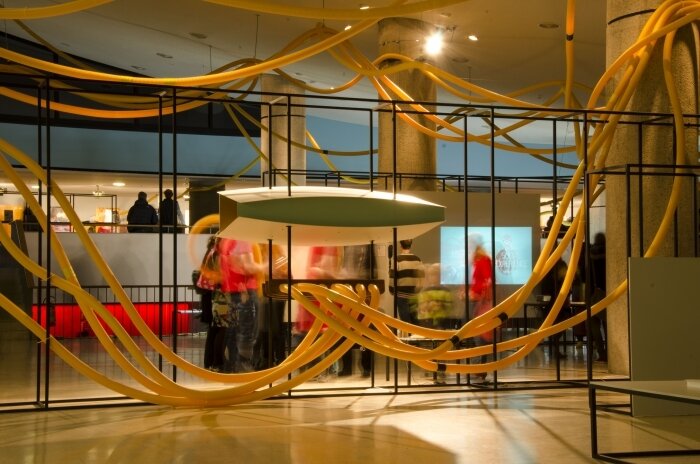
29.01 - 03.02.2013
The Miseducation of Anya Major openly investigates questions of knowledge, learning and education in relation to contemporary media, from the photocopier and paper shredder to computer games and the latest smartphone. What counts as useful knowledge in this context? And why is some knowledge considered irrelevant? What are we learning? What should we learn? What can we learn? What do we want to learn? Within which frameworks is this education taking place? Could it take place elsewhere? Who are our teachers? Do we trust them? Do other kinds of teachers exist? Is it necessary (and/or possible) to invent a radically different “school system”?
Addressing these questions, the exhibition series takes its cue from the famous television commercial for the first Macintosh computer that aired on January 22nd, 1984, during Super Bowl XVII. The commercial was directed by Ridley Scott, known for post-modern sci-fi classics Alien (1979) and Blade Runner (1982). Scott referenced George Orwell’s novel 1984 (1949) to create a dark futuristic setting, where an athlete/heroine carrying a sledgehammer tries to outrun a group of security guards through the halls of a sinister industrial complex. After running through tube-like corridors, she enters a big hall where a large group of people sits passively watching Big Brother on a large screen. Just as the guards are about to catch up with her, she throws the sledgehammer at the screen. The screen is destroyed in an explosion of light, and smoke blows into the dusty faces of the shocked listeners like some otherworldly life-giving force. Fading out, the commercial ends with the quote: “On January 24th, Apple Computer will introduce Macintosh. And you’ll see why 1984 won’t be like ‘1984.’”
The actress—and real-life athlete—who played the heroine is named Anya Major (b. 1966), and the exhibition series makes reference to her as a way of remembering and reimagining the rebellious spirit she embodies. Her miseducation is not a jeremiad about how she has been deliberately fed with false information and withheld important knowledge in order to keep her in a subordinate and passive position. On the contrary, it is a vision of the reemergence of a critical and inventive media literacy that, like Anya Major, escapes the forces of control and power to express disobedient engagement with the media of contemporary society. As such, it challenges the homogenization of media education enforced by creative industries and that education’s accompanying definition of a skillful media user in which the Macintosh life-style machine has become an integral part. Beyond standardizations of learning processes and pre-fabricated “student identities,” Anya Major’s miseducation opens up to an expanded and heterogeneous field of alternative possibilities for becoming an educated media user. It is, in other words, only literally a miseducation from the perspective of the educational principles of mainstream media culture. From the perspective of the exhibition series, it suggests a radical redefinition of what media education is or rather what it can be.
While the educational potential of computer games is often emphasised in discussions about contemporary media culture, computer art in the eyes of the general public is often perceived as too difficult and too strange to learn from. The Miseducation of Anya Major questions this perception and argues in favour of art as an educational language with its own set of experiences and forms of knowledge that sidesteps the progressive logic of media development to speculatively explore other, untimely ways of learning, using and developing media. It is language that enables smashing screens of control, neither with a sledgehammer nor with a Luddite incentive, but with conceptual tricks, visual subversions and material hacks that propose liberating reconfigurations of media objects and relations.
The three exhibitions respond to this educational challenge each in their own way. The exhibition Tools of Distorted Creativity presents a series of contemporary works that expands the notions of software tools and their affordance of creativity in nonconformist, and even dysfunctional directions. Imaging with Machine Processes: The Generative Art of Sonia Landy Sheridan, is a survey exhibition of an artist who experimented with the machines of technological society as instruments of the philosophical mind and artistic imagination from inside educational institutions. Finally, Evil Media Distribution Centre by the duo YoHa (Graham Harwood and Matsuko Yokokoji) is an installation that takes its point of departure from the book Evil Media (2012) by Matthew Fuller and Andrew Goffey. The installation presents everyday “evil media” objects accompanied by short texts by invited contributors to encourage an expanded notion of media and how it operates on our participatory behaviour. The connection between the three exhibitions is the introduction of a media literacy that is not based on the ability to use media the way it is supposed to be used or to be a more accomplished and effective user. The connection is an investigation of media as cultural construct and effect and as the means of envisioning the inventive mutation of such constructs and effects.
The mass culture promoted by the creative industries and the spectacular media society eventually assimilated Anya Major. The Miseducation of Anya Major invites visitors to rediscover her example of resistance of uniformity and authority. This resistance is manifested in a series of works and exhibitions that accentuate the significance of rebellious ecological intelligence needed for development of eccentric, experimental and truly diverse media environments.
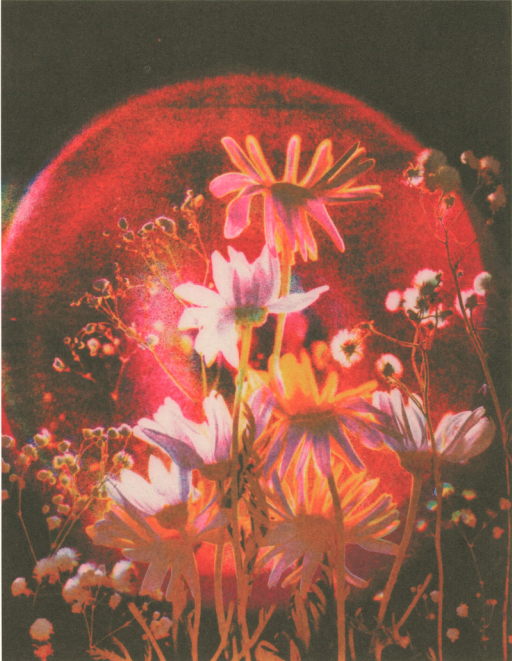
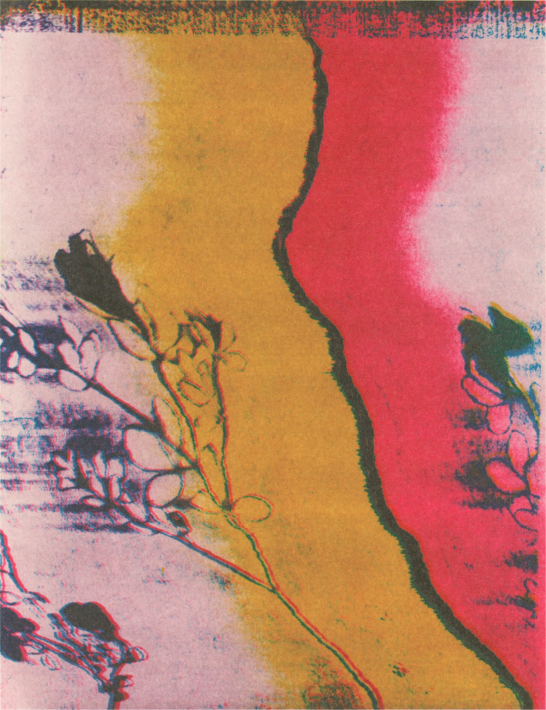
Every push of a button, every press by hand, every type of a key, every match burn is a moment in time. High-speed equipment permits the accumulation of hundreds of moments in the span of minutes or seconds. As fire burns instantly, so thermal images are made in seconds. Wires and fiber optics transmit information long distances in minutes. From the state of think it-have it we have moved to the state of have it- think about it. The age of the original is here. Each moment is unique, no two are exactly alike. A reproduction for everyone is metamorphosed into an original for everyone. For over a decade Generative Systems faculty and students have been studying the positive and negative implications of relative speed on art. It has raised an entirely new set of conditions for the continuous-running, stopped-time, 2-3D tactile systems. Thermography, electrostatics, magnetics, photography, accoustical graphics, transmission and much more are all interrelated with past and present fields of art. We try to keep the whole systems functioning, while individuals explore in depth. Slow and fast, private and public, old and new, positive and negative, on and off, inner and outer, east and west, north and south - such contradictions are characteristic of Generative Systems. Like Graham Peck in his book on China Two Kinds o f Time , we look both at the river moving toward us (as in the East) arid to where the river is flowing ahead (as in the West). We move in two kinds of time.
Imaging with Machine Processes: the Generative Art of Sonia Landy Sheridan
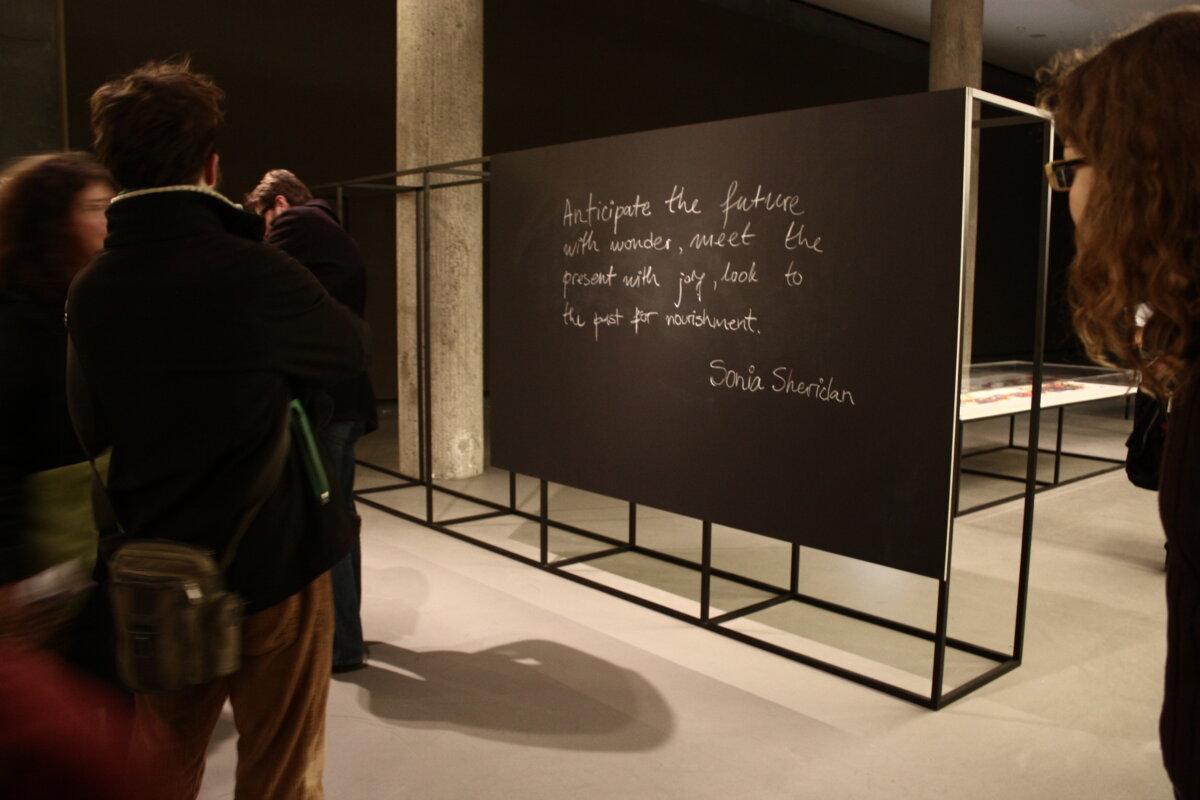
Ever since Sonia Landy Sheridan (b. 1925) first got her hands on new communication technologies in the late 1960s, she has playfully interacted and critically engaged with them to permit the imagination to develop alternate forms of both aesthetic beauty and philosophical depth. Imaging with Machine Processes. The Generative Art of Sonia Landy Sheridan—her first solo exhibition in Europe—presents a wide variety of material relating to this manifold, extensive and truly unique line of work. From early consumer electronic devices such as Thermo-Fax and the industrial 3M Color-in-Color photocopier, to software tools like EASEL, Lumena, Vango and Adobe Photoshop, Sheridan has experimented with machine processes to openly explore their generative capabilities for imaging beyond the politics of instrumental reason. Like a hacker or glitch artist avant la lettre, she has used “bugs” and unintentional effects produced by the machines to demythologize their authority and appropriate them for insubordinate expressions of artistic invention, essentially proposing a radical new perspective for the development of technology and of technological society. The exhibition combines historical works and documents with contemporary 300 objects and prints. The breadth of exhibited work shows the continuity in Sheridan’s art in terms of method and concerns, as well as its receptiveness to continual and dynamic change in the interrelationship between technology, social conditions and art.
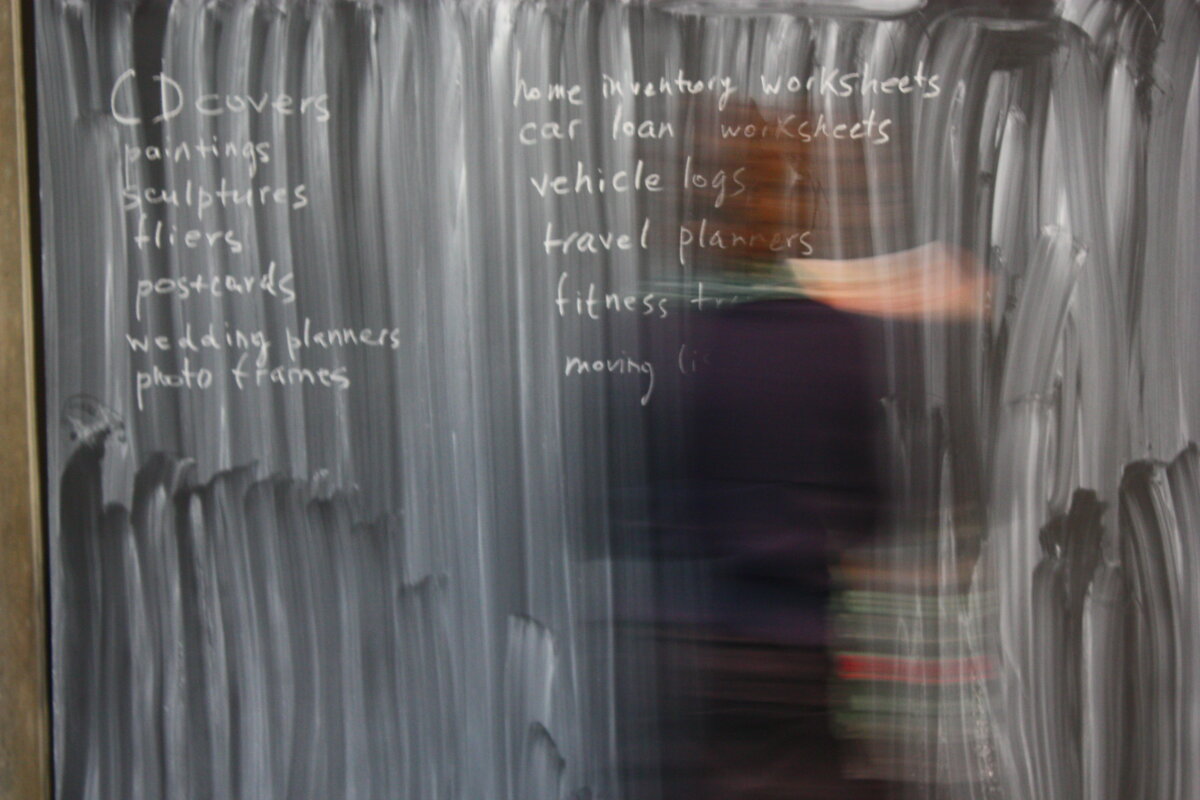
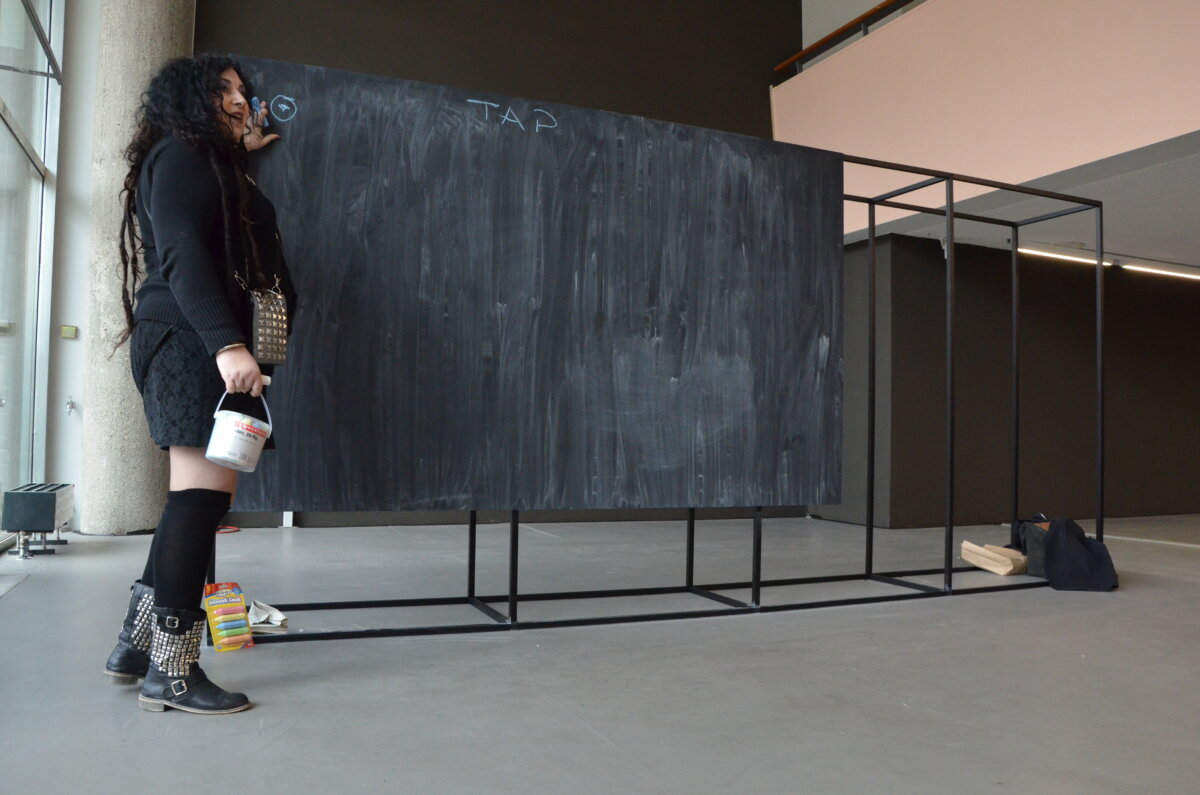
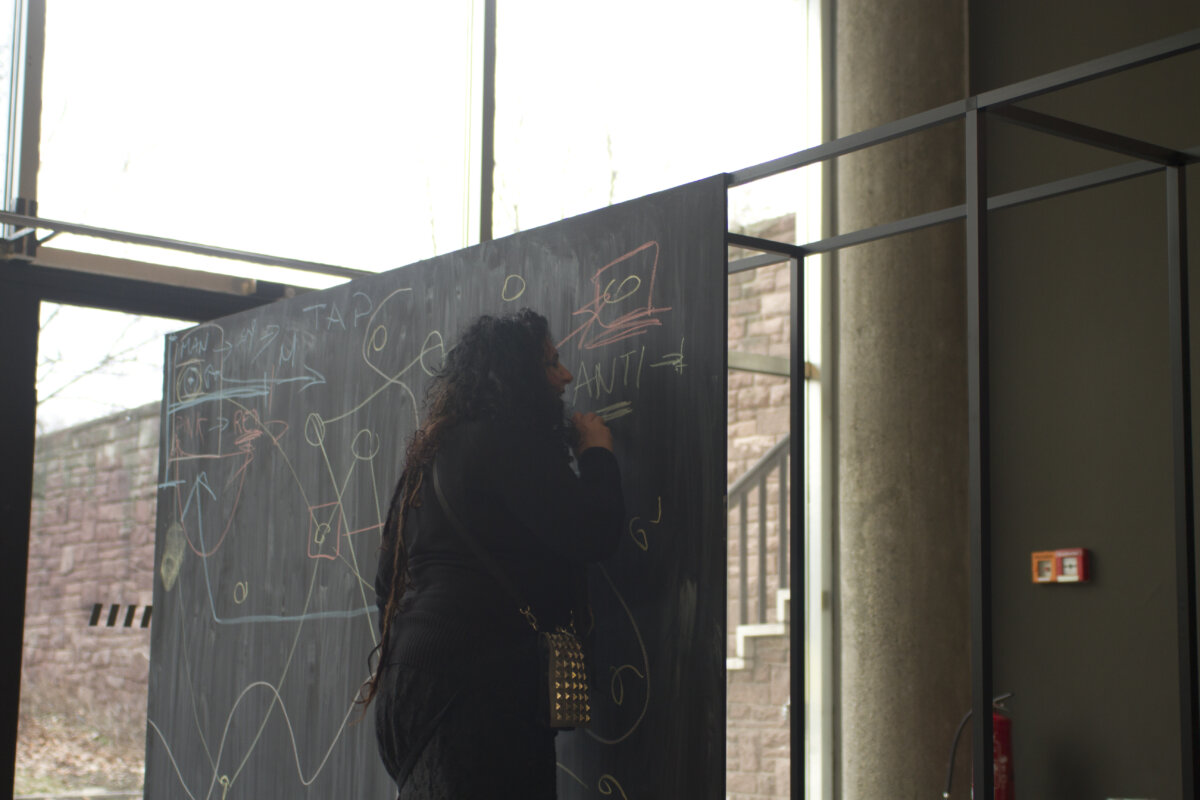
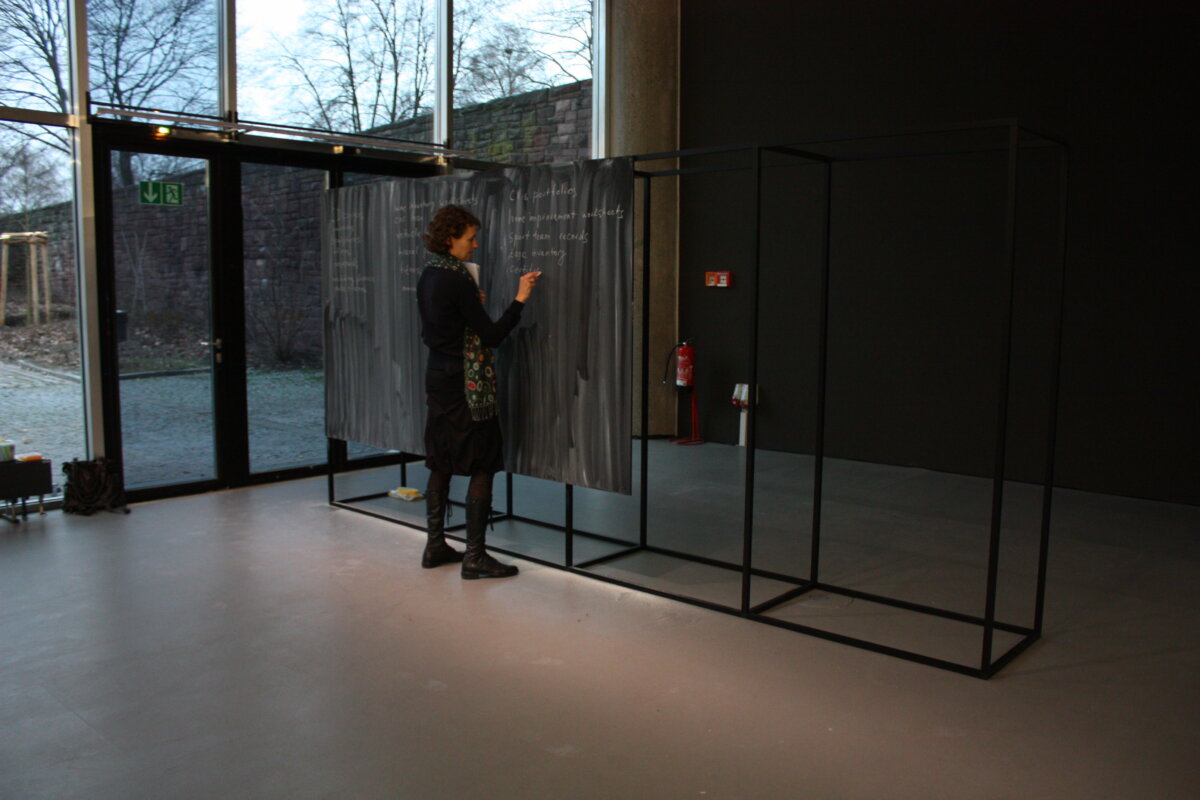
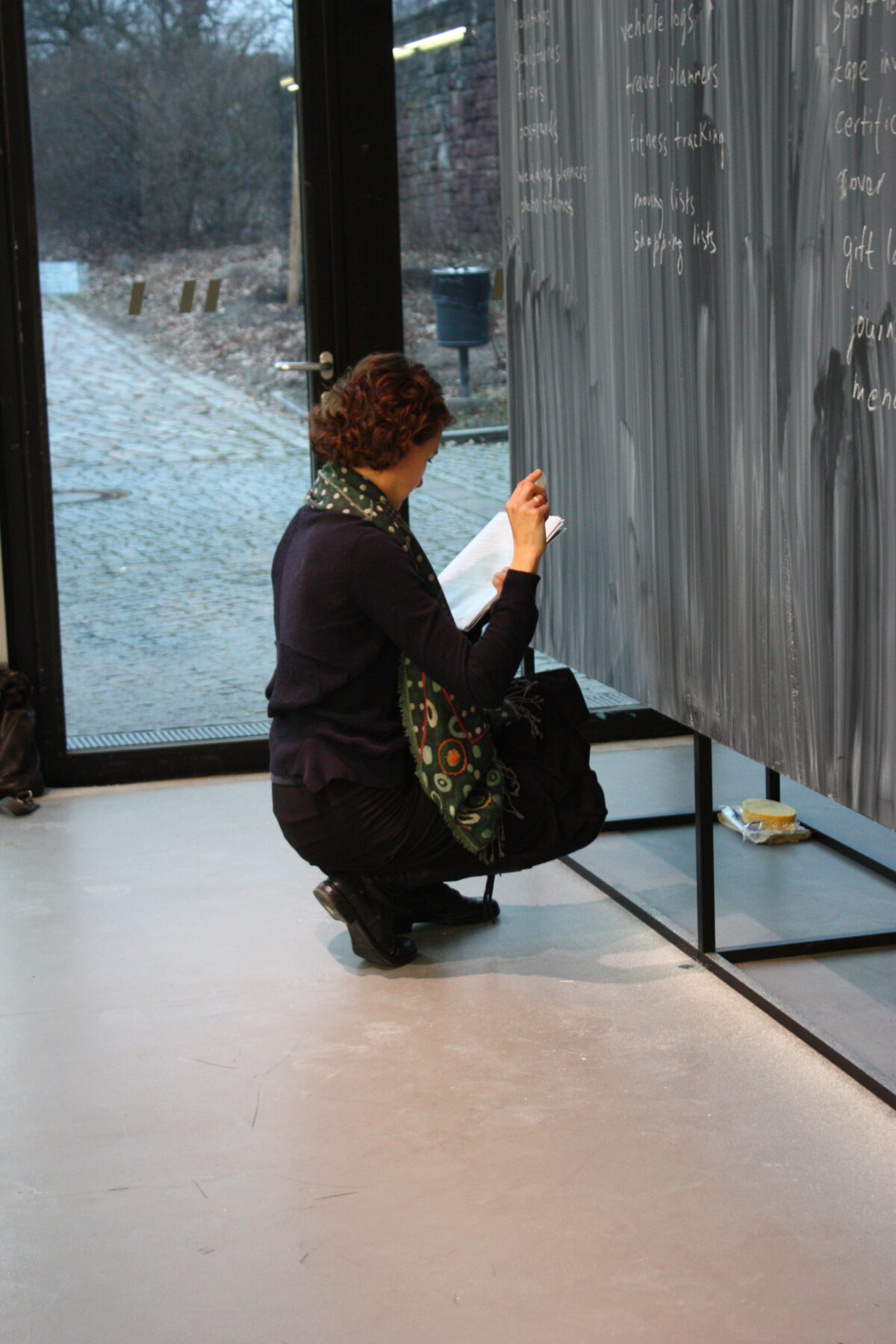
The exhibition also emphasizes Sheridan’s strong involvement in education and her challenging vision of teaching within institutional frameworks, in particular the Generative Systems program she set up and ran throughout the 1970s. In addition to film and photo material documenting this involvement, on every day of the festival a blackboard features a quote Sheridan posts that same day on the Generative Systems Facebook page. (Jacob Lillemose)
Tools of Distorted Creativity
Through a selection of 13 artists, Tools of Distorted Creativity questions the notion of creativity that has been instrumental to the development of the personal computer, from its first stationary instantiations in the 1980s to today's mobile devices. Since its introduction, the personal computer has embodied the dream of the creative machine that allows the user to expand and explore her creative potential, rather than making her a slave of the machine. The personal computer itself is, however, only half of this story about machine-aided creativity. The other and equally important half of the story are the software tools at the user's disposal within the machine environment. Each of these hundreds of thousands of tools presents certain forms of perception, ways of thinking and modes of acting, that in turn activate certain kinds of creativity. So rather than being a general notion, creativity needs to be recognised as a multiplicative and diverse form of practice. Creativity also needs recognition as the source of open potential for tools yet to be invented.
Tools of Distorted Creativity investigates how artists have challenged the paradigmatic notion of creativity introduced by the user-friendly personal computer revolution. The artists present their challenge by producing entirely new tools and modifying or "misusing" tools that are already around. Beyond the normative credo to be creative, the artists in the exhibition rediscover the original rebelliousness associated with the notion of creativity offered by the personal computer and its tools. They explore creativity as an unexpected and disruptive act opposing its assimilation into the creative industries' processes of cultural smoothening, conformism and standardisation. Discarding the prescribed and conventional use (and understanding) of tools, the works engage in an investigative and speculative reflection on the tools and their implied cultural order. The works encourage users to engage in a more undisciplined kind of tool use, turning creativity into a critical techno-cultural language. It is a language that refuses the logic of office-speak and rather, like Jimi Hendrix and his handling of the electric guitar, takes its point of departure in experimental sensibilities and intelligences that reinvent the notion and use of the tool for other disobedient expressions and purposes.
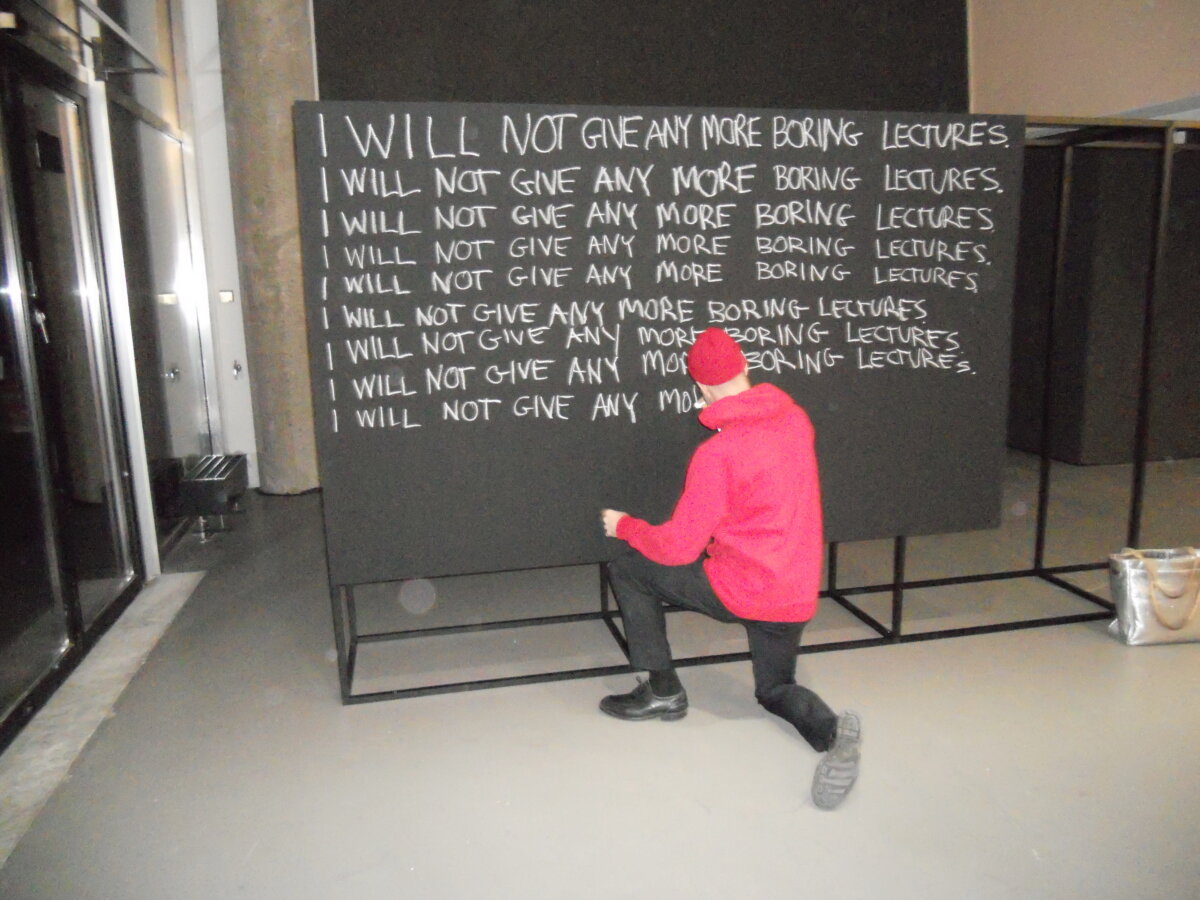
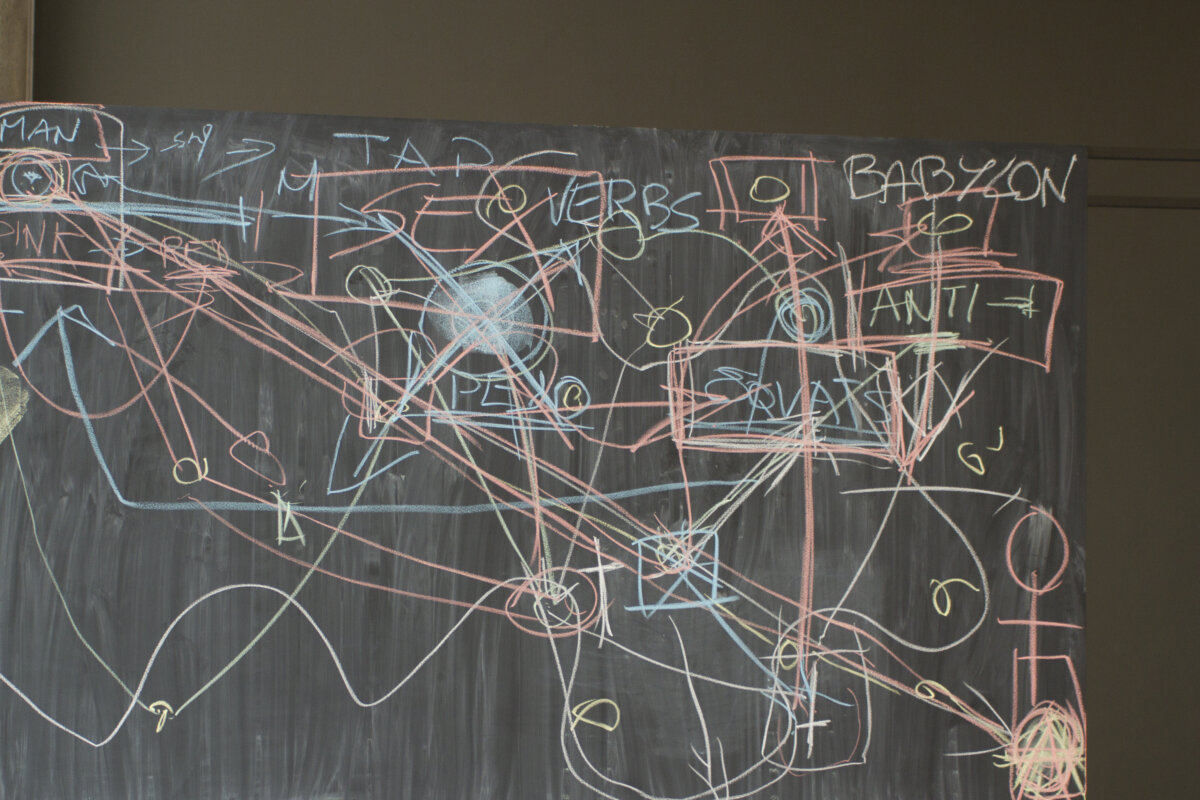
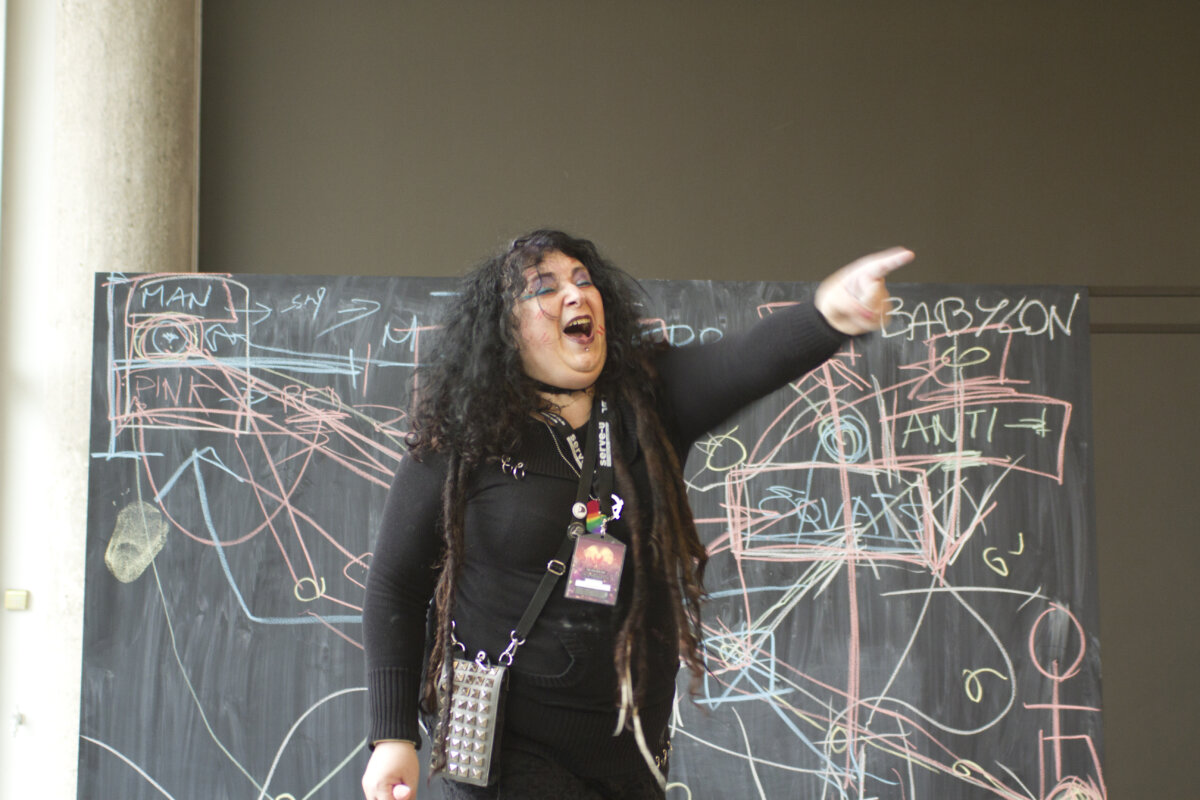
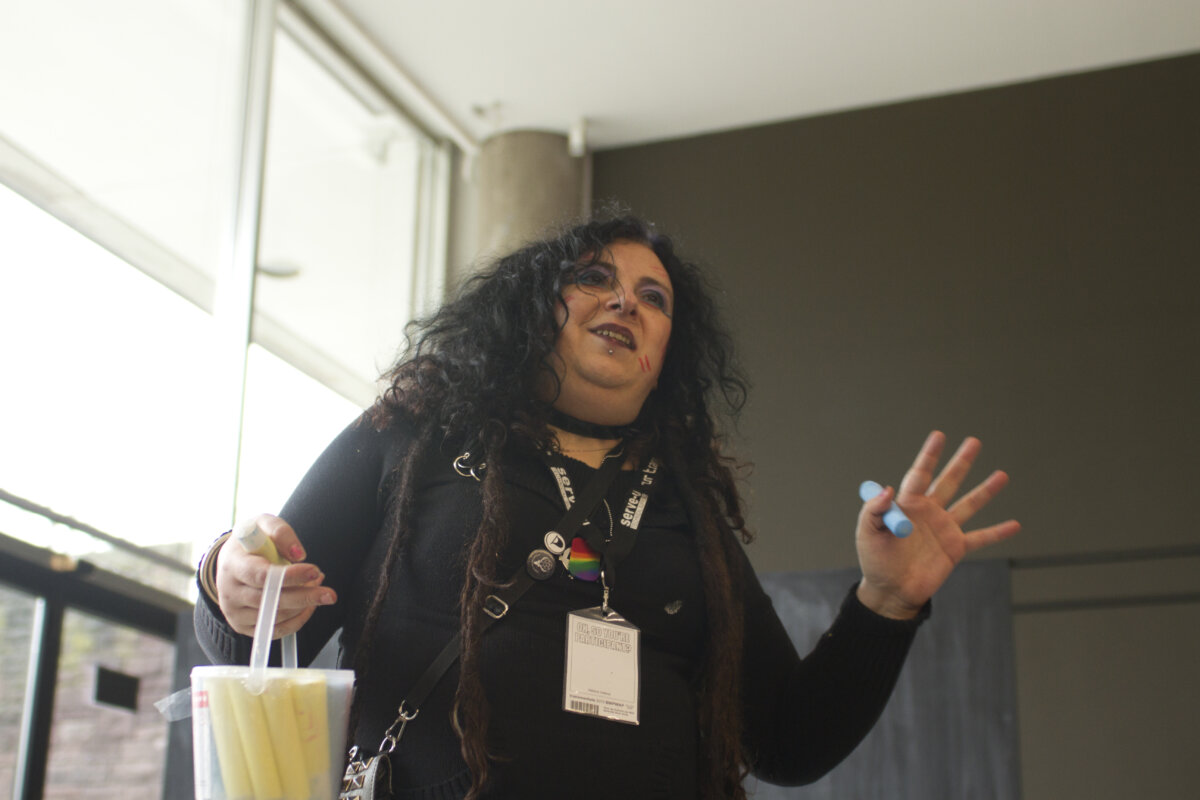
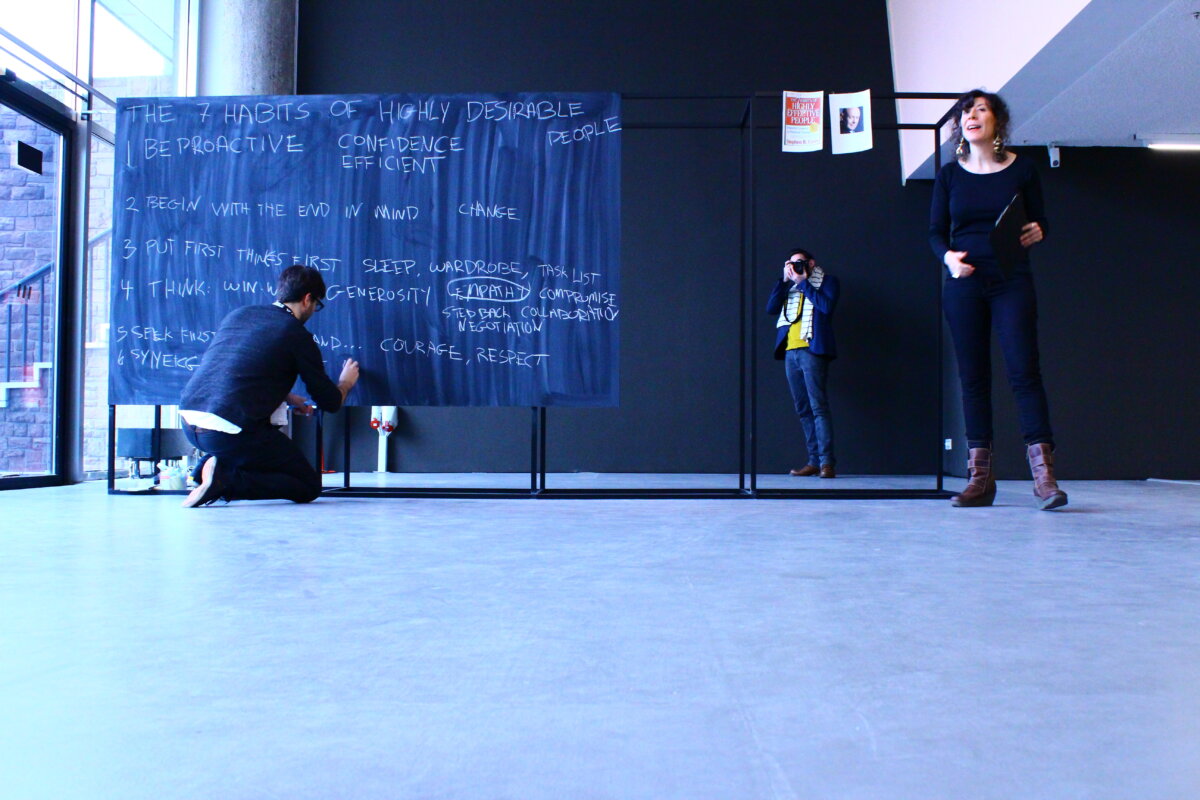
In its classroom setting, Tools of Distorted Creativity can be seen as a toolbox in the form of an educational chart, offering visitors the chance to experience the tools first hand and expand the contextualised understanding of them. In the Extracurricular Material section, visitors can sit down and browse through videos, texts and images that relate to and expand on the exhibition's theme. At the blackboards next to this section, twice a day, artists and special guests will give a "lecture" for the PowerPoint-less mind.
Evil Media Distribution Centre
The amalgamation of theory and practice is a prevalent aspiration in much contemporary art discourse. The ambition is to expand the perspective and relevance of artwork beyond its formal boundaries and to connect the abstractions of the written word to the materiality and experiences of life. This amalgamation is also essential to the transmediale festival. However, with its diverse and intense program of exhibitions, installations, performances, workshops and conference, the festival does not integrate theory and practice as separate entities but as fundamentally connected realms of reflective activity. For the transmediale, theory is not just theory, practice is not just practice. The festival promotes and explores the idea that an artwork expresses theoretical significance and that a theory, like the artwork, unfolds speculative critique and visions about our media society and is a practice of its own sort. Beyond institutional and disciplinary formalities, it approaches theory as an inherent part of practice, and practice as inherent to theory to create a transversal understanding of the energies, knowledge and perspectives of this condition and the possibilities they present for an investigative and inventive engagement in society.
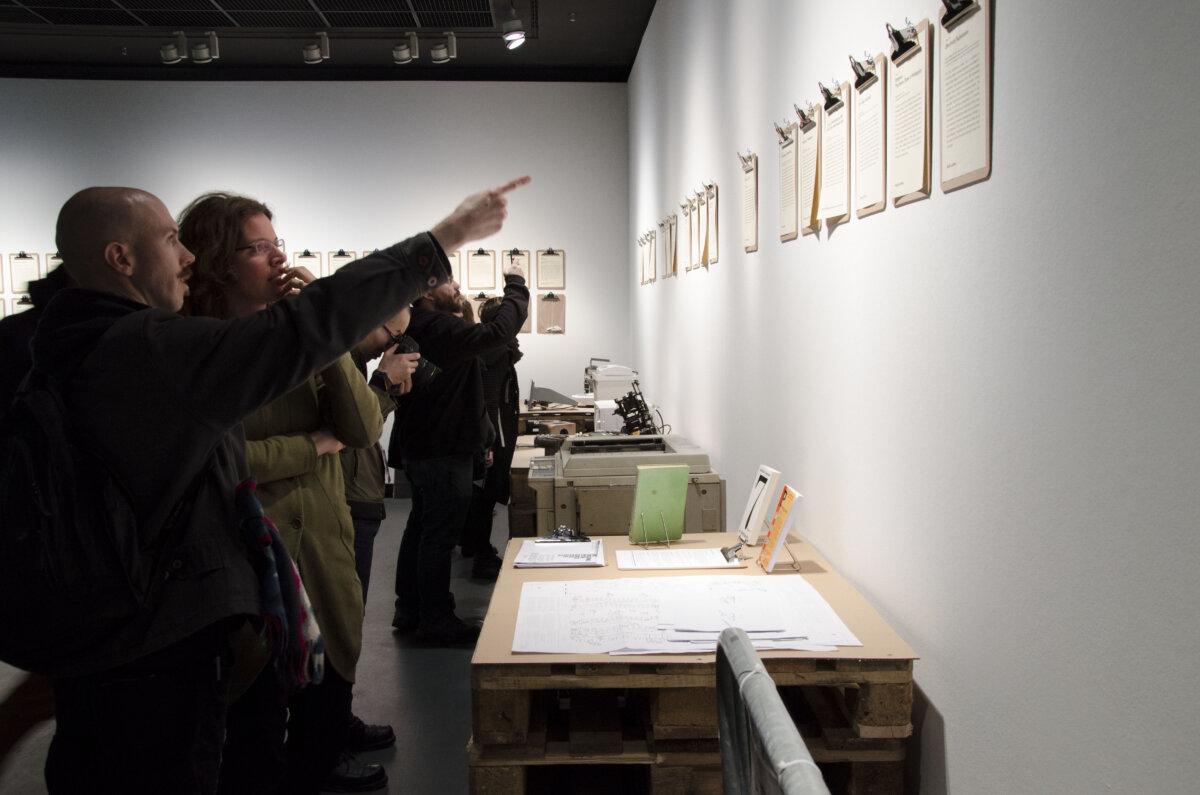
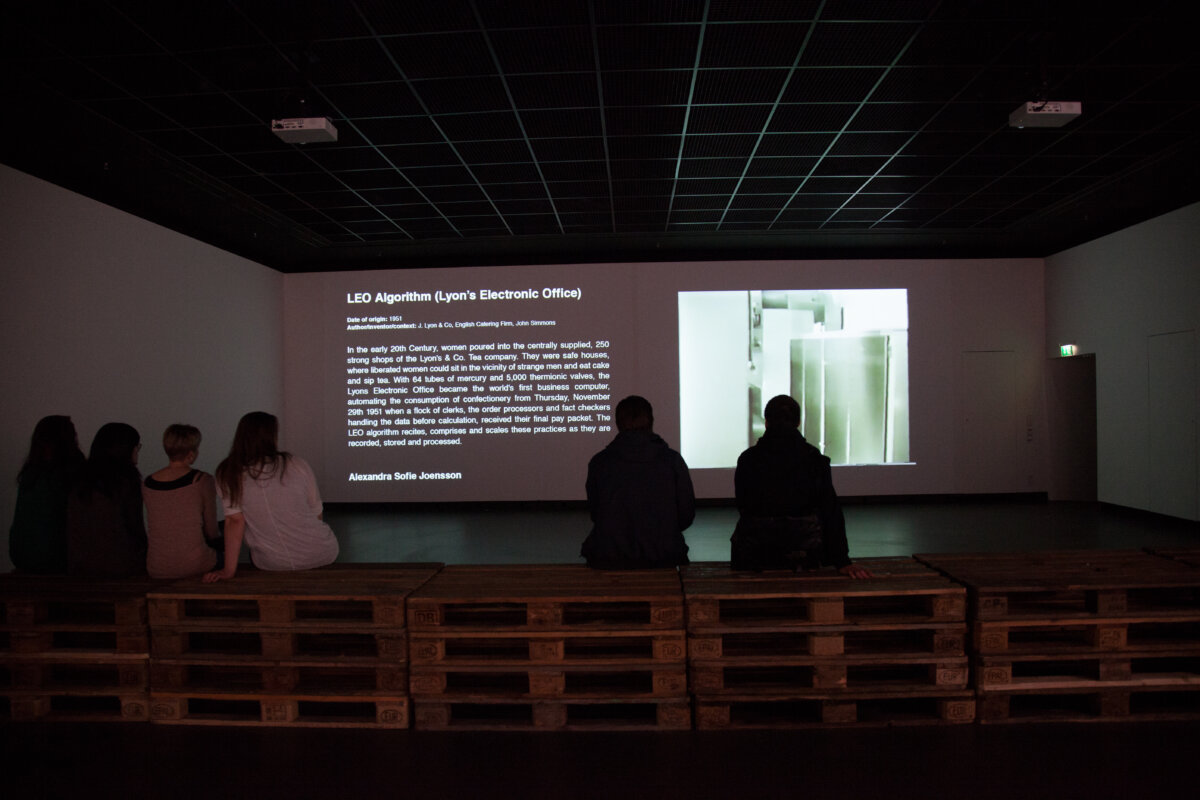
In this context, Evil Media Distribution Centre by YoHa (Matsuko Yokokoji and Graham Harwood) is a genuine transmediale project and one of the most explicit manifestations of the festival’s ambition to present theory and practice as an interconnected whole. The installation is an artistic response to the recently published book Evil Media (2012) by Matthew Fuller and Andrew Goffey, in which the two authors argue for an expanded notion of media or forms of mediation and a deeper, more complex understanding of their effects on how we act, perceive and think in our daily lives. They focus on the pervasive presence of so-called “gray media,” whose mediations “facilitate and amplify the creation of troubling, ambiguous social processes, fragile networks of susceptible activity, opaque zones of knowledge—the evil of media.” The argument takes the form of a series of stratagems that, “rather than simple recipes to be followed, might better be understood as operative constructs in the sense that they have to be taken up, used, worked with …” It is this anticipation of the stratagems’ involvement in experimental practices beyond the pages of the book that YoHa meet. The artists have invited 66 contributors to choose and write a short text about a gray media object, and these texts and objects are then presented in the setting of a curiosity cabinet designed as a distribution center (the presentation media—the pallets, forklift, plastic bags, clipboards and projectors—are also accompanied by a text). With this close proximity between text and object, ideas and materiality, the installation demonstrates a mindset and method where the amalgamation of theory and practice is not a point in itself, but becomes a working condition for developing reflective engagement with the evil of media.