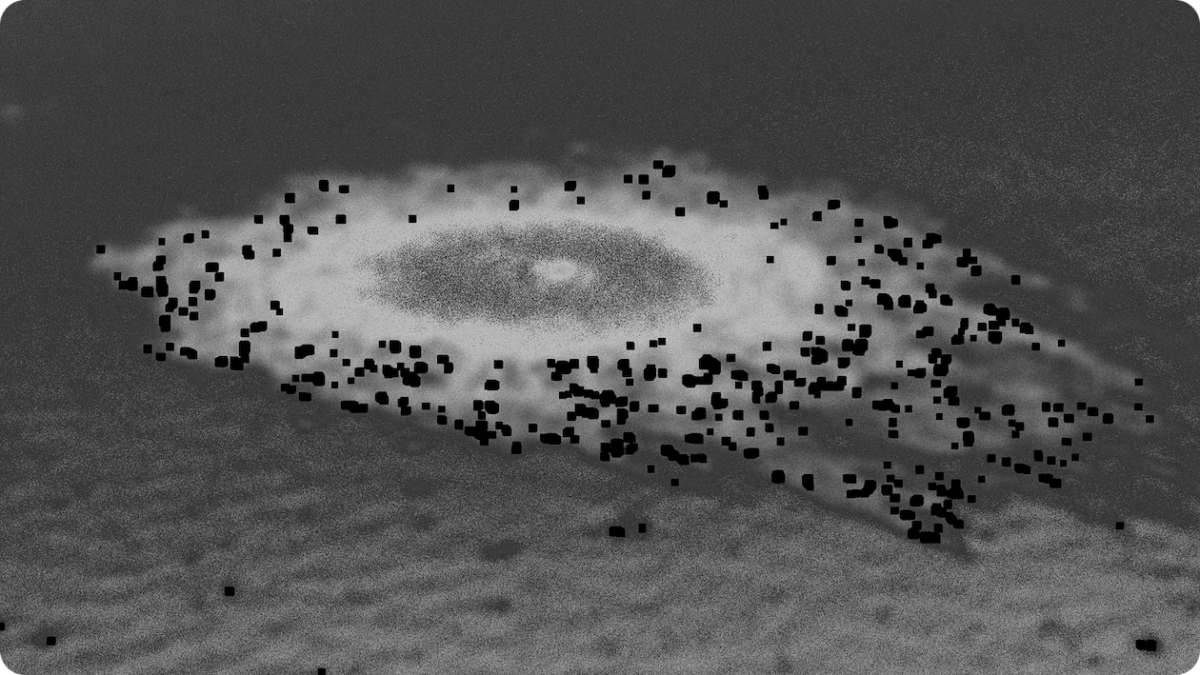
groundstates & fragile currents
Marking its 40th anniversary, transmediale RFC 40 presents a festival and an exhibition. Curated by Barbara Cueto and under the title groundstates, the festival’s programme will take place during the last week of January 2027 in silent green Kulturquartier. The exhibition fragile currents is curated by Antonina Stebur and will be on show at the Akademie der Künste (Hanseatenweg) until March.
| Tue, 26 Jan | Marshall McLuhan Lecture at the Embassy of Canada |
| Wed, 27 Jan | Exhibition Opening at Akademie der Künste (Hanseatenweg) |
| 28 Jan – 7 Mar | Exhibition period |
| Thu, 28 Jan | Festival Opening at silent green Kulturquartier |
| 29 Jan – 31 Jan | Festival days |
more comments on the forthcoming protocol
RFC 40 is a document from the early history of the internet. Request for Comments (RFC) is an unofficial note series on the development of ARPANET. It circulated among a small group of researchers and gathered documents with internet specifications, protocols, and events that later configured the workings of our today’s internet. The name RFC was chosen to avoid being deterministic: Request for Comments made no claim to finality. It acknowledged that no single voice had the complete picture, and that any protocol would only stabilise through collective response and revision. These were, by design, open drafts that invited disagreement as a condition of progress. Published in March 1970 and inspiring transmediale at its 40th anniversary, RFC 40 was titled more comments on the forthcoming protocol.
The paper's subject was error: how a network speaks about what fails, and remains open and functional nonetheless. Error here is understood as a communicative event, something the network must be able to name and transmit in order to keep functioning. What vocabulary do connected systems share for failure? How does a network stay legible to itself while things are breaking down? These are the questions RFC 40 was working through, questions that, in a way, remain unsolved and relevant today.
transmediale's first edition took place in 1988, back then still under the name VideoFest, at a moment when media technologies were primarily understood as tools of broadcast: centralised, directional, controlled by institutions. What the festival did from the beginning was to implicitly refuse this understanding of media, creating a space for artists and researchers asking what else media could be and do, in a critical, yet often playful way. Over four decades, transmediale built a network of artists, researchers, and practitioners working at the margins of dominant technological culture, sustaining forms of exchange, knowledge production, and collective imagination towards a different kind of technomediated present.
Looking at this becoming, transmediale acts as a counter-infrastructure. Not a fixed entity that critiques infrastructure from a position of comfort, but an ever-evolving practice, shaped by and responding to changing conditions and demands. Inhabiting this space, counter-infrastructure becomes above all a generative one: a practice of construction, keeping open the spaces where people can understand, respond to, and shape the technological conditions they inhabit.
28 – 31 January, 2027
silent green Kulturquartier
Under the title groundstates, the festival unfolds as a decentralised system, foregrounding a multiplicity of internets and resisting the expectation of a single technological future. It looks at the subterranean currents of imagination that build collective stories, rabbit holes, and speculations of the communities populating semi-shadowed worlds. groundstates centres around how they carve out autonomous spaces and articulate shared languages to organise, resist, and live otherwise. At its core, the festival presents a discursive and performance programme across four days, bringing embodied reflection to questions that resist analysis and critique alone. groundstates revolves around the human scale of technology to bring forward new forms of collective stewardship.
In physics, the ground state implies a latent potential. It represents the instant before excitation, when a system at its lowest energy possesses the capacity to activate a network. groundstates uses the lattice as both metaphor and method to build alternative technological futures at the edges of dominant infrastructures. A lattice is a structure that provides the scaffolding upon which complexity builds. Lattices exist across nature and science, from crystal formations to neural networks and cryptographic systems. A lattice is porous, holding by what it connects and by what it leaves open, carrying weight through relation. This structure mirrors the conditions we inhabit digitally: the networked world seems saturated, yet interstices continue to exist. These gaps are poorly indexed, non-optimised, non-gamified, and often overlooked. Yet these apparently blank spaces sustain the experimental and political imagination of digital culture. Like the ground state, they are not empty. They hold what has not yet been activated.
The 40th anniversary edition of the festival takes inspiration from these spaces and builds a counter-infrastructure. groundstates gathers communities building in the margins: systems that do not extract, protocols that refuse optimisation, infrastructures sustained without the promise of return. Technology is understood as a lived condition, continuously reshaped through use and misuse, where the conditions of living together are organised and contested.
Lattice Labs – a collective process building towards the festival
Building towards the festival, the Lattice Labs introduce a process-based approach to collective learning and knowledge dissemination. The Labs are a series of experimental and educational working groups dedicated to rethinking and testing alternatives to technological monocultures of extraction and surveillance. Running in the months before the festival, they bring artists and researchers together for sustained cycles of critical discussion and collaborative making, functioning as infrastructures for collective inquiry. Each Lab is formed by five participants selected via an open call and guided by an experienced artist or technologist.
Lab leads are Olia Lialina, Alex Declino, Viola He, selfservice.studio, and Sepp Eckenhausen and Geert Lovink.
28 January – 7 March, 2027
Akademie der Künste (Hanseatenweg)
Marking the 40th anniversary, fragile currents asks not what transmediale remembers, but what transmediale can do.
At a moment when political and technological realities are organised on an infrastructural level, what comes into view are the complex networks of dependencies, asymmetries, and unequal technological positions that connect them across the globe. Contemporary wars and repressions are fought through energy grids, communication networks, surveillance systems, and disrupted supply chains, revealing infrastructures not as neutral technical support systems but as terrains of political struggle.
fragile currents reactivates transmediale as a counter-infrastructure: not a platform for the presentation of art, but a performative node for assembling practices, methods of resistance, and solidarities. Counter-infrastructures are imagined as fragile and provisional arrangements through which other social and political relations can be assembled under conditions of exploitation, militarisation, and ecological breakdown. The title's currents refer simultaneously to flow and force, to electrical charge, to temporality, and to the fragile systems connecting distant geographies and bodily experience through an unstable historical conjuncture.
The transmediale archive is approached as a toolkit of potential political practices, available for collective use. Working with ruins as a method, fragile currents treats infrastructural breakdown not as a moment of collapse but as a condition from which other forms of organisation can emerge. Ruins reveal hidden dependencies while keeping alive tactics that can still be put to use. The exhibition is organised around a living centre: an agora-like installation that holds space for a public programme developed with researchers and international institutional partners operating in contexts shaped by extractivism, technological dependency, and infrastructural fragility, including Greece, Ukraine, Kazakhstan, Chile, and beyond.

About transmediale
transmediale is a festival and space for critical reflection on art and technology. It brings together transdisciplinary communities and diverse audiences with an interest in digital cultures to develop new perspectives on our technomediated times. The festival takes place annually at the end of January and forms the core of the organisation's programming. Beyond the yearly event, transmediale is a transversal, dynamic platform with a vibrant community and a strong network that enables year-round activities, including publications, studio events, and a residency programme. In 2027, transmediale will celebrate its 40th edition.
Funded by
