
During the Particular Waters film shoot in Hsinchu, Taiwan, I met a local farmer on the banks of the Touqian River. He shared his memories of the river. Pointing to the flood watchtower, steadfast on the riverbank, he told me:
As I stood beside the deserted flood watchtower, the memories of the water stirred words of Toni Morrison, which flooded my sight: “Floods is the word they use, but in fact, it is not flooding; it is remembering. Remembering where it used to be. All water has a perfect memory and is forever trying to get back to where it was.”1 Water holds memories, even those we tend to forget. For thousands of years, humans have domesticated water by means of engineered structures and devices, controlling water flows and altering rivers’ seasonal paths according to their needs. Dams, levees, and floodgates, all engineered to control the free flow of water, have now come to be regarded as blockades that can stand in the way of human interests.
The climate disaster is a human disaster
The performance of the fictional meteorological agency 洪火机构 (The Office Agency of Flash Flood and Wildfire) by musician and performance artists bela and Kloxii Li at transmediale 2024 opened the floodgates to disastrous climate imagery accompanied by a series of musical scores. The projection screen on stage streamed original video footage extracted from social media and news channels. Explosive wildfires in California. Imminent flash floods in South Korea. The seamless integration of diverse found footage from weather broadcasts and social media was facilitated by a tailored search engine created by Rim Mustafin. The artist wandered live through the stream of online videos, summoning hopeless content click by click, revealing ever more weather disasters.
The visualisation of overwhelming destruction blurred any supposed boundaries between fiction and journalistically-constructed reality. At the beginning of their performance, the artist bela stated: “The fictional agency focuses on the development and dissemination of contemporary re-ritual to untangle the condition between climate anxiety and mass disintegration.” Over the course of three acts, with the re-sampling of sonic and visual media, bela and Kloxxi Lii interrogated the mass media cycles of crisis that shape our psychological and emotional responses to climate uncertainty. Today, as the need to address climate change grows ever more urgent, we are constantly exposed to images that purport to represent it alongside misleading narratives that naturalise its causes and depoliticise its origins.
While it is true that “climate change’s multiscalar nature – the fact it takes place at both a molecular and a planetary scale – makes it particularly difficult to grasp and represent and thus requires new modes of analysis and narration,”2 it is also the case that climate change is experienced by people across the world viscerally and emotionally as weather phenomena, albeit lacking traceable sources or responsible agents. The longue durée of the global warming scenario has been simplistically represented with imagery of overheated weather events like droughts and wildfires; drastic weather imagery has been misused to create misleading climate simulations. The performance at transmediale 2024 unleashed an overwhelming flow of the kinds of dramatic images that are broadcast almost daily as news of ‘extreme weather events’, supposedly showing the effects of climate change, but offering limited insights into its underlying causes. Environmental imagery and its visual techniques are an essential part of the story of the climate crisis and its capitalogenic development. The imperative to represent climate change should not obscure the complex origins of the crisis. In this article, I offer an examination of some of those overlooked origins: the concrete fixtures and water management techniques deployed as natural resource development within Westernised modernity. Water as a natural quantity has been of primary importance to modern necessities and a forward-looking worldview.
Dammed failures
Dams manipulate the flow of water. Their cemented presence fragments river ecosystems as well as the cultural landscapes that have formed around water bodies. Artist Carolina Caycedo’s research-based project Be Dammed (ongoing since 2012) is an empowering examination of the ecological, psychological, and economic impacts of dams built along waterways, particularly in relation to development in Latin American countries. Taking El Quimbo, the first hydroelectric power project along the Magdalena River in Colombia, as one of her investigative sites, she points out that the extractive policy of hydroelectric generation is intertwined with “the militarization of the territory, the displacement of natives, and the consequent fragmentation of ecosystems, communities, and local economies.”3 We are systematically misguided to believe that hydroelectricity is a ‘green’ energy source. On the contrary, large dams may be one of the single most important contributors to the climate crisis, for they “continuously consume and emit large amounts of carbon dioxide (CO2) and methane (CH4), the two most important non-synthetic greenhouse gases.”4 Rivers play a role in carbon sinking, the rapid burial of tree trunks and other organic matter before they decay, removing carbon from the atmosphere and storing it in the water and in the ground below. However, decomposing organic matter trapped by dams can release significant amounts of methane and carbon dioxide.
Dams have held nearly two-thirds of the globe’s major water systems and turned public water bodies into private resources. Dams are both instrumental and a symbol of growth and progress in the collective consciousness, which has been described as the modern, twentieth-century water management paradigm.5 Most of the world’s large dams were built in the decades following World War II, between 1950 and 1985. According to a study published by the United Nations University Institute for Water, Environment and Health (UNU-INWEH) in 2021, the global construction of mega-dam infrastructure fell from about 1,500 a year in the late 1970s to around fifty a year in 2020.6 Between 1912 and 2023, more than 2,119 American dams were removed.7 Most of these dams are ageing and clogged with silt, reducing their capacity to generate power and release water. When a large dam (those higher than 15 metres) reaches its alert age of fifty, those responsible for its maintenance must be particularly vigilant regarding upkeep challenges and potential dangers associated with ageing infrastructure. According to the UNU report, “By 2050, the majority of the global population will live downstream of large dams built in the twentieth century that are ‘at increasing risk of failure.’” The rising number of ageing dams presents escalating safety risks as their structures become more fragile, and extreme weather events heighten the stress on them by intensifying river flows.
Climate change is often blamed as the primary cause of devastating floods, which diverts attention from engineering failures. In September 2023, the collapse of two dams along the Wadi Derna River in northern Libya unleashed torrential floodwaters that left at least 11,300 people dead and over 10,000 missing.8 The disaster occurred at the confluence of a historic storm, civil war, and ageing water infrastructure: the dams had been built in the 1970s and, according to reports, had not been maintained since 2002.9 Similar catastrophic failures are poised to occur around the world.
Eternal costs of anthropogenic intervention
Every change in any given ecosystem has consequences at another point. The more radical the intervention, the more amplified the effects might be. Ewigkeitskosten is a term coined to address the eternal tasks or eternal burdens caused by radical anthropogenic interventions, such as coal or lignite mining, in the Earth System. I encountered this term thanks to collective field research conducted within the exhibition project FLUID CIRCULATIONS - Hydrofeminist Explorations in Post-Industrial Landscapes;10 in dealing with the final closure of certain German coal mines, Ewigkeitskosten refers to the consequential costs for the post-mining landscape. Each year in the Ruhr region of Germany, around sixty million cubic metres of water are pumped out from coal shafts in order to prevent toxic mine water from contaminating fresh water. The ongoing requirements to sustain these modifications include maintenance works by pumping stations to keep the toxic water away from the aquifers. The immense energy demand required for infrastructural maintenance to keep the system in equilibrium is seemingly endless. Water bodies carry underground fractures and the stories of matter to the surface. They can testify to the ongoing disturbances of ecosystems.
How can water guide us to environmental historical memories? How might water’s many memories help us develop cultural habits of restoration that counter dominant technological cultures of command and control? Despite the allure of a “technological fix”11 , in the face of irreversible environmental degradation, repair practices need to deploy more than just technological means. With the following thought experiment, I would like to propose some different ways of world-making by examining our relations to modern water.
Memory carriers
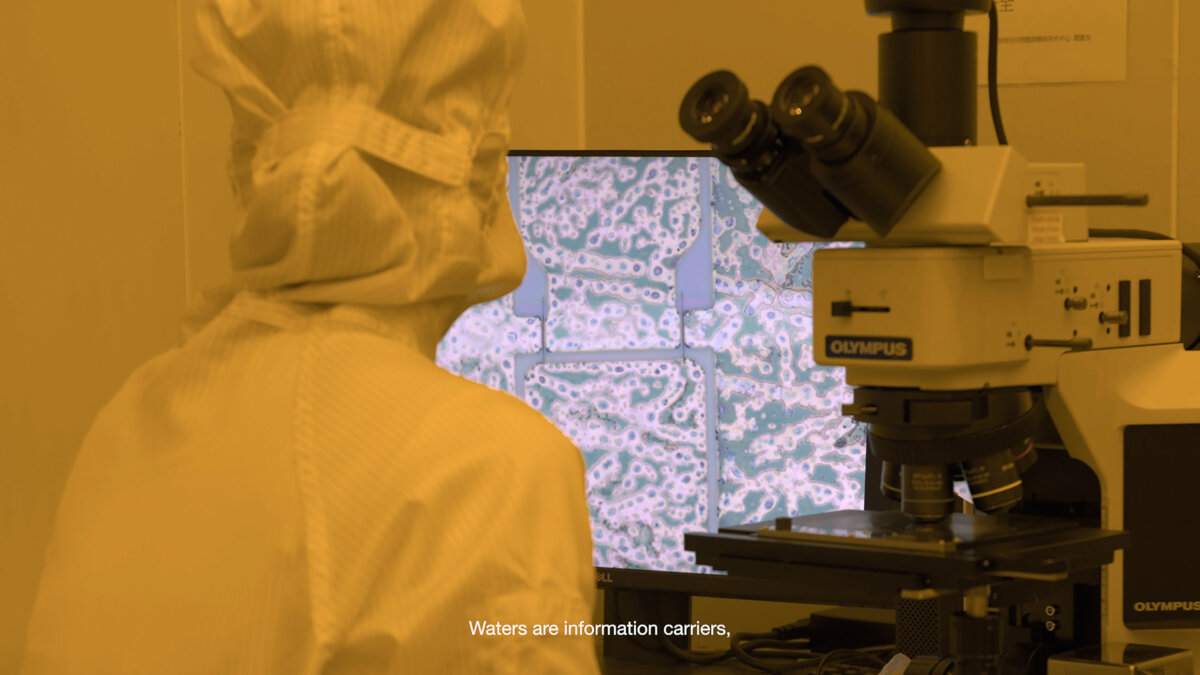
Nearly 99% of weather observation data that supercomputers receive today come from satellites, with 90% of these observations assimilated into computer weather models using complex algorithms. These algorithms, known as numerical weather prediction models, convert observational data into a numerical representation of the atmosphere in time to make weather predictions.12 Climate science largely relies on models; however, due to the complexity and unpredictability of the atmospheric climate system, the models must be continually adjusted. The global consumption of water for AI in 2027 may be accountable for somewhere between 4.2 and 6.6 billion cubic metres of water, equivalent to four to six times more than Denmark’s total annual water withdrawal.13 Through this lens, computation is both a victim of and a contributor to the climate crisis. Climate computing, the AI industry, and global telecommunications rely on the Taiwan Semiconductor Manufacturing Company (TSMC) for its production of ultra-high precision chips. Meteorological satellites are often powered by TSMC microchips, too. With my research-based film project, Particular Waters (2023), I began to explore the material trail of computing technologies in order to outline and critique the massive consumption of resources involved in the making of chips.
In 2021, Hsinchu, the home of the world’s most sought-after chipmaker, TSMC, was threatened by the worst drought in decades. Each year, three typhoons usually contribute to precipitation in Taiwan. But in 2021, not a single typhoon passed the island to bring much-needed rain to the reservoirs. In the face of the resulting drought, the Taiwanese government ordered industries to cut water use and imposed a halt on irrigation, which affected around a fifth of Taiwan’s irrigated land. The government flew planes and burned chemicals to seed the clouds above its reservoirs. Around the same period, it built a mobile seawater desalination plant in Hsinchu.
The world’s largest microchip foundry, TSMC, controls 84% of the market for chips with the smallest, most efficient circuits. To maintain its market presence, the company needs 156,000 tonnes of water daily – roughly one-third of all water used in Taiwan’s key science parks.14 During the drought, TSMC hauled truckloads of water, day and night, from other areas. According to Hsu Huang-Hsiung, a climate change expert at the Taiwanese government-funded think tank Academia Sinica, “Taiwan has been suffering from a significant decrease in the number of rainy days each year since the 1960s.”15 One could cynically remark that the profit growth of TSMC is much more predictable than the rainfall in Taiwan. In the case of the global chip shortage of 2021, the drought evidences the wider detriment to global supply chains. At the same time, the climate crisis has revealed the high water demands of chip production and how water shortages affect production capacity.
Waters carry environmental histories. But the holy water of semiconductor manufacturing – ultra-purified water – holds no stories. Its memory has been erased. By removing sodium, potassium, bacteria, organic compounds, metallic impurities, and anionic compounds, the filter system erases the stories of the waters to ensure a flawless manufacturing process. A human-made product, ultra-purified water’s social and historical ingredients are left out in its combination of oxygen and hydrogen. Water is a carrier and connector. Its capacity as carrier is utilised as a cleansing agent in semiconductor fabrication. The positively and negatively charged parts of the pure water molecules attract the unwanted materials that could jeopardise chip production. The problem is not just the exhaustion of resources, but the approach whereby life is treated as a resource at the disposal of technology.
Cosmic waters
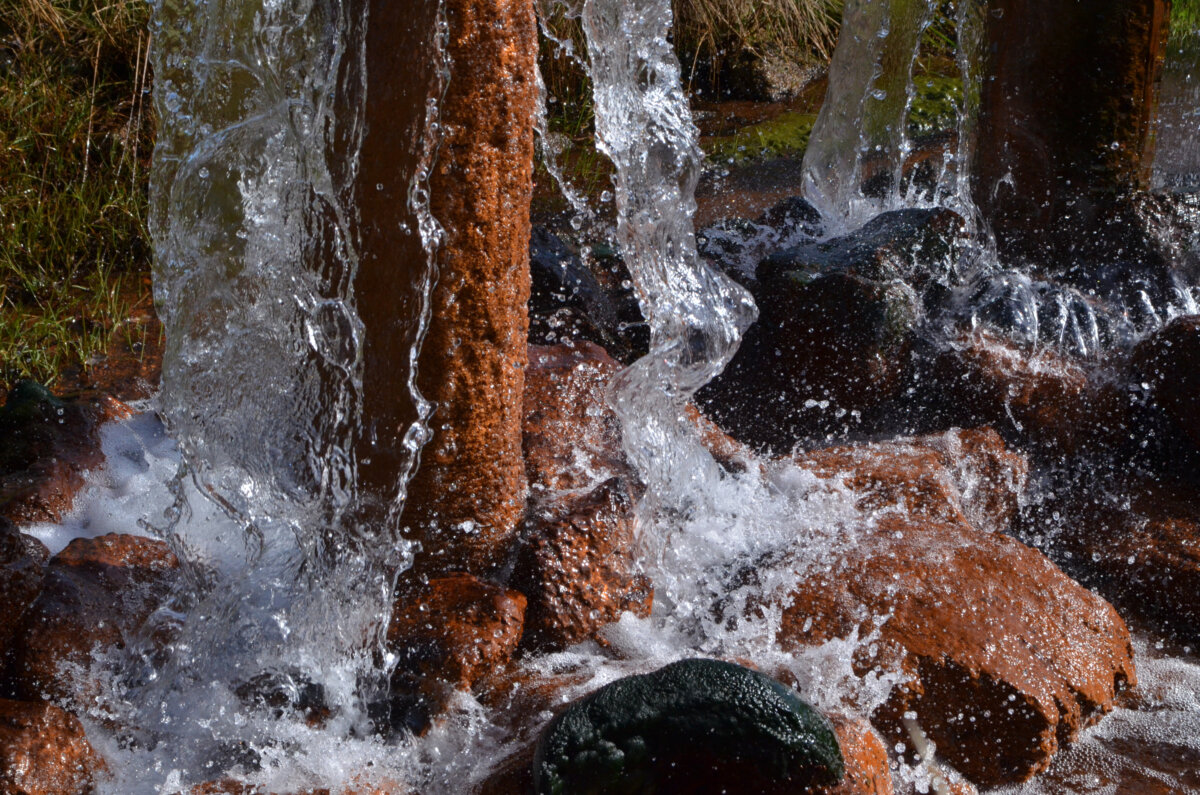
Water is commonly described as a resource: a term that gives diverse bodies of water a singular fixed material identity that can be conceived of and managed in abstraction. Conceiving domesticated and materially engineered water as an economic resource transforms it into quantifiable, dividable assets, and makes it susceptible to scarcity. As Jamie Linton observes: “Modern water is the presumption that any and all waters can be and should be considered apart from their social and ecological relations and reduced to an abstract quantity.”16 As a result, Linton continues, “All water is made known as an abstract, isomorphic, measurable quantity that may be reduced to its fundamental unit – a molecule of H2O – and represented as the substance that flows through the hydrological cycle.”17 Reducing plural waters to a homogeneous chemical compound strips bodies of water of their specificity. Derived from anthropocentric attempts to translate natural resources into a mathematical formula, the chemical representation of water as H2O obscures the ecological, social, and political dimensions of bodies of water. Scientific representation of water as H2O engenders blindness that conceals the multiplicity of waters.
A recent study in Nature confirmed the theory that water in planetary systems formed billions of years ago, before the Sun of our solar system, in interstellar space, and posited that water on Earth was ‘inherited’ from comets.18 Astronomer John J. Tobin and his team from the National Radio Astronomy Observatory in Charlottesville, Virginia studied a slightly heavier version of water in which one of the hydrogen atoms is replaced with deuterium, a heavy isotope of hydrogen. Heavy water forms under different conditions than drinking water does, so Tobin’s team used the water’s ratio to trace when and where the water had been formed. Their discovery reminds us that water is a carrier of geostories and interstellar stories. Derived from a narration of a world, cosmic waters invite us to consider different ways of making worlds according to different planetary relations.
Thinking about planetary connectivity through waters, whether they are rivers, lakes, water infrastructures, ocean currents, weather forecasting systems – or even global digital networks – helps us to recognise that we are embodied and embedded as localised and globalised subjects. Different water bodies hold their own spaces and flow into each other; as Astrida Neimanis has observed, attending to them is a way “to generate meaning from relation”.19 Water bodies are carrier bags, holding and storing particles, and are constantly on the move. I think of how sediments move downriver, solid bodies drift within the flows, and the interaction of the particles is mediated by water and air. Water is both media and medium. Seen in this light, water gathers information technology through drifting, blending, dissolving, eroding, weathering, and the conveyance of sediment downstream. These water processes gather information from their immediate environments and transmit stories of matter.
As thinking experiments, water leads us to examine the flows of relations, power, abstraction, and capitalist logic embedded in our modern water management techniques, facilitating a deeper understanding of the inextricable links between climate change and social, cultural, and economic structures of power. Climate change is presented as a fundamental, self-contained problem, but it can only be understood by addressing the centuries of colonial and extractivist practices that have conditioned us to see, attune, and relate to the world and its many worlds in crisis. I am committed to the collective endeavour to unravel the complex origins of the climate crisis through archival research and fieldwork in collaboration with local human and nonhuman actors and amongst a wider relational community. We need to go through this process: to create a cosmos in which we can differentiate which particular orders, distribution of resources, and relationships to power are undergoing disintegration or transformation. Such a process of differentiation may help us see different fields of possibilities: alternative ways to think, act, and imagine.
- 1 T. Morrison, ‘The Site of Memory’, in W. Zissner (ed.), Inventing the Truth: The Art and Craft of Memoir, Boston, Houghton Mifflin, 1995, p. 99.
- 2 B. Levin, ‘The Pencil of Cheap Nature: Towards an Environmental History of Photography’, Philosophy of Photography, Special Issue: ‘Violence: Part 2’, vol. 14, no. 1, p. 20.
- 3 C. Caycedo, ‘Be Dammed’ (unpublished master’s thesis, University of Southern California, 2014), p. 4.
- 4 P. McCully, Silenced Rivers: The Ecology and Politics of Large Dams, New York, Zed Books, 2001, p. 142.
- 5 P. H. Gleick, ‘The Changing Water Paradigm – A Look at Twenty-first Century Water Resources Development’, Water International, vol. 25, no. 1, pp. 127-138.
- 6 D. Perera, V. Smakhtin, S. Williams, T. North, and A. Curry, ‘Ageing Water Storage Infrastructure: An Emerging Global Risk’, UNU-INWEH Report Series, 2021 United Nations University Institute for Water, Environment and Health (UNU-INWEH).
- 7 See the map of U.S. Dams removed since 1912 by American Rivers, a non-profit environmental advocacy organisation. https://www.americanrivers.org/threats-solutions/restoring-damaged-rivers/dam-removal-map/ (accessed 21 June 2024).
- 8 J. Klemm and I. Winkler, ‘Which of the World’s Hundreds of Thousands of Aging Dams Will Be the Next to Burst?’, New York Times, 17 Sep 2023, https://www.nytimes.com/2023/09/17/opinion/libya-floods-dams.html (accessed 20 June 2024).
- 9 L. Leffer, ‘Dams Worldwide Are at Risk of Catastrophic Failure’, Scientific American, 15 Sep 2023, https://www.scientificamerican.com/article/dams-worldwide-are-at-risk-of-catastrophic-failure/ (accessed 20 June 2024).
- 10 The project FLUID CIRCULATIONS began in October 2022 with four-day field trips exploring the contested water ecologies of the Rhine and Ruhr area, formerly hard coal and lignite mining sites. In March 2023 an exhibition opened showing work by Maria Lucia Cruz Correia, Su Yu Hsin, Margarida Mendes, Nina Paszkowski, Marta Niedvał, Nada Rosa Schrowe, Vanja Smiljanić, and the ZAKOLE Collective at KunstWerk in Cologne.
- 11 A. Weinberg, ‘Social Problems and National Socio-Technical Institutes’, in Applied Science and Technological Progress: A Report to the Committee on Science and Astronautics, U.S. House of Representatives, National Academies Press, 1967, https://nap.nationalacademies.org/read/21281/chapter/20 (accessed 15 July 2024).
- 12 P. N. Edwards, A Vast Machine: Computer Models, Climate Data, and the Politics of Global Warming, Cambridge, MA, MIT Press, 2010.
- 13 Each year, Denmark withdraws a total of 0.98 billion cubic metres. P. Li, J. Yang, M. A. Islam and S. Ren, ‘Making AI Less “Thirsty”: Uncovering and Addressing the Secret Water Footprint of AI Models’, unpublished paper, University of California, Riverside and University of Texas at Arlington, 2023.
- 14 C. Ting-Fang, ‘TSMC tackles Taiwan drought with plant to reuse water for chips’, Nikkei Asia, 22 April 2021, https://asia.nikkei.com/Business/Tech/Semiconductors/TSMC-tackles-Taiwan-drought-with-plant-to-reuse-water-for-chips (accessed 10 July 2024).
- 15 C. Sui, ‘Why the world should pay attention to Taiwan’s drought’, BBC Asia, 20 April 2021, https://www.bbc.com/news/world-asia-56798308 (accessed 10 July 2024).
- 16 J. Linton, What is Water: The History of a Modern Abstraction, Vancouver, UBC Press, 2010, p. 163.
- 17 Ibid., p. 14.
- 18 The research is based on the discovery of water vapour around V883 Orionis, a young star some 1,305 light years away from Earth. Scientists used the Atacama Large Millimeter Array (ALMA) to measure chemical signatures of the water and its path from the star-forming cloud to the planets, according to a press release by European Southern Observatory (ESO). “The composition of the water in the disc is very similar to that of comets in our own Solar System”, observes John J. Tobin, an astronomer at the National Radio Astronomy Observatory. See J. J. Tobin, M. Leemker and J. C. Muñoz Mateos, ‘Astronomers find missing link for water in the Solar System’, European Southern Observatory (ESO), 8 March 2023, https://www.eso.org/public/news/eso2302/ (accessed 26 June 2024).
- 19 A. Neimanis and S. Bezan, ‘Hydrofeminism on the Coastline: An Interview with Astrida Neimanis’ Anthropocenes – Human, Inhuman, Posthuman, 2022, vol. 3(1), no. 8, p. 2.
To cite this text:
Su, Yu Hsin. “Water: A Geoarchive.” transmediale journal issue #7: Content (January 2025), edited by Elise Misao Hunchuck. https://transmediale.de/en/journal/water-a-geoarchive .