Relating to transmediale's 2024 festival theme, the annual Research Workshop in collaboration with Aarhus University and London South Bank University is now hosting an open call for workshop participants for its next edition content/form – in particular, individuals who are interested in exploring our relation to content and the forms through which it is made public. The workshop is specifically targeted toward PhD and early career researchers, but also welcomes submissions from researchers from inside or outside the academy, including artists, designers, and curators. It will result in a presentation (launch or collaborative newspaper publication) at Haus der Kulturen der Welt as a part of transmediale 2024 you're doing amazing sweetie.
Proposals may take an interest in the production and consumption of representation of content, the hyper-realities of content production, our troubled relation to content, the interfaces of content, the machinic production of our visual realities, or the crisis of political imagination that may follow from this – and how this is reflected in aesthetic production, artistic research, and the broad field of software studies and interface criticism.
For the application , we require the following brief descriptions:
Biography (100 words)
Details of current research project (100 words)
Intended contribution/abstract and relevance to workshop (200 words)
The 2024 edition of transmediale explores our troubled relations to content. The delivery of content has become central to our "algorithm-mediated realities – shaping language, identities, behaviour, and action. Scrolling, clicking, and swiping through loops of content has produced endless distraction, transforming bathrooms into stages, bedrooms into studios, and life into content." We invite proposals for participation in the workshop to explore our relation to content and the forms through which it is made public. Proposals may take an interest in the production and consumption of representation of content, the hyper-realities of content production, our troubled relation to content, the interfaces of content, the machinic production of our visual realities, or the crisis of political imagination that may follow from this – and how this is reflected in aesthetic production, artistic research, and the broad field of software studies and interface criticism. But we offer no clear delineation of ideas for the workshop or a theme as such. Instead, we ask whether it is outmoded to insist that form and content are necessarily entwined? In other words, we want to approach content as inseparable from the forms and formats through which it is rendered. If our attachment to all forms and formats – from AI generated content to gaming mods to reality tv to trends in language – serve to limit the space for political possibility and collective action, then what alternatives might we envision, including for research itsself? In the context of the notion of "unusable politics" (to reference the festival) and a perceived crisis of political imagination, the workshop is an attempt to apply this to research practice and its use-value. What does research (‘applied’, ‘artistic’, ‘pure’, etc.) do in the world? What are the challenges for research in this connection, what is productive for its development? Perhaps what is missing is a stronger account of the structures that render our research experiences, that produce new imaginaries, new spatial and temporal forms?
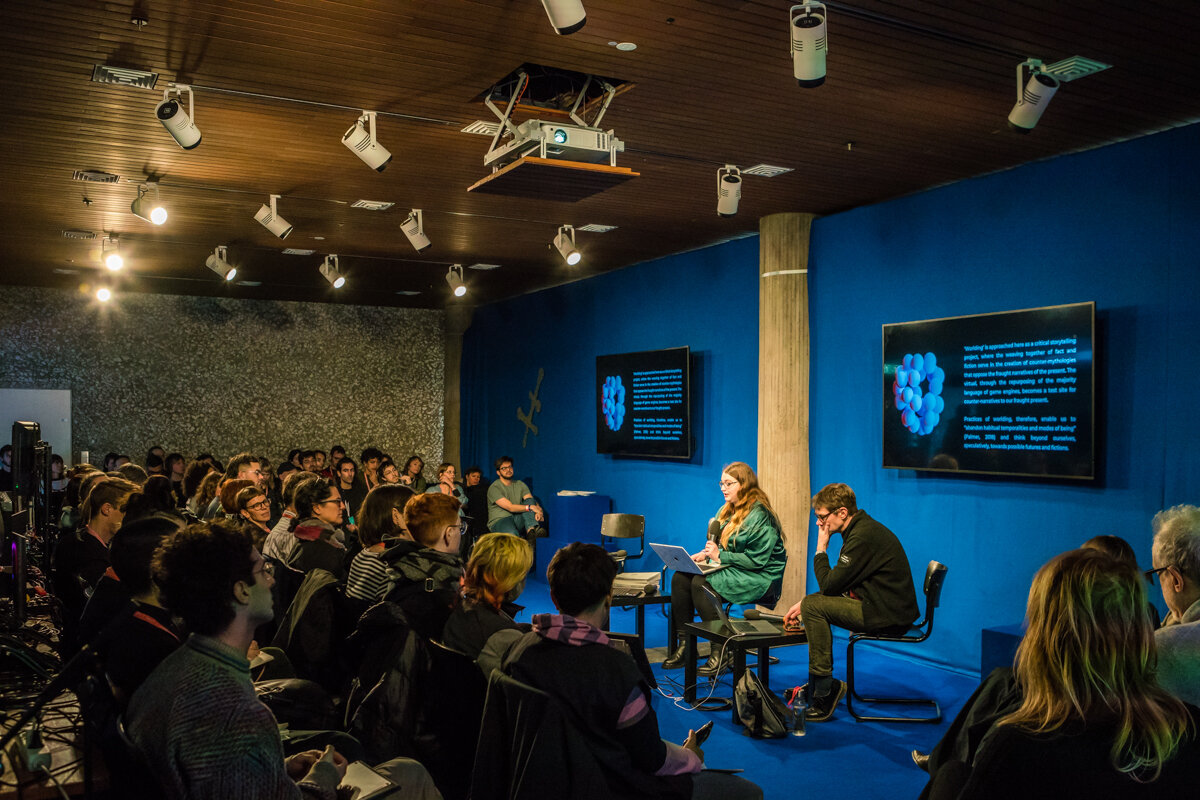
Through the workshop’s activities, we reflect on how the technical conditions relate to sustainable research practices and explore ways of collapsing the traditional workflows of academic publishing, drawing more closely together work-in-progress and feedback, writing and review, experimental print production and its dissemination, form and content. Importantly, our point is to stress how technological and social forms come together, and encourage reflection on shared organisational processes and collectivities. At the workshop participants not only engage with research questions and offer feedback to eachother, but also with the conditions for producing research, the ways it is shared and reviewed, the infrastructures through which it is served, and more. In support of this we use ServPub (http://servpub.net/ ) an experimental platform for research and practice on computational publishing, to reflect collectively on affective infrastructures, minor tech and autonomous networks within, and beyond, institutional constraints. ServPub is facilitated by In-grid with contributions from Systerserver and supported by CSNI at LSBU, Creative Computing Institute at UAL, SHAPE at Aarhus University, and Varia/CC.
The workshop is organised by SHAPE Digital Citizenship & Digital Aesthetics Research Center, Aarhus University, and the Centre for the Study of the Networked Image, London South Bank University, in collaboration with transmediale festival, Berlin.
For the application , we require the following brief descriptions:
Biography (100 words)
Details of current research project (100 words)
Intended contribution/abstract and relevance to workshop (200 words)
In summary, workshop participants will be expected to:
Attend an online meeting
Dec 14, 2023
Produce research essays (of 500 words)
by Jan 11, 2024
Exchange ideas online
up to Jan 28, 2024
Attend an in-person workshop in Berlin
(with 10 minute presentation of contribution and collective production of print newspaper)
Jan 29-31, 2024
Launch the newspaper at transmediale festival
(with 5 minute presentation of research contribution)
Feb 3, 2024
Submit, if so wish, full paper
(5,000 words for peer-review and publication in APRJA)
April 7, 2024
http://www.aprja.net
Following the workshop, participants are also invited to extend their arguments for submission to the online peer-reviewed academic journal APRJA – a journal that presents emerging research into software art and cultures.
The credits for full participation for PhD students are 2 ECTS. The workshop is free but participants (or ideally their institutions) are expected to cover their travel/accommodation costs.