transmediale 2027 invites applications for the Lattice Labs, a series of experimental working groups dedicated to rethinking and testing alternatives to technological monocultures of extraction and surveillance. Building towards the festival, the Lattice Labs introduce a process-based approach to collective learning and knowledge dissemination.
Each Lab is formed by about five participants and guided by an experienced artist or technologist. Together, participants develop a project that is presented and activated through public events during the festival week in Berlin.
Application deadline is June 7, 2026 (23:59 CEST).
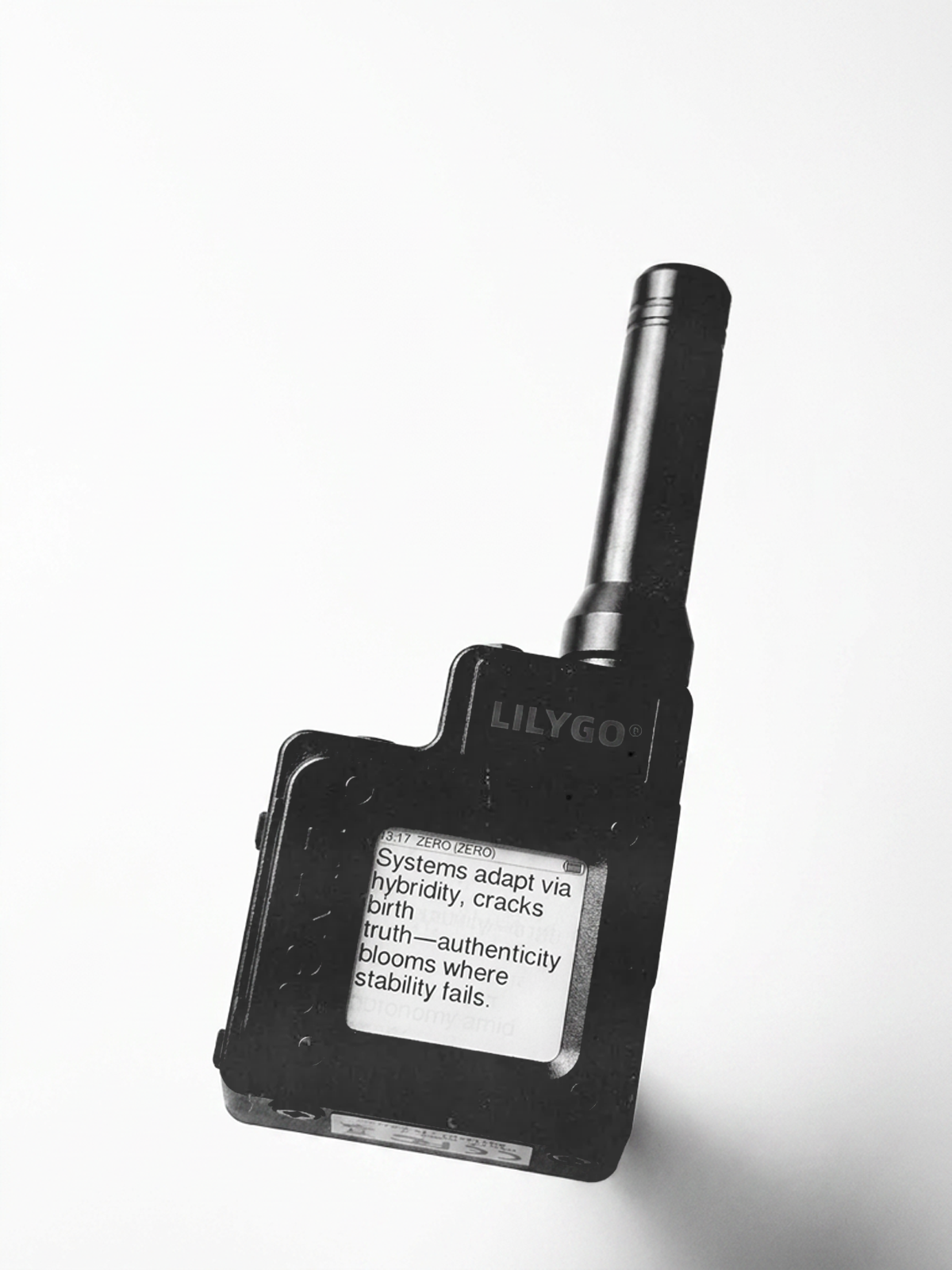
When the frontend becomes the backend, what does it mean to ‘build by hand’? What does autonomy look like under ambient surveillance?
A frontend inversion is taking place. Websites become backends for AI; chat interfaces and terminals the new frontend. A ‘generative’ era is emerging and being pushed – content increasingly manifests as datasets, mediated by APIs across the network. Practitioners and communities are starting to surface through the loop of ingestion, embedding, retrieval, and generation as a primary mode of discovery – contextualised by systems that compress them into patterns a model can resolve. Conditions of generation are now conditions of legibility.
The lab’s substrate is a Minor Index1 – a situated dataset built to confront the conditions of control: activated, composable, accessible, additive within a local hold. It functions as a layered medium: the dataset itself, the protocols that move it, the surfaces that render it, the analogue materials alongside. The posture is that of the bricoleur and the squatter – parasitising inherited infrastructure and loading it with friction, ornament, and local detail; counter-infrastructures that habituate by what they leave open.
The lab develops strategies for autonomy, confrontation, and resilience under conditions of consolidation, capture, and surveillance in an increasingly repressive context.
Goals
Hysteretic Reserves: substrates and practices shaped by what they've held – marked by their making and use, irreducible to the generic.
▫️ A Minor / Adiabatic Index – a ‘handcrafted’ dataset, activated, composable, accessible, additive within a local hold. Adiabatic2 : holding without exchange, maintaining its conditions internally rather than dissipating into surrounding networks.
▫️ Interfaces and methods of accessing and generating from it – across mesh networks, small/personal computational surfaces, in/out analogue and physical materials.
▫️ Device aesthetics and form research – visual, tactile, and material registers of computational surfaces and the methods that mediate them.
▫️ Literacy and practices of security, communication methods, and reducing vulnerability to surveillance and intrusion. In practice: collective sessions on threat modelling, secure messaging, encryption, operational security, dataset hygiene – invited guests, artists, and practitioners.
▫️ transmediale festival ‘The Minor Index’ and its accompanying prototypes, research, and interfaces presented at transmediale 2027
Candidates
Practitioners with active engagement in at least one area the lab is gathering knowledge across: security praxis, community archives, mesh networking, self-hosting, small-model and dataset work, interface and device design, and interested in historical practices of building under duress. Media and computational artists, researchers, coders, data scientists, archivists, organisers, writers, designers (UI/UX, hardware, graphic) — interested in self-reliance, privacy, and how knowledge is held and circulated under conditions of ambient surveillance and consolidation. Comfortable across registers (technical and conceptual, digital and analogue) and with prior collaborative experience. Candidates who can show what they’ve made or thought through and see friction and failure as part of the process.
Technologies involved
Distributed and federated registers, oriented toward local networks and offline operation.
Mesh and network protocols for communication independent of cellular and internet infrastructure. Computational surfaces of scale – single-board computers, mini-PCs, constrained displays. Local-first and federated databases and storage; the dataset travels by file, by device, by hand, between peers. Small language and machine learning models running on local hardware – for retrieval, processing, generation — bound to what the conditions / dataset holds. Self-hosted services and pipelines: the lab works with what we can run, maintain, and repair ourselves.
Analogue and physical materials and generative outputs alongside scanning, printing, hand-bound documentation. The Minor Index database itself as a collective medium.
What to expect
The lab works through the transmediale’s call and response framework – sessions move between provocations, shared research, collective production, lateral and friction-friendly.
▫️ (July–Sept) Bi-weekly sessions with invited guests – references, research, methods, vocabularies, hands-on experiments.
▫️ (Oct–Nov) The Minor Index, its prototypes, and interfaces take shape collectively. Work directly with the materials, hardware, and each other.
▫️ (Dec–Jan) Activation / Installation. Final production for transmediale: workshops, talks, deployment / installation of what the lab has made.
Lab location
This Lab takes place in Berlin, and presence in the city is required throughout the whole time. Participation for Berlin based artists and researchers only.
transmediale can care of only one trip to Berlin from your country of residence.
Support & participation conditions
▫️ transmediale covers travel costs for each participant to be in Berlin for the duration of the lab. Train travel is prioritised where possible; otherwise, round-trip economy flights will be provided.
▫️ No Accommodation will be provided.
▫️ transmediale supports visa applications by providing letters of invitation.
Participant responsibilities
▫️ Participate in all meetings.
▫️ Commit to develop a collective project.
▫️ Presence in Berlin throughout the lab period.
Lead
selfservice.studio is an open platform exploring infrastructure anxiety through ongoing research, prototypes, and deployments – examining how communities can build, own, and maintain their own technological infrastructures. selfservice.studio was initiated in 2025 by Christopher Dake-Outhet and Leïth Benkhedda at Trust in Berlin.
▫️ May 18: Open Call announcement
▫️ June 7: Open Call deadline
▫️ June 29: Participants announcement
▫️ July 13: First meeting
▫️ July-Aug-Sept: Bi-weekly meetings
▫️ Oct-Nov-Dec: Weekly meetings
▫️ January 26–31: Festival
Application deadline: June 7, 2026 (23:59 CEST)
▫️Applications are only accepted via transmediale’s submission form. The applicants’ information will be stored only on our own servers in Berlin.
▫️Only one application per candidate across all labs will be accepted.
▫️No collective applications.
▫️Authenticity matters more than perfection, please use your own voice.
▫️Results will be announced in June.
▫️For further questions, please contact: submit[at]transmediale.de
- 1 Minor is borrowed from Deleuze and Guattari’s notion of minor literature – work made by a minority within a dominant language, deterritorialising it from inside, charged politically, collective in voice rather than individual.
- 2 Adiabatic: in thermodynamics, a process that occurs without exchange of heat with its surroundings. An index that holds without leaking out, that maintains internal conditions rather than equilibrating with the network around it.