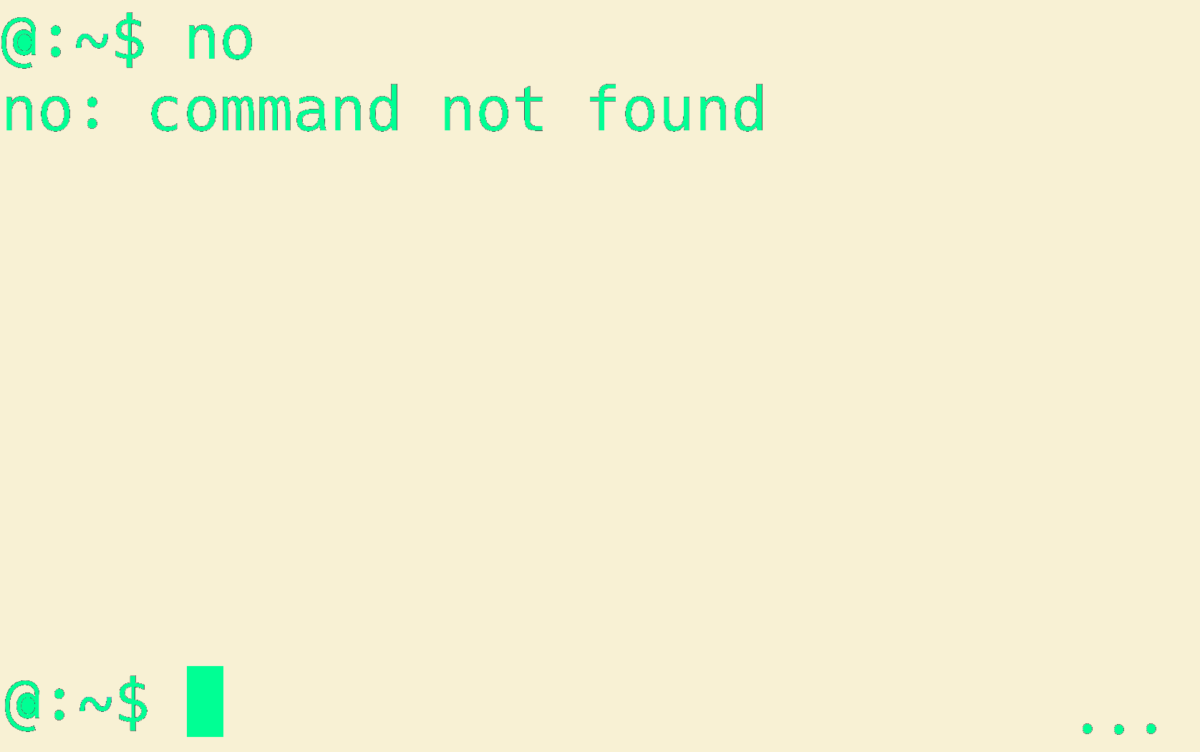
In this essay, Giuseppe Torre notes the absence of the ‘no’ utility from coding and programming lexicon. Departing from this observation, the writer imagines an entirely digital world and asks: if operating systems only have ‘yes/accept’ for answer, how can refusal emerge? Three theses materialise as three impossibilities for refusal. Returning from this speculative, fully digitised realm to our digitally mediated present, Torre reflects on the possibilities and limits of refusal, and therefore, radical change.
Part One
PROGRAM NAME: “No”
REPEAT print “n” + carriage return; UNTIL the program is terminated
END1
Part Two
The program above, “No,” is recalled in the computer’s shell by typing “no” and pressing “Enter”. It then displays an endless sequence of “n”s – one per line – until the user terminates the program.
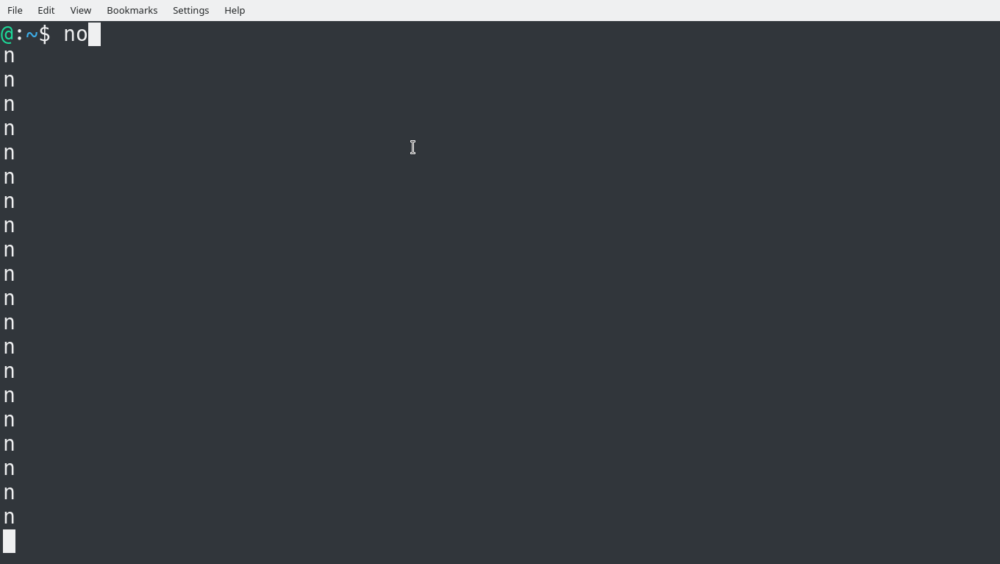
I made this program and included it in an unofficial release of the GNU core utilities. GNU core utilities2 are a set of basic utilities (i.e., programs) that exist in every UNIX operating system. These utilities are recalled in the computer’s shell, the command-line interface for accessing various core services of an operating system. For example, the coreutil “ls” lists the items in the current directory, and the coreutil “mv” moves a file from one directory to another. The full list of GNU coreutils:
[ b2sum base64 base32 basenc basename cat chcon chgrp chmod chown cksum comm cp csplit cut date dd dir dircolors dirname du echo env expand expr factor false fmt fold ginstall groups head id join kill link ln logname ls md5sum mkdir mkfifo mknod mktemp mv nl nproc nohup numfmt od paste pathchk pr printenv printf ptx pwd readlink realpath rm rmdir runcon seq sha1sum sha224sum sha256sum sha384sum sha512sum shred shuf sleep sort split stat sum sync tac tail tee test touch tr true truncate tsort tty uname unexpand uniq unlink vdir wc whoami yes
I highlight the “yes” coreutils to point towards what I believe to be a curious fact: the official set of GNU core utilities includes a “yes” command. But not a “no”. Thus, the coreutils “no” fills this gap. (You are welcome!)
The absence of the coreutil “no” from the official GNU core utilities is not for lack of will but lack of meaning. To understand this, we ought to look to its counterpart, the “yes” coreutil. The “yes” command (similar to my “no” one) prints an endless list of “y” (instead of “n”) followed by a carriage return. The need for this utility can be understood by way of an example of its use. When this command is concatenated to a script (using the symbol |), it will answer “y” (i.e., yes) to any question that the script will prompt during its execution. For example, let’s imagine that I wish to run a script that will install multiple software on my computer and that, for each software in the list, the script will prompt me with a question, asking me to confirm with the letter “y” that I wish to proceed with the installation. My command on a Unix terminal would be:
yes | install-this-and-that.sh
Because the “yes” coreutil does nothing but print an endless list of “y”’s, and because the “yes” command will run concomitantly to the script “install-this-and-that.sh”. Each time the script will prompt a question, in fact, any question (!), the automatic answer will be “y” (i.e., yes).
As critical code literature highlights, even in the triviality of a program like “yes”, one can unmask the implicit culture responsible for its creation and utility3 through careful reading of the code and programming practices. For the “yes” utility, such a discourse relates to an implicit convention that, as in our script example, sees questions prompted in the form of: “would you like to proceed?” rather than: “would you rather not proceed?” An unwritten rule or practice, that outside installation routines and terminal shells, we all experience perhaps in the form of “Do you accept/agree?” rather than “Would you like to consider the terms and conditions more carefully?” - all cases, of course, in which a coreutil that automates nodding would become counterintuitive. It would seem that even from the basic levels at which the coreutils operate, the entire digital apparatus is built around an implicit and yet unequivocal “yes/accept”. And what about the meaning of coreutil “no”, then? At the technical level, none. If you execute some script to then automatically recall a routine that stops it (by answering all scripts’ questions with an “n”), why would you initiate the script in the first place at all?! From this perspective, the coreutils “no” is, rather, a core(f)utility. But as a gesture, and one that reveals the absence of the par excellence gesture of refusal in the very core mechanics of an operating system, it means to tell a story or, perhaps, a word of caution. The question that follows: what about the space for a refusal within a digital infrastructure?
Part Three
As the theme of transmediale infers, we live in a moment in history where the spark of what Marcuse called “the Great Refusal” (in relation to the historical protests of 1968) is reigniting the masses, globally, in their refusal of the status quo and their demand for a better world. Like in 1968, we see protests against police brutality on black people, racism, gender discrimination, sexual abuse, pollution, authoritarian regimes, democratic governments, censorship and corruption. The world appears to be, once again, in a global and synchronous state of agitation. But perhaps, unlike in 1968, we now observe that dominant powers have outgrown their ability to tolerate, withstand and ultimately absorb dissent to a scale that was unimaginable before. Perhaps, more uniquely, this resilience is built today on the ubiquitous ability of the system to always divert discourse away from those foundational issues that enable its systemic inequalities.
Within a neoliberal (i.e., self-centred) and rhizomatic (i.e., self-centring) system, any act of refusal has become exceedingly difficult, and any “No” is transformed into an opportunity for the system to know where to find yet another obstacle to “freedom” and erase it. As a result, we seem to protest for the system but not against it. And yet, all acts of refusal remain possible because they retain, both then and today, their negotiating and propositive character to make it possible to envision “a new culture which fulfils the humanistic promises betrayed by the old culture.”4
And what can be said about acts of refusal within a system that is increasingly relying on (in fact appearing as wanting to transform itself into) a digital infrastructure that allows only for nodding, negating dissent? Wouldn’t it be logical to say that an increase in digital infrastructure would inevitably be followed by a contraction of the space for refusals? We are accelerating towards the digitalisation of every aspect of our lives – a mathematisation of everything – perhaps even beyond what Husserl called the mathematisation of nature in The Crisis of European Sciences and Transcendental Phenomenology.5
So, reader, let’s imagine a world in which such acceleration has reached its final destination: a fully digitised existence. A world where body and flesh are utterly redundant. A world where the closest match to an individual’s physical identity is their MAC address. A world where numbers are not only a way to inscribe and structure culture6 but absolutely everything else, too. A world where all interactions and actions are numbers, which are not given as the representation of their physical counterpart in a “real world” but have become their exact replacement. A world, then, where the image of a friend on a video chat is not just the image of the friend but is the friend because there is no other way for me to experience her than via the numerical (digital) identity provided to me. A world where the so-called virtual coincides with the real.
What can be said of any refusing act in such a numerically driven world, where meaning becomes and always returns to symbols, and semantics are reduced to syntax?
Allow me to present three theses for consideration:
Thesis 1. You cannot refuse that which can only be stated.
You cannot refuse 1. Nor can you refuse 1+1=3. At best (for the latter) you can say that the statement is wrong. Even then, though, you are only admitting the meaningfulness of the statement. You are saying that “it is true that it is wrong.” Thus, one is entangled in a loop of statements that are only affirmative, positive – devoid of negations and refusals – and whose meaningfulness is granted by the axiomatic nature of the system. A system whose validity is rooted in the non-provable and unquestionable validity of its axioms. Within this imaginary digital world, the numerical form of any statement or action is only the proof of a de-facto and immutable existence, and by no means a pre-condition for exchange or mediation. Everything says “it says”, or, worse, everything boils down to a tautology; “it says it”. Content and meaning are left at the door, and so is any differentiation between idiocy and intellectualism, right or wrong.
Thesis 2. You cannot refuse that which is not negotiable.
If refusing is an act of negotiation, then such an act ought to operate within an open space that should not be defined as apriori. The reason is simple: if that space were to be given apriori, all negotiations would become mere acts of selection (i.e., agreements over selecting an option from a list of available ones).
Yet, the digital world is precisely that finite list of options – given in the form of mathematical statements. Within this list, we can only select options but never question anything else intrinsic to the process (for example, the modality with which such a list was created in the first place). Every act of negotiation is reduced to a mere act of selection. Within this landscape that mimics consumers and consumerist culture the size of the list of options at hand does not matter. More options would certainly provide a larger pool for selection, but that would still not be sufficient in transforming a selection into negotiations.
The possibility to negotiate (and hence refuse) requires not only flexibility beyond listable choices but an ability to embrace the unknown, the unaccountable and the uncountable. But in the digital world, negotiation cannot be provided. Not for lack of will, but because of the necessarily finite logic of the digital and hence anything else will only necessarily be... access denied… cannot compute... option non-valid... not a number (NAN).
Thesis 3. You cannot refuse through that which does not have “no” in its language.
Imagine you were given a finite set of words that afforded you a limited set of actions in the world. Within that set of action words, you were given the word “yes” to accept but not the word “no” to refuse. That world is the world of mathematics and of digital. Indeed, the closest match to a “no” in mathematics is, perhaps, the symbol Ø. Yet Ø means simply “no solutions”, and that is hardly interpretable as an act of refusal. At best, it is an act that conceives victory to the unknown without further actions towards the propositive character of a refusing act. With a different approach to the problem (and yet unique in its explicit reference to it), J.J. Smith7 argues that the lack of the word “no” in mathematics is because negation is presented in its longer form of a “this expression does not exist” while, for mathematics’ sake, he argues, it should be presented with a “we do not understand it yet”. Perhaps, if “non-existent” is used in place of “no” as J.J. Smith argues, we can also understand why, within our imaginary digital world, one cannot refuse but, at best and last resort, make something “non-existing” (cancelling it with a “yes”).
Part Four
When all is a number, everything is a statement, a declaration (Thesis I). When all is a number, nothing is negotiable (Thesis II). Our digital world, entangled in the false identity between digital and reality, forces us to think and act within the rules of its language. A language that does not allow for a refusal. A language that does not have the word “no” (Thesis III).
What is more emblematic of technology’s positivist soul than the radical embrace of “yes” and the ostracization of “No”! There is no point in refusing within the digital and no point in refusing the digital within a digital infrastructure either. The very syntax of the digital does not allow for it! In the countable, non-negotiable, and axiomatic digital world, “no” cannot be a core utility but be, at best, a core (f)utility.
But such a bleak world where refusals are impossible is only a world imagined. In our world, the digital is still only an attempt to represent something numerically. And herein lies an important difference. If, on the one hand, the ubiquitousness of the digital has enabled us to connect in our global dissent, on the other hand, then, it remains important to realise that any dissent cannot exhaust its energies solely within the digital realm – the place where a command is a command, a click is a click; where tautologies cannot become refusals. After connecting through the digital, we ought to move the discourse back into the “real” world. Only there, in the bodily presence of the masses, will we regain the perspective and space to question our condition. To confront it. To refuse it. Only then, by reconnecting with our past, will we honour the old pledge from Herbert Marcuse:
“In proclaiming the 'permanent challenge' (la contestation permanente), the 'permanent education', the Great Refusal, they recognize the mark of social repression, even in the most sublime manifestations of traditional culture, even in the most spectacular manifestations of technical progress. They have again raised a specter (and this time a specter which haunts not only the bourgeoisie but all exploitative bureaucracies): the specter of a revolution which subordinates the development of productive forces and higher standards of living to the requirements of creating solidarity for the human species, for abolishing poverty and misery beyond all national frontiers and spheres of interest, for the attainment of peace. In one word: they have taken the idea of revolution out of the continuum of repression and placed it into its authentic dimension: that of liberation.”8
This Almanac contribution is published as part of the partnership between transmediale and the University of Limerick.
Giuseppe Torre teaches in Digital Arts disciplines at the University of Limerick (Ireland). His research interest lies at the crossings between digital art practices, open source technology/culture and philosophy. These interests respond to a questioning of the relationships between art and technology and that has so far led him to question under what forms and forces truly creative efforts may, or may not, arise.
- 1
- 2 Free Software Foundation, 'Coreutils - GNU core utilities', GNU Operating System, Boston, USA, 2020, https://www.gnu.org/savannah-checkouts/gnu/coreutils/coreutils.html , (accessed 28 September 2021).
- 3 N. Montfort, The Trivial Program “yes”, The Trope Tank, Cambridge, MA, The Trope Tank, Massachusetts Institute of Technology, 2012, https://tropetank.com/reports/TROPE-12-01.pdf , (accessed 21 September 2021).
- 4 H. Marcuse, An Essay on Liberation, Boston, Beacon, 1971, p. 10.
- 5 E. Husserl and D. Carr, The Crisis of European Sciences and Transcendental Phenomenology, Evanston, Northwestern University Press, 2006.
- 6 For example, see Friedrich Kittler’s “Number and Numeral” in Theory, Culture & Society, vol. 23, no. 7-8, 2006, p. 51-61.
- 7 J.J. Smith, “How to say “no” in mathematics”, Journal of the Franklin Institute, vol. 240, no. 2, 1945, p. 113-122.
- 8 H. Marcuse, An Essay on Liberation, Boston, Beacon, 1971, p. ix-x.