Artist Maud Craigie in conversation with Ben Evans James
In Indications of Guilt, pt.1, artist and researcher Maud Craigie examines the structures of American police interrogation and their relationship to fictional screen representations of law enforcement. The film asks what it means to be familiar with legal processes through television before experiencing them in real life. Bringing together interviews with detectives, false confession experts, footage from TV series, and police training videos, Craigie reveals the interplay between fact and fiction in detective work and the subjectivity that constructs ‘truth’.
Ben Evans James: Through the themes explored in Indications of Guilt, pt.1 it seems that police-led interrogation has a complicated relationship to reality?
Maud Craigie: The apparent purpose of psychological interrogation is to get the truth. However, the meaning of truth has to be defined, moulded, and reduced down into something manageable. Under US law, truth can become ‘probable cause’. This means interrogation can shift from a truth-seeking exercise into a process of constructing a coherent narrative.
"Once a law enforcement officer has 'probable cause' he is under no duty to continue the investigation to determine whether exculpatory evidence existed, and is under no obligation to investigate, or give credence to, a suspect's story or alibi.”1
BEJ: The purpose of interrogation then appears to be to create a story-driven ‘world’ for the courts to consume and legitimise (one based not necessarily on ‘truth’ but on the altogether hazier concept of probable cause). Shaped in the interrogation room, this story-world goes on to be actualised through the legal system and is given tangible power in reality by the significant effect it has on people’s lives. Can interrogation in this form be viewed almost as a type of worldbuilding?
MC: There is a phrase, ‘bad evidence’, which is used by police in the US to describe evidence which goes against their theory of the case. So in this way, worldbuilding is overtly built into the interrogative process. Similarly, police are legally allowed to lie to suspects and imply they have evidence, even when they don’t.
Take the idea of the dummy file which comes up in the film. The dummy file is a folder filled with papers – it might include a DVD or a forensic lab results envelope – which is placed in the room during an interrogation. The dummy file is the implication of a body of evidence. Real details about the crime are written on the paperwork. The suspect is not allowed to touch it; its purpose is to legitimise and intimidate. I was interested in what this performative paperwork does – not only to a suspect’s understanding of reality but also to a detective’s. The same style of evidence bag might hold a blank DVD to imply evidence or a DVD with incriminating footage on it – everything gets very blurry.

BEJ: In this role, the dummy file appears to operate like Donald Winnicott’s definition of a “transitional object.”2 , Routledge, London. Working in the field of child psychology, Winnicott pointed towards toys such as building blocks or plush bears as examples of objects so steeped with imagination that they can be seen as neither entirely fictional nor entirely real. Here, perhaps the dummy file is loaded with so much imagination from the suspect that it exists in a similar kind of inbetween state?
MC: Winnicott talked about the appearance of transitional objects as being at a moment of realisation of selfhood in child development. It’s around this time children realise they can withhold information and lie. The purpose of the dummy file is almost a reversal – to make someone feel like everything about them is known.
In the US police system, guilt should be determined prior to interrogation. Therefore, an interrogation is meant to be conducted when there is a reasonable degree of certainty that the suspect committed the crime. The purpose of the interrogation is to get the suspect, who is believed to be guilty, to confess. The dummy file is a tactic in that process. Other tactics include the ‘alternative question’. Here, the suspect is offered a morally acceptable and an unacceptable reason for committing a crime. For instance “did you steal money because you’re greedy? Or did you steal money because you wanted to feed your kids?” Whichever answer the suspect gives, they are still legally admitting responsibility. Here, the detective appears to offer them two alternative worlds – where the actions they are accused of have different moral meanings – but ultimately it’s a false choice.
BEJ: If the idea of false choice attaches different narratives to the same ‘truth’ outcome, I wonder if we can think about the ways we construct narrative around an ‘untruth’ – so how do we as individuals form and communicate stories when we’re trying to hide a ‘truth’? In his text, On Bullshit, Harry Frankfurt explores the difference between lying and bullshitting. He suggests that bullshitters create a kind of aura around their personality where claims about truth and falsity become almost irrelevant. Bullshitters, Frankfurt says “quietly change the rules governing...the conversation.”3 The dummy file in this sense perhaps feels like a strategy employed by a bullshitter? In contrast, lying is said to be “an act with a sharp focus”, a strategic action aimed at removing the space occupied by a truth. While both tactics might be used to obfuscate the same truth, they achieve it in different ways – and maybe with different morals?
“Telling a lie is an act with a sharp focus. It is designed to insert a particular falsehood at a specific point in a set or system of beliefs, in order to avoid the consequences of having that point occupied by the truth. This requires a degree of craftsmanship, in which the teller of the lie submits to objective constraints imposed by what he takes to be the truth. The liar is inescapably concerned with truth-values. In order to invent a lie, he/she must first think he knows what is true. And in order to invent an effective lie, he/she must design their falsehood under the guidance of truth.”4
MC: That’s interesting – how a good lie has to coherently fit with the truth. The dummy file is not an outright lie, so in that sense feels closer to bullshit. Frankfort argues that, “bullshit is unavoidable whenever circumstances require someone to talk without knowing what he is talking about.”5 The dummy file fills in the blanks of real evidence.
It makes me think of another approach commonly used by detectives. In America, police are taught that following a confession, when they write up the details of the crime, they should purposefully insert minor errors. For instance, describe a car as the wrong colour or misdescribe the layout of a house. They should then get the suspect to read the statement and if they notice these errors, correct and initial them. All this sounds fair enough – a final check to make sure the suspect is engaged and telling the truth. However, police are taught that if the suspect doesn’t notice the errors, they should point them out to them and still get them to initial the changes. So then the process becomes about creating a document that looks more truthful through the purposeful insertion of these corrected errors. If a judge or jury sees a statement like this, they might assume the suspect has verified the details they gave and that consequently the confession is true. False confessions expert Saul Kassin describes how this “creates an illusion of credibility regardless of whether the confessor is guilty or innocent.”6 In other words, it is a performance of truthfulness.
“To the naïve spectator, such statements appear to be voluntary, textured with detail, and the product of personal experience. Uninformed, however, this spectator mistakes illusion for reality, not realizing that the taped confession is like a Hollywood drama – scripted in accordance with the police theory of the case, rehearsed during hours of unrecorded questioning, directed by the questioner, and ultimately enacted on paper, tape, or camera by the suspect.”7
BEJ: The idea that a fiction – in this case a manipulated statement – is released into the world as fact could be viewed as parafictional? (Where a parafiction is defined as a fiction we experience as fact). Especially in its performed truthfulness, which is almost theatrical in application.
“When we extend the idea of the theatrical beyond its traditional confines of artistic performance we are crossing the line which divides fiction from fact and attempting to apply categories of fiction to the domain of fact.”8
It also casts our interrogator in the role of a “parafictioneer, who produces and manages plausibility.”9
MC: The narrative construction of a crime is sewn into real events. Often, actions that did occur and objects that do exist are shifted into new roles and given new meanings – it is “the one foot in the field of the real”10 that makes a false narrative or a false confession so hard to disbelieve.
BEJ: The idea of truth is also a troublesome one in documentary filmmaking. While revealing some of the strategies of fiction-making that underlie forms of interrogation, the film also appears to point towards the idea that a ‘truer’ world can exist? How did you control your own responsibility to ‘the truth’ when making the film? I’m thinking of a reference you’ve mentioned in the past from film theorist Stella Bruzzi, who compares the construction of a documentary as following similar conventions to that of a trial.11
MC: I shot a lot of footage and sound recordings without a defined outcome – either in terms of the length or shape the final film would take. I viewed this process like evidence gathering: you don’t necessarily know the importance of a certain piece of material until you have all the constituent parts.
Mike Ware, executive director of the Innocence Project of Texas, told me how even forensic evidence is open to interpretation. Forensic investigators are often told who the police believe committed a crime – and this knowledge can influence their reading of, for instance, a fingerprint or a hair sample – making them more likely to find a match. So, I was encountering this material that revealed the unreliability of what appears to be hard evidence.
In terms of my own responsibility to ‘the truth’, I wanted to foreground an awareness of the construction of narrative by drawing a parallel between the making of the film and detective work – which was something that naturally developed through the editing process.
BEJ: You describe the editing process almost like an interrogation room for the film. Where each cut creates an incision that can act as a site of inquiry, but also transform the overall meaning – allowing different worlds or outcomes to emerge.
“An image is never alone, it only exists on a background (ideology) or in relation to those that precede or follow it.”12
MC: This quote from Godard and the idea of an image never being alone could also be applied to the roles we enact – such as that of the interrogator. The interrogation process exists on a background of ideology, which is itself informed by images. Like the flattening of events on an editing timeline, there is the flattening of events in a written statement.
The image’s dependence on context has direct repercussions for criminal justice. For instance, the camera angle used to record interrogations has been found to play a role in how likely jurors are to believe whether a confession is coerced or voluntary. Research shows that if the camera focuses on the suspect, jurors are more likely to think they are guilty compared to a camera angle that shows both the interrogator and suspect in profile.13 I was interested in how many of the issues that arise during the interrogation process directly relate to the process of filmmaking.
BEJ: I’m currently sitting here staring at a DCP, or Digital Cinema Package, on my desk. The production of a DCP represents the end of the editing process, the time when the boundaries of this world constructed within the edit are set and closed. The DCP I’m looking at takes the form of a small, hard plastic case with a handle and protective foam inside – in itself it feels like the presentation of documentary ‘evidence’.
Moving onto the install of the work – here at transmediale, fragments from your research are used to extend the film out from the cinema space into other areas of the gallery. This results in the visitor being led through a series of artifacts taken from (or informed by) the interrogation training you undertook as part of the making of the film. The first thing the visitor is likely to come across is a PowerPoint presentation given to you by a retired detective you met in Texas, who trains new police recruits in interrogation. It is made up of a series of statements, some of which are almost funny until you consider the forum within which these are usually presented and viewed.
Wandering on from the PowerPoint presentation, the visitor is met by a partially redacted, framed certificate hanging on the wall that shows your successful graduation from the course. Finally, there’s the nervous sound of someone frantically clicking a pen, which permeates the space. This reminded me of a scene in the film where a fellow student in your class is nervously and frantically twitching their leg, which also has a gun strapped to it.
The PowerPoint and graduation certificate, while real, seem to take on a different quality in the exhibition environment. Within this space, I’m already questioning their authenticity or validity, something I probably wouldn’t be doing if I saw them in a different context – if I saw the certificate hung up in an office, for example. The experience of walking through this part of the install feels like a transition zone in which the viewer is asked to leave one world behind and enter into another – one where we’re asked to question what we see and hear. I felt a little like I was being asked to consider your role as a filmmaker entering what must have been an unfamiliar environment.
MC: There’s something inherently performative about the gold embossed certificate: its purpose is to denote knowledge and power. Just as props like the dummy file are used in the interrogation room, the certificate seems to operate in a similar way.
With the pen click, a retired detective I met told me a story about a woman who had confessed to him during an interrogation. At the trial following her confession, she told the court how unbearable she had found him constantly clicking his pen. The detective said he’d had no idea at the time, but remembered it from that point on, as it was something that could set someone on edge. A pen click is so mundane and ostensibly unthreatening. To me it feels a bit like a raised heart beat – like someone else is in control of your internal tempo.
You’re right that bringing the certificate and the PowerPoint into the exhibition environment makes you question them in a way you probably wouldn’t in their original context. With the PowerPoint – the new context seems to heighten the absurdity of some of the statements – one slide states the unsubstantiated statistic that people who arrive (presumably at a police station) with crosses or a bible are deceptive 90% of the time. Another, that it is difficult to insult a guilty person.
BEJ: Or that you can judge guilt by how long it takes a suspect to stub out a cigarette!
Perhaps these objects in the exhibition environment also reveal something of your role in the film as someone who moves between learning interrogation, but also being an interrogator. There’s this magic point in the film where a detective you’re interviewing congratulates you on your line of questioning. I think at the end you ask her if there’s anything else she wants to add and she responds with something like, “oh I always end my interviews with that question too”.
MC: Yeah, she draws an analogy between our roles, suggesting I should become an interrogator based on my line questioning. This feeling of mirroring occurred in many of my interactions with detectives.
During the training we learnt a lot about reading nonverbal behavioural cues. There’s something intuitive about this information – and there’s something compelling and perhaps even reassuring about the idea that someone’s outward appearance can reveal their inner self. More widely in society, we are taught through films and television that we are able to recognise innocent and guilty people. In fictional crime dramas, every facial expression we are shown has significance and we are often rewarded for identifying the signifiers of guilt (the person looking ‘shifty’ in episode 2 turns out to be a serial killer in episode 5, for example).
The interrogation training aimed to heighten our awareness of how people present themselves. At the same time, I was researching and speaking to psychologists about how unreliable nonverbal behavioural cues are for establishing guilt – how, for instance, in a study comparing police investigators and college students, police were found to be more confident and less accurate at identifying whether a confession was true or false than the untrained students.14 So I was learning and unlearning simultaneously – becoming an interrogator and questioning the role at the same time.
BEJ: At points in the film you show us clips from glossy US cop-shows and legal dramas such as HBO’s The Wire. In my experience of watching your film, I felt like you were helping me understand how to question or refuse the power of these images; to almost bring down the aura of the image. If these manufactured images of interrogation are influencing police work out in the ‘real’ world, we need to know how to decode and deconstruct them. To find the spaces between and within the image that open up the space for refusal to manifest.
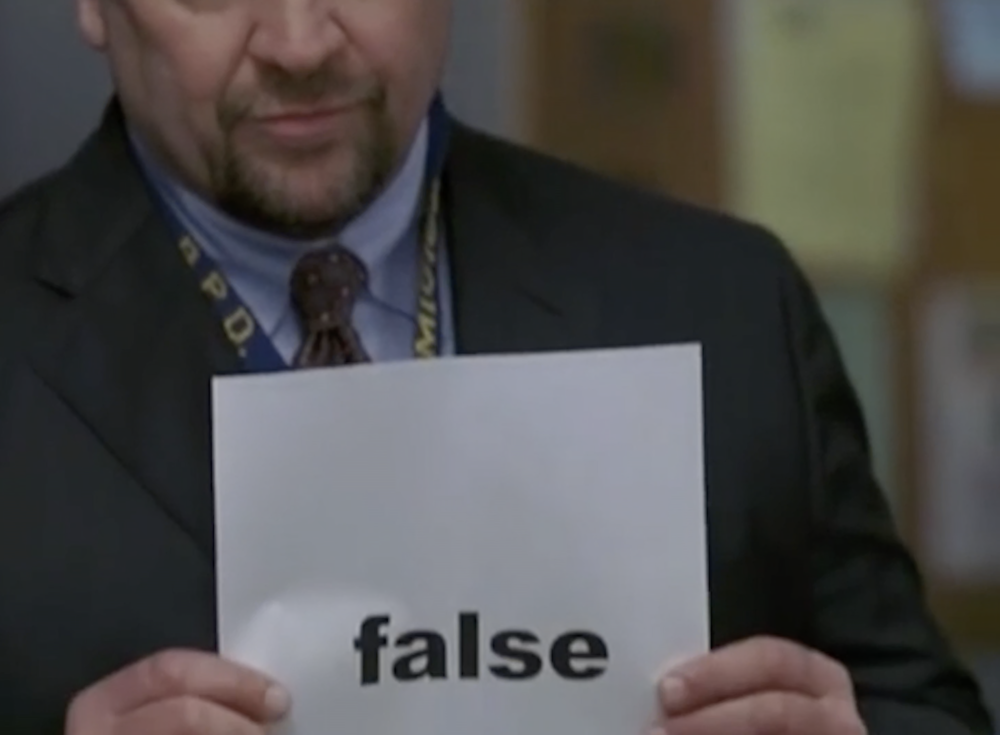
MC: The narrative beat of these highly produced TV shows and Hollywood movies can be so beguiling and powerful, I had to work out how to balance them within the rest of the film, so that they didn’t take over. The pixelated video and compressed audio of the YouTube clips was an important aspect of this distancing process – of attempting to remove some of their potency.
At the same time I was also thinking about how we are taught to distrust highly produced images. How lo-fi phone footage feels more direct and honest. The immediacy of phone footage has a different kind of aura?
BEJ: Yes, this is really interesting. How truth perhaps manifests itself or exists differently across mediums. In your research you talk about the use of different materials employed in the interrogation process; such as written notes or the use of cameras and audio recorders. Whenever evidence is remediated across these formats, there is a chance that some form of misrepresentation will occur due to one medium attempting to represent another. Each medium has different qualities and perhaps ‘holds’ truth and fiction in different ways. I wonder what this means for the interrogation process? And for the filmmaking process?
MC: There is a legal maxim, Perspicua vera non sunt probanda, which academic Peter Goodrich translates as – Things that can be seen clearly do not need to be proven – which is in many ways true.15 For instance, if you confess to a crime on video tape and then later recant your confession, a jury will find it very hard to watch the video taped confession and find you innocent – even if that is the only evidence of your supposed guilt and your attorney is able to pick holes in its accuracy.16
There are still many US states where the electronic recording of custodial interrogations is not mandatory, despite widespread agreement amongst wrongful conviction experts that such recordings are beneficial.17 However, as videotaping becomes more widespread, it seems important to recognise that moving image evidence is particularly compelling – and learn how to improve the visual literacy of those evaluating the footage. Interestingly, research shows that people are better judges of whether a confession is true or false when they are given an audio recording rather than an audio-visual recording of the confession.18
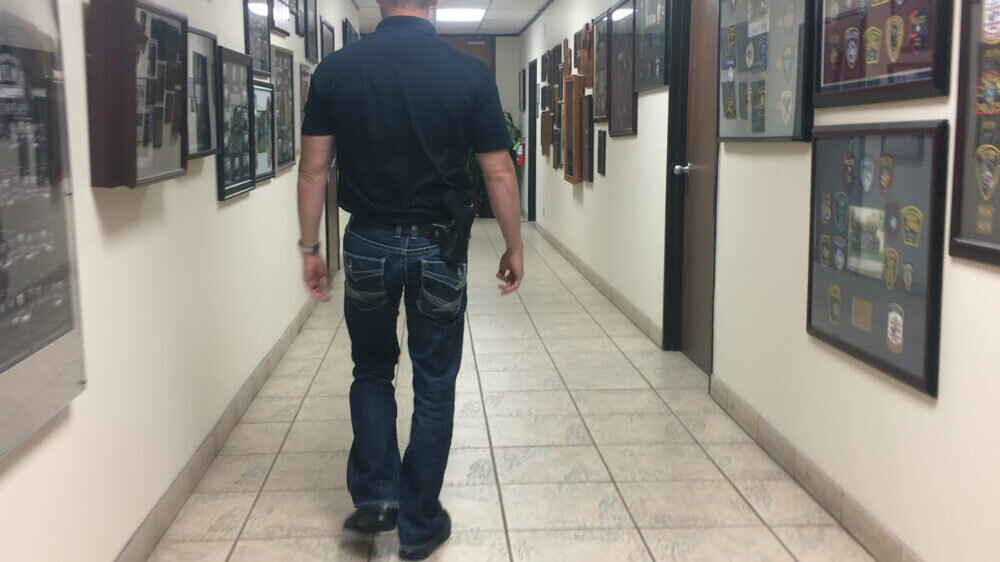
BEJ: Returning to the theme of this year’s transmediale, the filmmaking strategy you adopt for Indications of Guilt, pt.1 also seems to speak to ideas of refusal. For example, in the way you adopt certain approaches and tactics of police interrogation that you come across within the filmmaking process itself. There’s one particular moment where a police officer informs you that there is no legal requirement to tell a suspect they are being recorded in the state of Texas. At this point, you then inform us – the viewer – that the officer is unaware he himself is being recorded by you. It’s such a brilliantly incisive moment in terms of the themes of the film, but also delivered with such deadpan humour.
MC: I was really interested in how I could co-opt and repurpose the tools used by interrogators. The attitude of many of the detectives I met was: this is what is legally permissible, and this is how you can stretch and interpret the boundary – so there was a sort of symmetry in that we were both repurposing a set of rules in different ways.
Indications of Guilt, pt.1 is exhibited at transmediale 2021–22 as part of the remote. response. request. film programme. The work was made with the support of the Boise Travel Scholarship, 2016 and South West Showcase, 2020.
- 1 Mich, E.D (2008) Molnar v. Care House, 574 F.Supp.2d 772.
- 2 Winnicott, D (2005) Playing and Reality
- 3 Frankfurt, H (1986) On Bullshit, Princeton University Press.
- 4 ibid.
- 5 ibid.
- 6 Kassin, S (2008) Confession Evidence: Commonsense Myths and Misconceptions, 35(10), pp. 1309–1322. doi: 10.1177/0093854808321557.
- 7 ibid.
- 8 Wilshire, B (1990) ‘The Concept of the Paratheatrical’. TDR (1988-), vol. 34, no. 4, 1990, pp. 169–178. JSTOR, JSTOR, www.jstor.org/stable/1146050 .
- 9 Lambert-Beatty, C (2009) Make-Believe, Plausibility and Parafiction, MIT, Masuchusetts.
- 10 ibid.
- 11 Bruzzi, S (2016) Narrative, ‘evidence verité’ and the different truths of the modern trial documentary. Bristol (Arnolfini), Keynote at ‘Screening the Criminal Trial Symposium’, 21 Jan 2016 (GW4: Media and Criminal Justice Studies Network).
- 12 Godard, J.L (1986) Godard Par Godard Les Années Cahiers, DeCapo, Paris.
- 13 Ware, L & Lassiter, G & Patterson, S & Ransom, M (2008) Camera Perspective Bias in Videotaped Confessions: Evidence That Visual Attention Is a Mediator. Journal of experimental psychology. Applied. 14. 192-200. 10.1037/1076-898X.14.2.192.
- 14 Kassin, S.M & Meissner, C.A & Norwick, R.J (2005) “I’d Know a False Confession if I Saw One”: A Comparative Study of College Students and Police Investigators. Law Hum Behav 29, 211–227 https://doi.org/10.1007/s10979-005-2416-9 .
- 15 Goodrich, P (2011) The Visual Thresholds of Law, presentation at ‘Visualizing Law in the Digital Age’ conference, New York Law School, 21 Oct 2011.
- 16 Mnookin, J.L (2014) Videotaped confessions have value, but they can also be misleading, accessed 14th April 2021 https://www.nytimes.com/2014/07/14/opinion/videotaped-confessions-can-be-misleading.html
- 17 Innocence Project (n.d.), False Confessions & Recordings of Custodial Interrogations, viewed 14th April 2021 https://innocenceproject.org/false-confessions-recording-interrogations/
- 18 ibid.