This newly commissioned text by UK lecturer and researcher Rebecca Smith is an adjunct to the final edition of the remote. response. request. III. film programme. The exhibition brings together two filmmakers, Chloé Galibert-Laîné and Katerina Suvorova, who individually explore the conditions through which the filmic image produces and asserts its power over us, and the ways in which this power can operate both in favour of, or against political demands and actions.
1 BELT
a closed loop of flexible material used to transmit mechanical power
The belt is the film, which harnesses the image, and in doing so transmits a form of mechanical pressure. The film is a closed loop - duration is set, bound to time - but content is flexible and belongs to the editor and audience. Human intervention tries to tame and master the image by smoothing and shaping the f(r)iction. The image becomes belted, contained and constricted. It belongs to the audience.
Let the film frame its own image. Loosen the belt, reveal the cogs, remove the pressure and free-fall into the image.
2 VISCOSITY
a measure of the resistance of the fluid image to deformation under the shear stress of the editor’s eye. It is commonly perceived as thickness, or resistance to pouring. The image does not want to be moulded. Viscosity describes a fluid image’s internal resistance to flow and may be thought of as a measure of fluid f(r)iction.
The fluid image gives resistance to deforming under the application of the stress of editing. It is thick; heavy with resistance to the pouring, shaping, and moulding of human intervention. This creates a gooey perspective part image, part editor, producing a static f(r)iction and fixed perspective.
Remove this resistance and let the image speak.
3 BENDING MOMENT (BM)
is a measure of the bending effect that can occur when an external force (or moment) is applied to a structural element, in this instance the film.
The bending force and distance. A moment of absolute pressure between image and editor.
Structural analysis is the determination of the effects of these loads on the physical structure of the image and its components. Image structures subject to this type of analysis include all that must withstand the weight of the editor’s mind and point of view.
BENDING MOMENT DIAGRAM
Shear and bending moment diagrams are analytical tools used in conjunction with structural analysis to help perform structural design by determining the value of shear force and bending moment at a given point of a structural element such as when the editor and image meet.
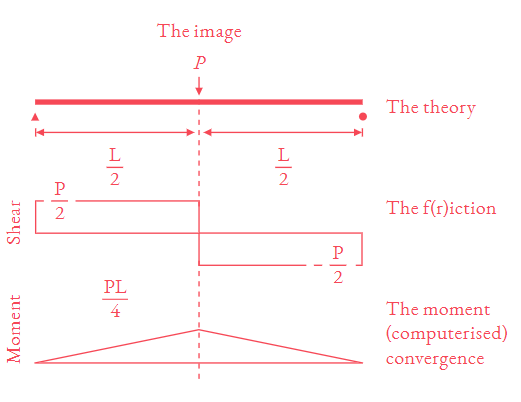
Bend and relinquish control to the image.
4 DEFORMATION (DISPLACEMENT) (DEFLECTION)
1: alteration of form or shape also: the product of such alteration 2: the action of deforming: the state of being deformed 3: change for the worse
In engineering, deformation refers to the change in size or shape of an object (the image). Displacements are the absolute change in position of a point on the object (the image). Deflection is the relative change in external displacements on an object (the image).
Deformation is the action of spoiling or altering the usual and true shape of something - at this point the editor may encounter more f(r)iction.
This is a call to change from rigid bodies to falling bodies that make kin with the image as an act of absolute change.
5 YIELD
is the point on a stress-strain curve that indicates the limit of elastic behaviour and the beginning of plastic behaviour. Below the yield point, image material will deform elastically, and will return to its original shape when the applied stress is removed.
Once the yield point is passed, some fraction of the deformation will be permanent and non-reversible and is known as plastic deformation.
Yielding is a gradual failure mode which is normally not catastrophic, unlike ultimate failure.
The editor should limit plastic behaviour in favour of elastic behaviour. Stop the image becoming fixed, plastic and brittle. Elasticity will let the image return to its original state. Ignorance in this is a gradual failure where slowly plasticity wins.
Let the image produce free flowing f(r)iction to avoid ultimate failure.