Desire is never simple. Desire can be a verb and desire can be an ideology. And it is desire, as Xiaowei R. Wang discovers, that "informs our politics, with the potential to make resistance or spaces of refusal possible." In their essay Acts of Desire, Wang unfolds and lays bare the contradictory complexities these possibilities hold by drawing out the connected histories of American counterculture, libertarian politics, and land relations. An act of creative non-fiction, Wang’s text is the story of their time in the coastal community of Bolinas, California, during the ongoing pandemic. It is also the story of how the environmental movements of the 1960s gave rise to a libertarian political movement that still persists today. These two threads of history help us to read desire as ‘a full act’; one that can "move us beyond our habits", and in so doing, "unveil new spaces of refusal".
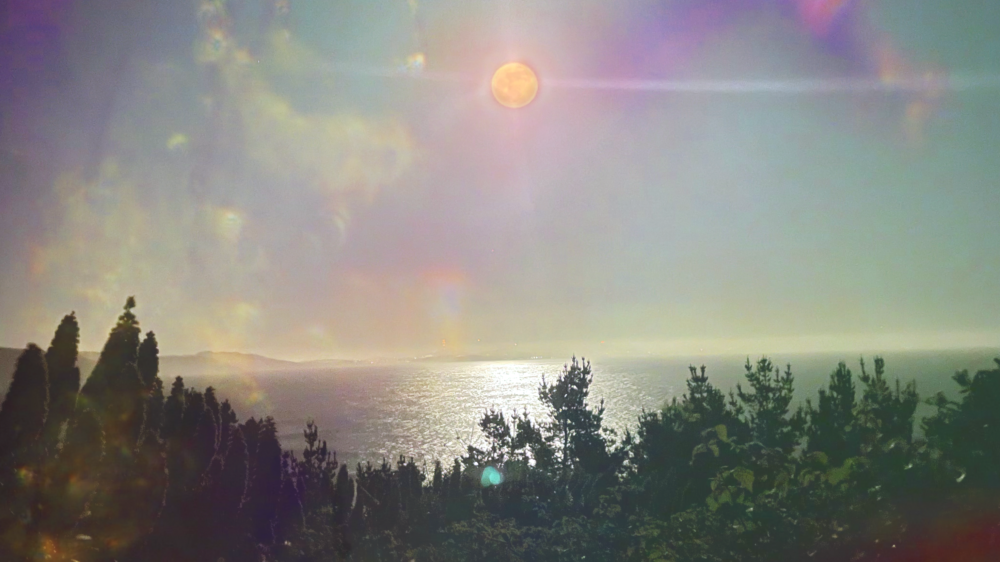
A lunar eclipse can be read as an omen, a catalyst. Like the Tower card in the tarot, a lunar eclipse is like a wildfire, searing everything in its path while activating seeds that needed the heat to grow. I wake at 3 am to watch the full moon redden into embers until it fully sits in the Earth’s shadow. Our shadow. Without the moon’s bright yellow glow, the sky dims, revealing the Milky Way.
It is late spring, and I am an hour outside San Francisco along the coast of Marin County, in a town currently called Bolinas. A few weeks ago, I arrived in this sleepy rural town with a population of 1,500 to dog-sit for a few weeks, a gig I originally found posted on Craigslist, to fulfil a desire to live next to the ocean. Learning to swim as an adult made me tenacious about being near water, clinging to the glassy blue of the Pacific. I would rather live in the ocean. Now, the days are getting longer. There is an optimistic tone around California opening back up due to the success of its vaccination efforts. Everywhere I go, I overhear discussions of new travels, parties, and desires unfurling. In this moment in late May, I stare at the red moon, mouthing the word desire.
Desire is never simple, and as bell hooks writes, desire informs our politics, with the potential to make resistance or spaces of refusal possible.1 Desire is complex because it requires untangling desire as ideology versus desire as the continuous act of opening up space. In the US, we are taught desire as ideology through endless forms of storytelling; love is the fulfilment of desire, individual desire is the assertion of individual freedom, with fulfilment only possible once the desirer possesses or subsumes the desired. Like an ouroboros, desire can be endless return, blurring the line between the desired and the desirer. Individual desire is seen as the selfish assertion of personal freedom, opposed to a collective requiring conformity. Writing during the rise of Nazism, Erich Fromm reminds us that the binary framing of individual versus collective is necessary to authoritarian power – the only sense of liberation and open space is in choosing one or the other.2
Myths and rumours function as traces of desire; myths create a projection of what we desire to be. Like any northern Californian town on stolen land, Bolinas is filled with settler colonial myths of self-creation. As Eve Tuck and Rubén Gaztambide-Fernández write, “Settler colonialism is typified by its practiced epistemological refusal to recognize the latent relations of the settler colonial triad; the covering of its tracks. One of the ways the settler colonial state manages this covering is through the circulation of its creation story.”3
Writing about settler colonial logics and how they reproduce themselves does not require writing about Bolinas, and to say Bolinas is unique or special would only further its self-aggrandising creation myth. I write about Bolinas because it is a place that became part of my desire, and it is a place of loud, aggressive, collective desire — a potent desire that blurs the line between complicity and action.
The image of the American West is saturated with the myth of Manifest Destiny, a widely held cultural belief in the 1800s with enormous impact, propelling American territorial expansion across the continent. As Kate McCoy explains, “Manifest Destiny provided an important rationale for the violence of settler colonialism, specifically the violence of dispossession of Indigenous peoples from their land and enslavement of Africans.”4 Borne out of Protestant creation myths, it was the idea that being human meant dominion over the Earth and nature, taming vast ‘wilderness’ into manicured, private property or areas of conservation for leisure. Manifest Destiny is decisively biblical, with the erotic undertones of religious fervour. As a genre, Western films reflect Manifest Destiny: a lone stranger, a Christ-like, gunslinger protagonist arrives in a frontier town, intermingles with locals and battles against the status quo, often with a Mary Magdalene-esque character by his side. More often than not, our hero dies, just like the figure of Christ. We see the flip side of desire through these familiar tropes – the anxiety, the neurosis of loss.
In Empire’s Tracks, Manu Karuka writes about rumours as “the prose of countersovereignty”, where “countersovereignty” is a settler stance, “a position of reaction to distinct Indigenous protocols governing life in the spaces the United States claims as its national interior.”5 The normative values of large, invisible systems become embodied through ritual – objects, media, hearsay. For Karuka, rumours reflect the constant anxieties of the settler; for example, the rumours among settlers that Chinese railroad workers shared traditional Chinese medicine with Paiutes was the reproduction of paranoid fantasies of racial supplantation, whether by Indigenous nations, racial aliens, or others.6 They are conspiring against us, goes the rumour.
As an imagined place, Bolinas proliferates on myth and rumour. News reports of Bolinas often describe it as geographically and culturally ‘far-out’, a nod to the town’s New Age culture. Part of the town’s myth is that it is founded on hippie principles, epitomised in Measure G, a ballot measure in Bolinas that passed with 67% of the vote, which officially declared Bolinas as “a socially acknowledged nature-loving town”. Bolinas has a reputation of having a strong community ethos, which has been cast as the reason for its successful Covid-testing measures.7 It is a place that likes to emphasise a local, rich cultural production – rumours of Grateful Dead concerts, and artists and poets like Aram Saroyan passing through.8
Recently, more and more people have been ‘discovering’ Bolinas. Its denizens now include an Academy Award-winning actress and director, multi-millionaire philanthropists, tech CEOs, and two wolves, kept by a group of people really into Ayahuasca. Bolinas has reinforced its ‘far-out’ nature by making itself hard to find – a rumoured organisation called the Bolinas Border Patrol has repeatedly taken down the road sign off Highway 1 that signals the turning to ‘Bolinas, 2’, cementing the town’s desire to be left alone. More recently, far-right militias insistent on defending the US border have found themselves naming the Bolinas Border Patrol as part of their confederation, finding a thread of comradery. Abolish Bolinas Border Patrol.
In Bolinas, a hand-painted sign awaits you at every corner encouraging progressive values of peace and love. The underside of these proclamations: desire, a yearning for peace and love that remains elusive. I proclaim what I desire. What I desire is what I do not have. Default, dominant cultural values are so ingrained they become unspoken, requiring enormous efforts even to begin to see their shapes through the deep furrows of habit. New values go against habit, needing to be proclaimed and performed, filled with the anxiety of change. The anxiety present in Bolinas’s rumours is nerve-wracking, frozen into panic with a peace sign.
Bolinas lies within Marin County in the San Francisco Bay Area, on unceded Coast Miwok territory. Marin County is one of the top five wealthiest counties in the United States, and home to some of the least diverse cities in the Bay Area. Bolinas itself is 90% white. Geographically, the town lies on the San Andreas fault with bluffs that constantly chatter with crumbling rocks and pebbles sheering into the ocean. It is split into two areas: what residents refer to as ‘the Mesa’, where most inhabitants live, and the ‘downtown’, home to a handful of stores and restaurants. Through the violence of conquest, of the Spanish missions, of Russian fur traders and American settlers looking for gold, logging and ranching, Bolinas arrived at another juncture in the 1960s, which reflected a broader shift in dominant American culture.
The myth of the hippie is all free love and free spirit, counter to the interests of big business and government. Historian Fred Turner has excavated the advent and trajectory of the hippie in great detail, particularly how the hippie movement of the 1960s gave rise to the libertarian political consciousness of contemporary Silicon Valley tech culture, to empty freedom for freedom’s sake.
One issue of the Whole Earth Catalog, an influential hippie technoculture tome, reflects another Manifest Destiny myth. “We are as gods”, writes Stewart Brand, in between the catalogue’s pages of tools to equip such gods – moccasins, tractors, and books. Trapped within the myopia of their historical moment, the hippie movement saw themselves as revolutionaries, when in fact they were staunch reactionaries. Reacting against tight-lipped, suburban protocols of the 1950s, they sought to create a counter-culture that was just that – counter to the dominant culture and ideology, unable to imagine the fullness of a new world.
The Whole Earth Catalog was reflective of the broader New Communalist movement where the young white hippies, disillusioned with the ‘mess’ of the urban, streamed out and into the countryside.9 Urban mess and rural idyll are always racially coded. Bolinas became an epicentre for these hippies: Charles Reich, who wrote the classic paean to 1960s counter-culture The Greening of America referred to himself as “The Sorcerer of Bolinas Reef” and Lloyd Kahn, the shelter editor for the Whole Earth Catalog, lived in Bolinas. These New Communalists held a nostalgia, a desire for an illusion of the past. It was this desire that created the “largest wave of commune building in American history”.10 In Bolinas, the New Communalists shaped drastic policy measures under their vision of community.
Warren Weber, founder of Star Route Farms in Bolinas, considered the godfather of California organics, reflects: “A lot of people in the late ’60s were looking to leave the cities. It had to do with Vietnam and all the social movements at the time, the anti-establishment scene … Basically it was a lot of pretty highly educated people, brought up in the ’50s grey-flannel suit generation, like me, trying to do something different. We were drawn to Bolinas … The early years, the ’70s were just great. We were pretty much self-taught and teaching each other.”11
Bolinas is so beautiful, why would you ever want to leave?
If these New Communalists truly believed in changing society, why draw boundaries around an isolated commune rather than pursue engaged politics? Their theory of change centred around the idea of consciousness, a Thoreau-like project of self-reliance, of healing oneself to start healing others. Numerous signs in downtown Bolinas proselytise: healing yourself is healing the planet; changing the world begins with changing yourself from within. “Ironically, by making consciousness the basis of community, the New Communalists found themselves replicating the racism, the sexism, and even the class divisions of mainstream America … Slowly but surely, the New Communalists came to a new and narcissistic understanding: the world was indeed a whole system, as was each individual within it … It was, in short, all too easy to believe that one’s intimate personal surroundings were in fact the whole Earth”, writes Turner.12 In short, these New Communalists returned to liberalism – a refusal to see that even the notions of the ‘personal’ or the ‘private’ are shaped in the context of a broader system.
This focus on inner consciousness is intertwined with an environmentalism founded on deeply troubling, constructed notions of nature and pollution. The locus of power in this form of environmental protection relies on upholding whiteness, borders, and private property. As scholar Richard White writes, early nature conservation movements were dependent on the image of a white man in pristine wilderness, a vision of a ‘pure’ nature that first needed to be constructed before it could then be preserved as a space of leisure.13 This imagined Nature, with all of its xenophobic implications, persists. Organisations like the Sierra Club were steeped in anti-immigrant sentiment, with the fictive notion of a “population bomb”, whereby overpopulation would lead to widespread famine and ecological destruction, central to these politics disguised as ecology.14 This “overpopulation-as-environmental-degradation” argument became popular among ecologists with right-wing leanings and ecologists on the left who equated population growth and development with environmental degradation. Encoded in population growth was the idea that non-white races would outnumber and overthrow white supremacy. The ideas of J.I. Rodale, the writer who influenced the New Communalist movement towards organic farming, reflected this anxiety towards white racial decline, deeming organic foods necessary because of the rising rates of disease in the US, comparing them to the so-called ‘primitive’ races of Asia and Africa.15 Environmental protection was the protection of the settler status quo.
In Bolinas, the New Communalists took over the Bolinas Community Public Utilities District, exercising power over the town’s infrastructure. Saving the environment would be their central concern. Many places use zoning to address questions of housing and development. Bolinas decided to use zoning to manage access to water – that element which is most essential to terrestrial life. On 26 November, 1971, a resolution was put into place, halting any new water infrastructure from connecting to the town’s municipal water supply. The preamble to this water moratorium contains its justifications: environmental protection and the limiting of “chaotic human influx capable of destroying the existing delicate ecological balance.”16
“The intent of the moratorium was to halt population growth by stopping building”, wrote one resident, Marguerite Kirk Harris.17 “This action by the [then] recently elected Public Utilities Board reflected community attitudes towards environmental concerns which had developed in response to recent moves to further develop and commercialize the area … Tactics used to retain the moratorium resulted in deterioration of the water supply, inadequate fire protection, and an increase in the occupancy of sub-standard illegal dwellings.”18
Central to the identity of Bolinas was the view of its community and the power of the people over county-level policies. The moratorium was popular not just for environmental reasons but also for residents who bristled at the idea of connecting Bolinas’s water supply and sewage to a neighbouring town, which would connect it to the rest of the county. Even after the moratorium, in 1975, a proposed plan for Marin County that included more water storage for Bolinas, that included a growth clause of 14 new homes a year, was struck down by the New Communalists of Bolinas.19
As activist-scholar Laura Pulido reminds us, racial capitalism works through land: the appropriation and taking of Indigenous lands, and the control of who has access to land via private property ownership.20 “Property law is a settler colonial technology”, writes la paperson, and it’s not just property or the ground itself that can be possessed.21 It’s everything on it – the infrastructure, the water, and the pollution.
We like to think that under duress, we will be the heroic individuals that we think we are inside. The truth is that under pressure, we revert to our habits, the values we practice every day. In the imagined apocalypse, we want to be the one who still recognises our relation to others. At the start of the pandemic, city dwellers flocked to Bolinas for day trips, looking to leave their apartments for time in the ocean. Bolinas Border Patrol took it upon themselves to stage a protest against visitors, holding signs – “If you don’t live here, don’t come here”; “TOWN IS CLOSED” – and cheering when startled visitors turned around. Even before the pandemic, the town’s cloistered attitude verged on the xenophobic. These signs are examples of a deep, longstanding race and class gap in access to coastal areas, as highlighted in a report published by UCLA, a gap that organisations like Brown Girl Surf, Black Girls Surf are trying to address.22 In contrast to the New Communalists who championed environmental conservation, “environmentally reverent” is the phrase Brown Girl Surf uses to describe their mission. Joy overwhelms the ideology of desire, turning doctrine into an open space for awe and pleasure.
During my dog-sitting stint, I attend two parties. I meet other residents of the town. I hear fables. Current residents have a multi-generational rumour that the Coast Miwok never lived in Bolinas and that it was a place of temporary residence for healing. If you stay too long, for more than seven years, they say, you go crazy. Whatever crazy means to you.
Unprompted, the residents I meet all apologetically bemoan the lack of diversity and the sense of privilege they feel to live in Bolinas. I cannot think of anything to say. I want to say, if you feel so guilty, give up your house. Pay estate tax. See the system that you are part of that you benefit from.
In conversations, I laugh, sometimes full and other times hollow. I go on long silent walks with my dog companion. Through wisps of tall grass, I find the tiny purple flowers of wild radishes. When I stare at the ocean, I notice I am holding my breath, overwhelmed. I learn that Glaucus is the Greek god of fishermen – glaucus, meaning a stormy sea-grey, the colour of peach fuzz in sunlight, the colour of yeast on muscat grapes at sunset.
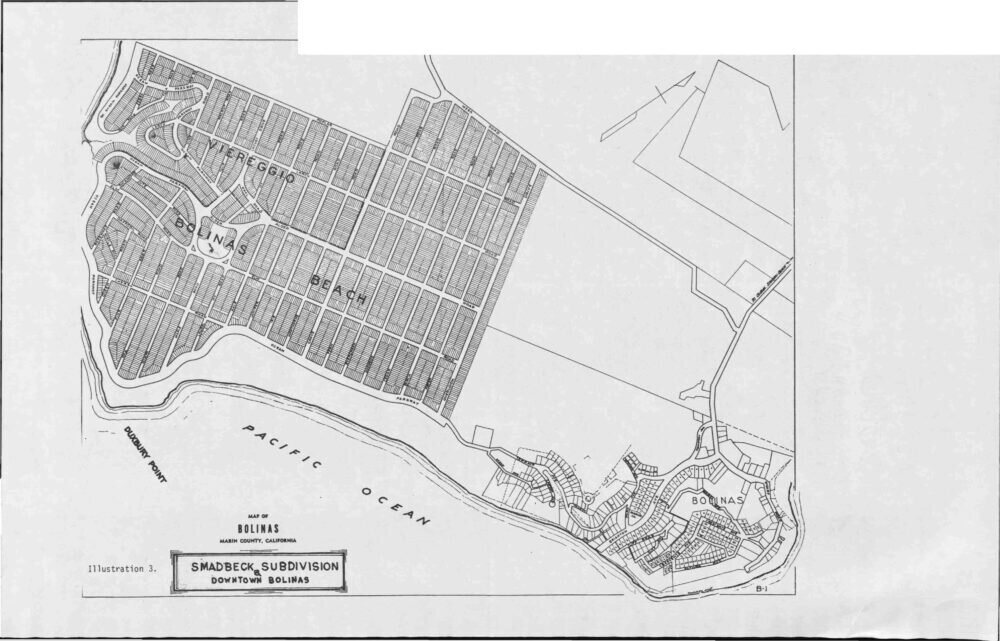
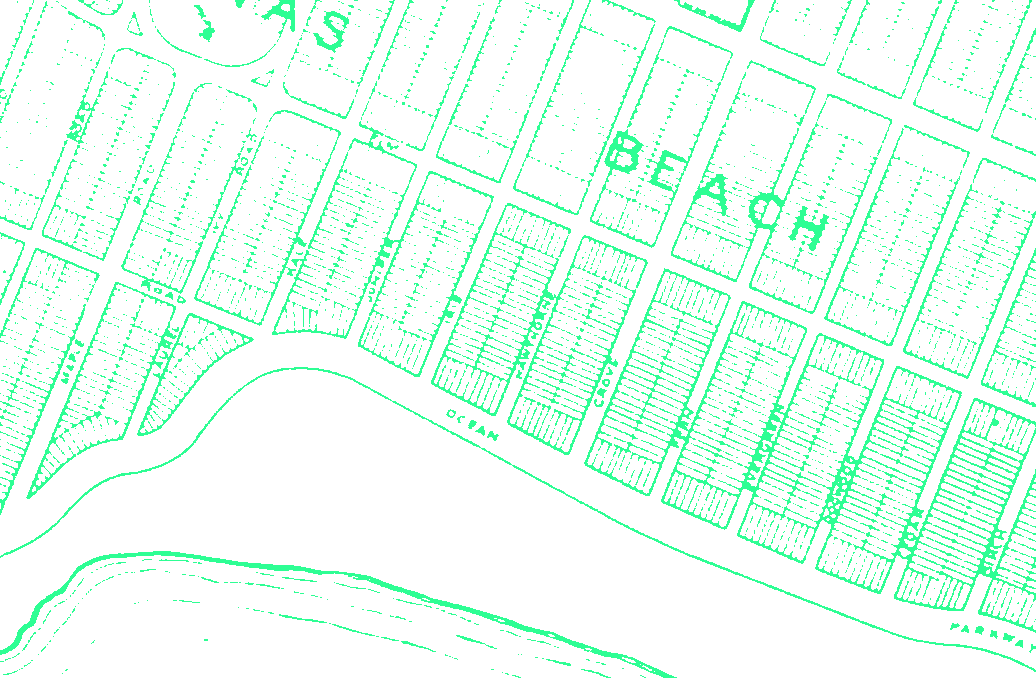
I dig deeper and find reports of at least one Coast Miwok shell mound in Bolinas, near the Arroyo Honda creek.23 Other shell mounds are located near Gospel Flats in Bolinas, where mortar and pestles, abalone shells and arrow points confirm a longstanding village of the Guaulen, the tribe whose village site is here in the rich soil, filled with abundant food sources near a freshwater creek. I receive confirmation from a historian that Bolinas was a longstanding settlement, beginning at least 1,500 years ago. I wonder where the fantasy of temporary healing and craziness came from. I know the answer, though – more settler anxiety than fact. If you tell yourself you don’t live on stolen land, you can sleep well at night. For the guilt of how white Bolinas is, I discover an archival entry: the Mesa, once a 300-acre dairy farm, was divided into 5,336 residential subdivisions in 1928, called the Smadbeck Subdivisions. Sales of the subdivisions had covenants attached, stating no slaughterhouses, insane asylums, or the “acquisition of the lots by Orientals, Negroes and Indians.”24 Our present is not an accident or oversight. Power made it this way.
Xiaowei R. Wang is a designer, writer, educator, and coder. The creative director at Logic Magazine, their work encompasses community art projects, education, and research on technology and ecology.
- 1 b. hooks, ‘Eating the Other: Desire and Resistance’, in Black Looks: Race and Representation, Boston, South End Press, 1992, pp. 21–39.
- 2 E. Fromm, ‘Selfishness and Self-Love’, Psychiatry: Journal for the Study of Interpersonal Process (The William Alanson Psychiatric Foundation), vol. 2, 1939, pp. 507–23.
- 3 E. Tuck & R. A. Gaztambide-Fernández, ‘Curriculum, Replacement, and Settler Futurity’, Journal of Curriculum Theorizing, vol. 29, no. 1, 2013, pp. 72–89, https://journal.jctonline.org/index.php/jct/article/viewFile/411/pdf .
- 4 K. McCoy, ‘Manifesting Destiny: A Land Education Analysis of Settler Colonialism in Jamestown, Virginia, USA’, Environmental Education Research, vol. 20, no. 1, 2 January 2014, pp. 82–97, https://www.tandfonline.com/doi/abs/10.1080/13504622.2013.865116 .
- 5 M. Karuka, Empire’s Tracks: Indigenous Nations, Chinese Workers, and the Transcontinental Railroad, Berkeley, University of California Press, 2019, p. xii.
- 6 Ibid, p. 5.
- 7 N. Heller, ‘The Town That Tested Itself’, The New Yorker, 20 May 2020, www.newyorker.com/news/california-chronicles/bolinas-california-the-town-that-tested-itself-for-the-coronavirus .
- 8 D. Chiasson, ‘What the Bolinas Poets Built’, The New Yorker, 31 May 2021, www.newyorker.com/magazine/2021/05/31/what-the-bolinas-poets-built .
- 9 F. Turner, ‘The Politics of the Whole — Circe 1968 and Now’, in D. Diederichsen & A. Franke, The Whole Earth: California and the Disappearance of the Outside, Berlin, Sternberg Press, 2013.
- 10 Ibid, p. 44.
- 11 W. Weber, Essay and Reflections from Warren Weber, https://evolutionoforganic.com/wp-content/uploads/2018/04/2-warren-weber-essay.pdf .
- 12 F. Turner, p. 45.
- 13 R. White, ‘“Are You an Environmentalist, or Do You Work for a Living?”: Work and Nature’, in W. Cronon, Uncommon Ground: Rethinking the Human Place in Nature, New York, W.W. Norton & Co, 1996, pp. 171–85.
- 14 S. Cagle, ‘Anti-Immigration White Supremacy Has Deep Roots in the Environmental Movement’, Mother Jones, 19 August 2019, www.motherjones.com/politics/2019/08/anti-immigration-white-supremacy-has-deep-roots-in-the-environmental-movement/ .
- 15 J.I. Rodale, The Encyclopedia of Common Diseases, Emmaus, PA, Rodale Press, 1976, https://archive.org/details/encyclopediaofco00jir_ntn/ .
- 16 M. Kirk Harris, ‘Radical environmental protectionism in a small community: a study of the Bolinas water moratorium’, MA thesis, Montana State University, 1977, https://scholarworks.montana.edu/xmlui/bitstream/handle/1/5315/31762100141991.pdf .
- 17 Ibid.
- 18 Ibid.
- 19 Ibid.
- 20 L. Pulido, ‘Geographies of Race and Ethnicity II: Environmental racism, racial capitalism and state-sanctioned violence’, Progress in Human Geography, vol. 41, no. 4, 13 May 2016, pp. 524–33, https://journals.sagepub.com/doi/abs/10.1177/0309132516646495?journalCode=phgb
- 21 la paperson, A Third University Is Possible, Minneapolis, University of Minnesota Press, 2017.
- 22 J. Christensen & P. King, ‘Access for All: A New Generation’s Challenges on the California Coast’, 25 November 2017.
- 23 Bolinas Hearsay News, 22 June 2018, https://www.dropbox.com/s/5mdr8evl4xdb1y4/fri.6-22-18hearsay.pdf?dl=0 .
- 24 J. Mason, Last Stage for Bolinas, Inverness, CA, North Shore Books, 1973, pp. 87–88.