Curators: Pierre Wolter & Melanie Zagrean Special guest: Stephen Kovats (Artistic Director of transmediale) Location: Today Art Museum Beijing A commission of Goethe Institut Beijing and transmediale in co-operation with the gallery Art Claims Impulse
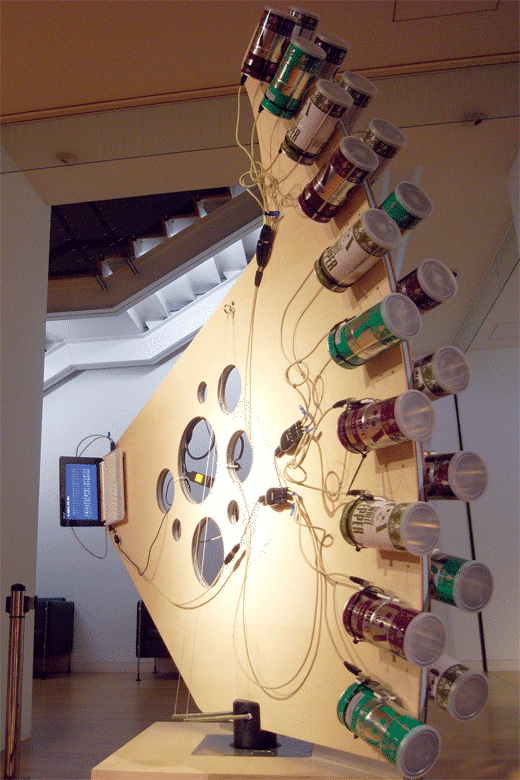
Julius von Bismarck: *Image Fulgurator (2007/08), Torus (2010), Untitled (2010) *Julian Oliver: *Artvertiser *(2009/10) Holger Mader, Alexander Stublic, Heike Wiermann: Expanded Spaces (2009/10) Dave Ball: *How to Live *(2008) Michelle Teran: *Buscando al Sr. Goodbar *(2009) Maria Vedder: Threshold (2006) Marc Aschenbrenner: Im Abri/ In the rock shelter (2008) Martin Howse: *Psychogeophysics *(2009) Matthias Fitz: *Electromagnetic plot *(2008) Adam Somlai Fischer, Bengt Sjölén, Usman Haque: *Panoramic Wifi Camera *(2008) Miles Chalcraft: At the End Road (2008) Andreas Fischer, Benjamin Maus: Reflection (2009) Boredom Research: *Snail Mail *(2008/09) Tudor Bratu: *Conversation Piece *(2008) Niklas Goldbach: Habitat C3B (2008)
The exhibited artworks deal with static and moving, virtual and material topology of an urban site, obvious as well as hidden structures, materialising or 'grounding' virtual networks, and shapes and traces 'invisible' to the naked eye, some of which are the result of current media and communication technology. By way of digital devices, engineering tools and software, but analogue means of creating minor ruptures or alterations in the topological surface, they question, re-interpret, visualise and explore that topology, uncovering some of the complexity of urban environments.
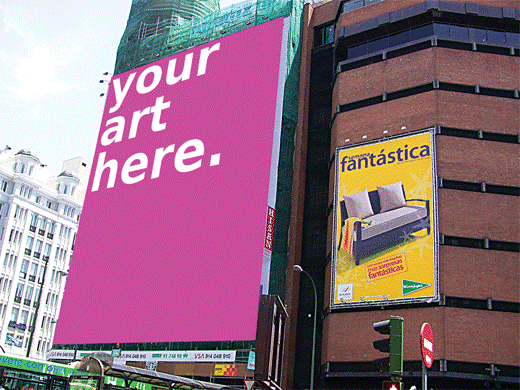
Some of the works, such as* The Image Fulgurator* and *The **Artvertiser *alter or 'sabotage' the topological surface of the urban space, thus revolting against and challenging cultural, social and political seemingly rigid 'structures'. The works of Mader Stublic Wiermann and **Dave Ball **explore the physical space by inverting structures, breaking them, playing with perception and thus challenging mind and eye or causing minor ruptures to disturb pre-conceived perspectives on 'how things are or should be'. The platform 'New Berlin' on *Second Life *translocates this discourse into the virtual world, into a parallel universe resembling the material or physical topology but functioning through different paradigms and parameters and thus expanding allowing for parallelity between reality and utopia.
The works of transmediale.10 award winners Michelle Teran, Maria Vedder, Tudor Bratu, Niklas Goldbach and **Marc Aschenbrenner **look at human existence and interaction, at networks, boundaries and thresholds, virtual and real, yet frequently invisible in the topological structure of an environment. While Michelle Teran's work attempts to visualise virtual social networks and their content by 'tracking them down' to their physical location, Maria Vedder explores constructed and imagined boundaries of borders and transitional non-spaces, also alluding to the issue of migration, portraying 'undetermined' contours, movement and interaction. Marc Aschenbrenner and Niklas Goldbach's work visualises an extremely altered, almost apocalyptic, urban topology with humanoid forms resembling atomised solitary sculptures or clones.
The visualisation of inevident or invisible structures, and with it the drawing of attention to the increasing complexity of material and immaterial structures that change our society, has been a common artistic practice over several decades. Some of the works, such as those of Adam Somlai Fischer and Bengt Sjölén, Matthias Fitz, Benjamin Maus and Andreas Fischer, portray their percussions of digital media on the physical environment, use complex engineering and software to digitally visualise complex material structures, and 'visualise' yet undetermined or imagined dimensions by using interdiciplinary scientific approaches and subjective reactions to topologies.
・・・
Kuratoren: Pierre Wolter & Melanie Zagrean Special guest: Stephen Kovats (Künstlerischer Leiter der transmediale) Ort: Today Art Museum Beijing Eine Veranstaltung vom Goethe Institut Beijing und transmediale in Zusammenarbeit mit der Gallerie Art Claims Impulse
Julius von Bismarck: *Image Fulgurator (2007/08), Torus (2010), Untitled (2010) *Julian Oliver: *Artvertiser *(2009/10) Holger Mader, Alexander Stublic, Heike Wiermann: Expanded Spaces (2009/10) Dave Ball: *How to Live *(2008) Michelle Teran: *Buscando al Sr. Goodbar *(2009) Maria Vedder: Threshold (2006) Marc Aschenbrenner: Im Abri/ In the rock shelter (2008) Martin Howse: *Psychogeophysics *(2009) Matthias Fitz: *Electromagnetic plot *(2008) Adam Somlai Fischer, Bengt Sjölén, Usman Haque: *Panoramic Wifi Camera *(2008) Miles Chalcraft: At the End Road (2008) Andreas Fischer, Benjamin Maus: Reflection (2009) Boredom Research: *Snail Mail *(2008/09) Tudor Bratu: *Conversation Piece *(2008) Niklas Goldbach: Habitat C3B (2008)
Obwohl Berlin einigen Kunstwerken als Metapher, als Kulisse oder als Plattform dient, schieben sich die typischen Merkmale der Stadt an den Rand der Perspektive. Die Idee einer urbanen Topologie wird neu definiert und erweitert, indem die Perspektive sich dem Subtilen, dem Unaufdringlichen, dem Versteckten, der Vorstellung, dem Flüchtigen zuwendet. In diesem Kontext widmen sich die Arbeiten von transmediale.10 Award-Preisträgerin Michelle Teran, Maria Vedder, Niklas Goldbach und oft unsichtbaren menschlichen Spuren, Netzwerken, Grenzen und Schwellen der topologischen Struktur einer Landschaft. Während Michelle Terans Arbeit virtuelle soziale Netzwerke und Inhalte durch deren performative Einbettung in eine Landschaft zu visualisieren versucht, widmet sich Maria Vedders Arbeit tatsächlichen und imaginierten Grenzen sowie vorübergehenden Nicht-Räumen einer Landschaft. ** Marc Aschenbrenners** und Niklas Goldbachs Arbeiten zeigen fast apokalyptische Landschaften, die humanoide Formen und vereinsamte menschliche Skulpturen oder Klonein sich bergen, die sich der entfremdeten urbanen Topologie anzupassen scheinen.
Die Arbeiten von Martin Howse und Tudor Bratu widmen sich der menschlichen Kommunikation und der Flüchtigkeit der Spuren, die diese in der Landschaft hinterlassen. Die Arbeiten versuchen, diese festzuhalten und sie in eine interaktive, performative Erfahrung umzuwandeln. Die Idee der Kommunikation beschäftigt auch Bengt Sjölén, Adam Somlai Fischer und Matthias Fitz, jedoch verlegen sie den Fokus auf digitale Kommunikation und die Visualisierung der Strukturen auf denen diese fußt. Ähnlich widmet sich die Arbeit von Boredom Research virtuellen und materiellen Kommunikationsstrukturen in einer Installation, die eine ungewöhnliche Art von langsamer Kommunikation vorschlägt.
Mader Stublic Wiermann, Julius von Bismarck, Julian Oliver, Miles Chalcraft, und** Dave Ball** erkunden in ihren Arbeiten die physische Landschaft: Teils auf humorvolle Weise, erweitern sie diese, drehen sie um, brechen sie auf. Sie spielen mit der Wahrnehmung und erzeugen winzige Risse, welche die voreingenommene Perspektiven stören, die unterschiedlichen Facetten aufdecken, die den Geist und das Auge herausfordern.