Books, letters, documents and indexes are all paperbound forms central not only to literary, but also to computational culture. In his recent book, White Magic. The Paper Age (2012), Lothar Müller suggests looking at paper’s cultural significance not only from the viewpoint of its practical use, but also as a universal metaphor informing everyday culture. In this sense, paperbound cultural practices are not restricted to the analog. Instead, we can see how the persistence of paper confounds the idea of linear transition from the analog to the digital. As Alessandro Ludovico argues, the post-digital era is one where print is not obsolete, but is in the process of reinvention. This argument examines how the legacy of different paperbound forms is being transformed and is transforming cultural imaginaries and practice. Lothar Müller’s historical view of paper serves as an introduction to his exploration of the evolving social and cultural impact of paper in different formats, such as postage stamps, punch cards and newsprint, as well as the influence of paper on literary modernity. Markus Krajewski will delve deeper into the computational aspects of paper, looking at the transformation of writing that took place in electronic contexts, as well as giving a brief introduction to his Synapsen software, a virtual punch card environment. Janneke Adema and Gary Hall explore how books exist between being material and conceptual objects, juxtaposing the paperbound artist book and the scholarly monograph, where in both cases the book may be seen as a political tool for constructing an alternative future.
...Papierbasierte Medien wie Bücher, Briefe, Dokumente und Karteikarten spielen nicht nur für die literarische Kultur, sondern auch für die Computerkultur eine zentrale Rolle. In Weiße Magie – Die Epoche des Papiers (2012) stellt Lothar Müller die These auf, die kulturelle Bedeutung von Papier sei nicht nur aus praktischer Sicht zu bewerten, sondern Papier sei als universale Metapher zu denken, die unsere Alltagskultur durchdringt. In diesem Sinne sind papierbasierte kulturelle Praktiken nicht auf das Analoge beschränkt. Das Fortbestehen von Papier stellt die Vorstellung von einem linearen Übergang des Analogen zum Digitalen infrage. Alessandro Ludovico geht davon aus, dass Druckmedien in der postdigitalen Ära nicht obsolet geworden sind, sondern nur neu erfunden werden. Er untersucht, wie das Erbe verschiedener papierbasierter Medien transformiert wird und umgekehrt das kulturelle Imaginäre und kulturelle Praktiken transformiert. Müllers historischer Ansatz ist die Basis für seine Erkundung des sozialen und kulturellen Einflusses von Papierformaten wie der Briefmarke, der Lochkarte oder dem Zeitungspapier und des Einflusses von Papier auf die literarische Moderne. Markus Krajewski geht am Beispiel der Veränderungsprozesse des Schreibens in elektronischen Kontexten auf Papier als Aspekt der Computerkultur ein und stellt seine Software Synapsen vor, ein virtueller Zettelkasten. Gary Hall und Jenneke Adema untersuchen die Existenz des Buches zwischen materiellem und konzeptuellem Objekt. Dafür stellen sie das Künstlerbuch und die wissenschaftliche Monografie gegenüber. In beiden Fällen kann das Buch als papierbasiertes politisches Werkzeug für den Entwurf einer alternativen Zukunft betrachtet werden.
Related Media
 Panel introduction by Kristoffer Gansing: Paperbound - Cultural Imaginaries and Practices in the Epoch of Paper
 Panel introduction by Alessandro Ludovico: Paperbound - Cultural Imaginaries and Practices in the Epoch of Paper
 Presentation by Gary Hall and Janneke Adema: Paperbound - Cultural Imaginaries and Practices in the Epoch of Paper
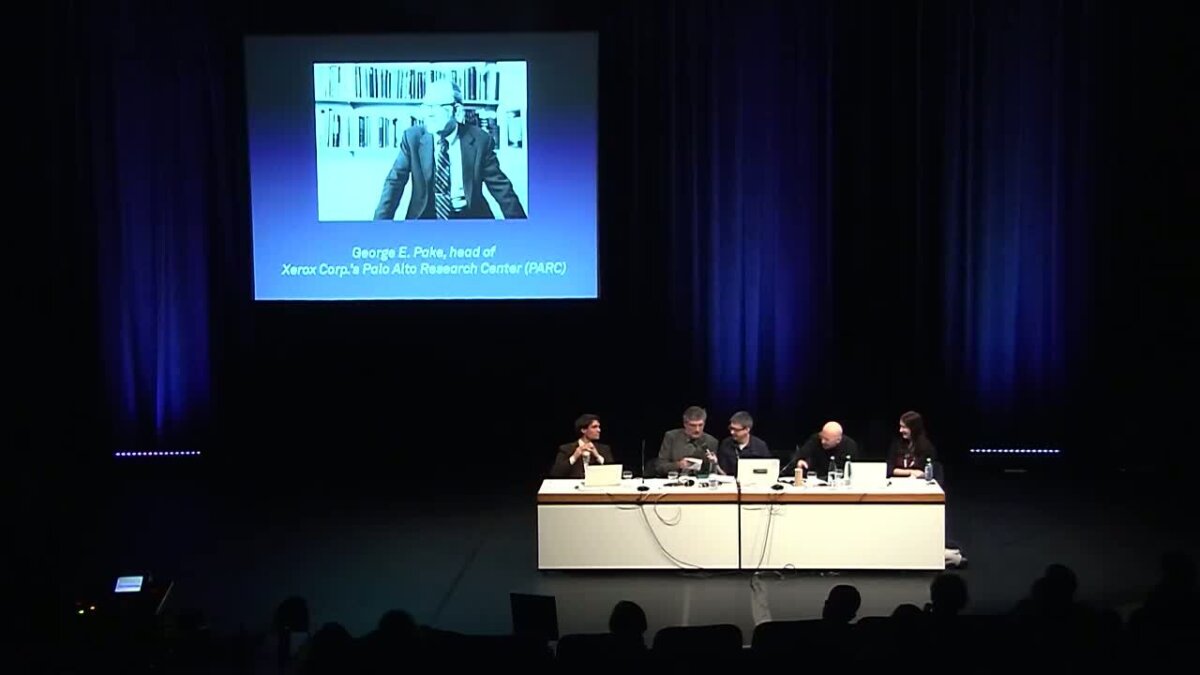 Presentation by Lothar Müller: Paperbound - Cultural Imaginaries and Practices in the Epoch of Paper
 Presentation by Markus Krajewski: Paperbound - Cultural Imaginaries and Practices in the Epoch of Paper
 General Discussion: Paperbound - Cultural Imaginaries and Practices in the Epoch of Paper