Conference Stream Life
In this panel, the next level of face recognition technologies, face expression recognition tools, will be discussed as devices of subcortical scanning. Since Darwin’s The Expression of the Emotions in Man and Animals, it is known that genetically determined aspects of behaviour can be traced through the expression of emotion on the most semantically important surface of our bodies: the face. Over the course of the past decade, we have also witnessed the rise of affective neuroscience and the study of faces as an interface of affect. As a consequence of the intensive study of affect, a variety of software applications that can detect “emotion” have been introduced to public and private use. As we have entered the age of “big data”, what would be the cultural and political implications of gathering affective data on large populations? Can this data be actually used to improve the quality of life or does it become another tool for discrimination or social isolation? We will take a quick look at neuroscientist and emotion theorist Paul Ekman’s highly popularised work on facial expressions, and MIT Media Lab faculty Rosalin Picard’s project Affdex, a webcam based system that detects “the emotional connection between people and brands.” Emotion detection is a free entrance pass to the limbic system that is positioned at the centre of our brains and our lives. What would be the outcome of opening our subcortical neural networks to the corporate networks of power?
Conference Stream Life
In diesem Panel wird die nächste Ebene von Gesichtserkennungstechnologien diskutiert – die Erkennung von Gesichtsausdrücken, als Element des subkortikalen Scannens. Seit Darwins Vom Ausdruck der Emotionen bei Menschen und Tieren ist bekannt, dass die genetisch festgelegten Anteile des Verhaltens durch den Ausdruck von Emotionen auf der semantisch am wichtigsten Oberfläche unseres Körpers nachverfolgt werden können: unserem Gesicht. Im letzten Jahrzehnt ließ sich ein Anstieg der gefühlsbedingten Neurowissenschaften und der Studien von Gesichtern als Interface der Gefühle erkennen. Das Ergebnis davon ist eine Reihe von Software, die „Gefühle” erkennen kann und im öffentlichen und privaten Gebrauch genutzt wird. Jetzt, da wir das Zeitalter von „Big Data” erreicht haben – was sind die kulturellen und politischen Folgen von der Sammlung solcher affektiver Daten von ganzen Bevölkerungen? Können diese Daten wirklich genutzt werden, um die Lebensqualität zu verbessern? Oder werden sie zu einem weiteren Werkzeug zu Diskriminierung und sozialer Isolation? Wir werden uns in diesem Panel mit dem Neurowissenschaftler und Emotionstheoretiker Paul Ekman und seinem sehr bekannten Werk zu Gesichtsausdrücken beschäftigen, sowie mit dem Projekt Affdex von Rosalin Picard vom MIT Media Lab, einem auf Webcams basiertem System, das „die emotionale Verbindung zwischen Menschen und Marken” erkennt. Gefühlserkennung ist ein Freifahrtsschein zum limbischen System im Zentrum unseres Gehirns und Lebens. Was würde passieren, wenn wir die subkortikalen neuralen Netzwerke für die mächtigen Firmennetzwerke freigeben?
Related Media
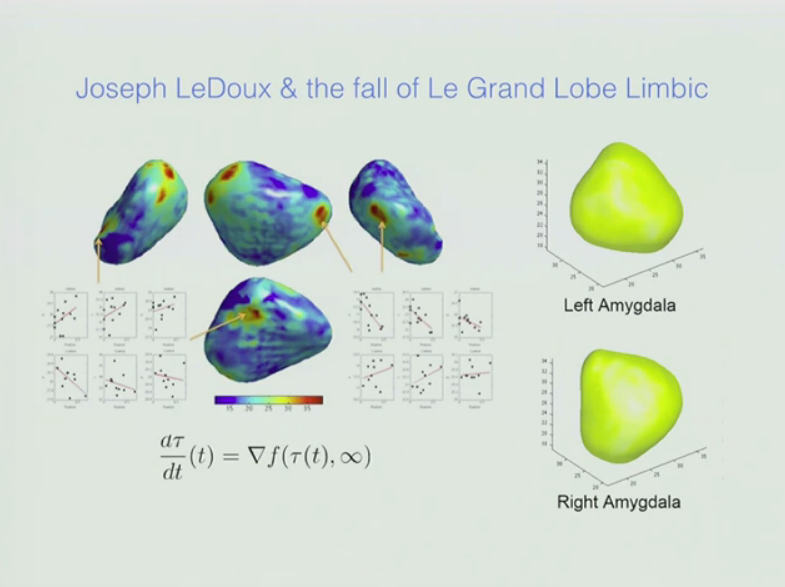 Introduction by Daphne Dragona and Pinar Yoldas – Devices of Affective Surveillance
 Presentation by Marie-Luise Angerer – Devices of Affective Surveillance
 Presentation by Matteo Pasquinelli and discussion – Devices of Affective Surveillance
 Matteo Pasquinelli, Pinar Yoldas and Marie-Luise Angerer (left to right) at "Devices of Affective Surveillance"