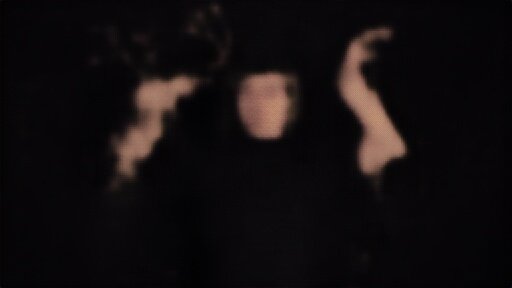
The work combines a calm musical score with a 3-channel moving image projection onto a cylindrical screen that can be entered by the public. The moving image shows a randomised composition of dance moves blurred by Machine Learning models that reconstruct them using a method from a scientific paper that proposed imitating sleep cycles, dream-like phases in which what has already been learned is replayed, to counteract an issue known in AI research as “catastrophic forgetting”. The term refers to the fact that Machine Learning models are unable to learn new information unless previously learned information is presented alongside it. Otherwise, the previously learned information will be wiped from the artificial neural network, or “forgotten”. Compression is an integral part of today’s digital communication. It makes retrieval and exchange of information faster. Simultaneously, the Internet seems to provide an archive of the past thirty years, making hidden gems of culture readily available. Never has it been so easy to access material published long ago. With the emergence of publicly usable Machine Learning models, “compression” has also become a marketing term, used to claim that a model can compress all of humanity’s information into a few gigabytes. Compression, in the way it is used for communication and the creation of models, is mostly lossy: information will become coarser to save space. While in classical compression, data is treated according to fixed, human-designed rules, in AI the importance of data points is determined statistically.
As Machine Learning models are based on Artificial Neural Networks, their developers often look to the functioning of the human brain, replicating biological processes for technological advancement. re- connects this to cultural development, or perhaps rather its regression: Over the past decades, trends have been regurgitated by the mainstream, making many wonder why in times of rapid scientific development, experimental approaches hardly seem to reach a wider public. There are two seemingly conflicting technologies here: on the one hand AI, which very lossily retains the past, supporting a narrative of days gone by only painted by preserved mainstream and the Internet on the other hand, a living archive including the obscure. Human memory is lossy, too, and exactly because of this imprecision it is so effective, allowing organisms to easily adapt to new situations. Instead of basing importance of information on statistics, it manages to also retain singular important moments given the right conditions, making sure uniqueness is not sacrificed for generality. AI, as a new memory technology, is governed by statistics, meaning it loses the singular and keeps the general. Combined with data of the past decades being so easily accessible, it seems as if we, a society, have gotten stuck replaying the past. Thus the question arises: Does society lose its ability to interact with and reconsider the present and future?
Related Events
- 07.11.26.18:00– 20:00Emergent Conditions Artist Talk & Séance
with Amanda E. Metzger, Laura Benech, Zeno Gries
Moderated by Anna-Lena Panter
- Artist Presentation
silent green / transmediale studio - 03.11.26.18:00– 22:00Emergent Conditions Opening
with Amanda E. Metzger, Laura Benech, Zeno Gries
- opening
silent green / transmediale studio