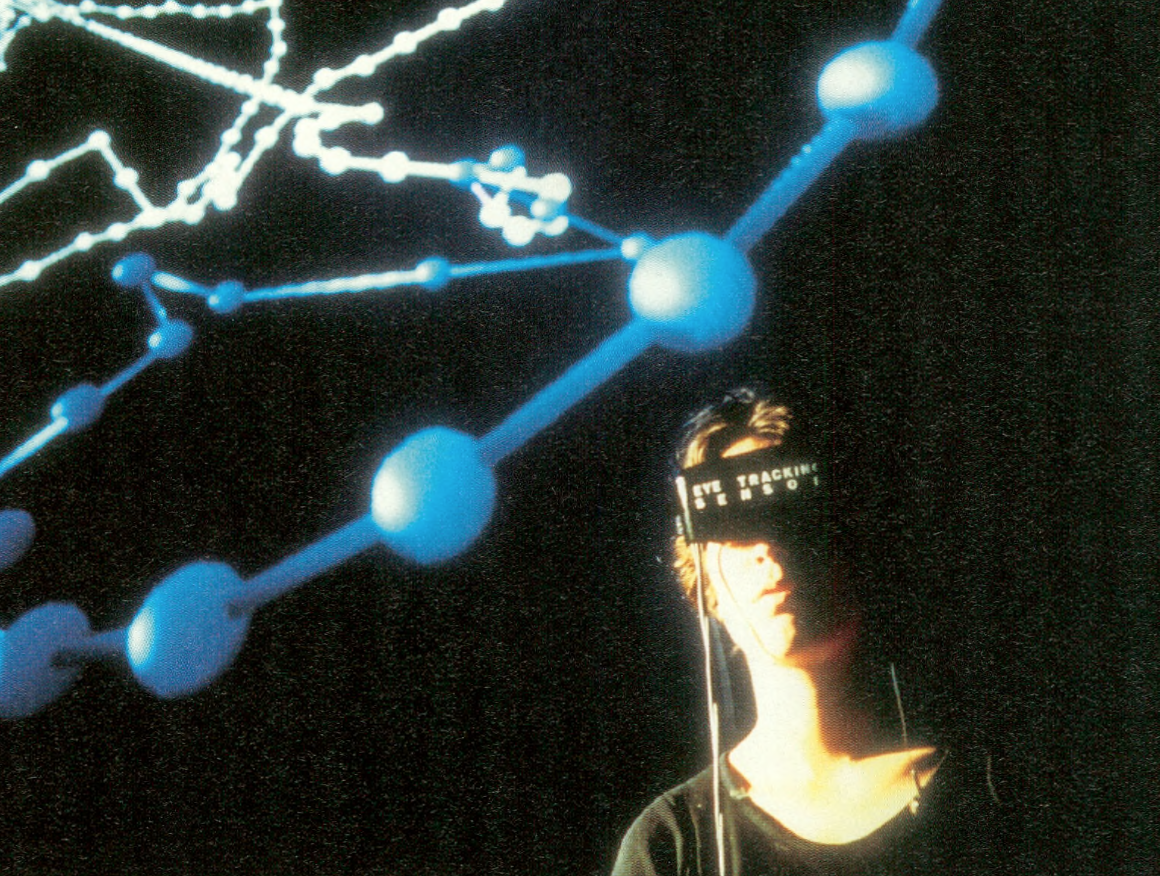
Molecular Informatics is based on the assumption that the human body consists of abstract information, which may be illustrated visually as well as an interface function, existing totally independent of personal subjectivity, perceiving and influencing the environment. The work explores the mental space arising between object and viewer, using the eye and the ear as inter-media linking both entities. If the human component is missing, the entire system ceases to exist. In Molecular Informatics the eye is the interface, its move ments are recorded, translated into data and visualised by an animated graphic display. The trajectory of the gaze is visualised by the projection as a chain of molecules and finds its audio counterpart in a sequence of sounds. Two visitors, sitting facing each other may trace the flow of their own gaze, as well as tracking the gaze of the other. While it is possible to steer eye movements up to a certain degree, it is impossible to fix one’s gaze permanently: as soon as this happens, uncontrollable pupil-movement automatically sets in. A permanent vacillation between control and loss of control takes place. The visitor experiences this uncon trollability of the affective eye-reaction as a sign of indepen dence of their body from their will. “Looking” is the occasion and the motive of “seeing”, and the traces of the gaze are not only visible, but also audible. Distances, overlappings and collisions of gazes are expressed as sounds. In this way the experience of the reflective gaze in this installation becomes intertwined with the gaze of the other.
…
Molecular Informatics geht von der Idee aus, dass der menschliche Körper sowohl aus abstrakter Information besteht, die visuell darstellbar ist, als auch ein Interface ist, das unabhängig von der eigenen Subjektivität existiert und die Umgebung wahrnimmt und gleichzeitig beeinflusst. Die Arbeit beschäftigt sich mit dem Denkraum, der zwischen Objekt und Betrachter besteht und benutzt dazu Auge und Ohr als Inter-Medien, die beide Entitäten verknüpfen. Fehlt der Mensch als Bestandteil, existiert das ganze System nicht. In Molecular Informatics ist das Auge das Interface, seine Bewegungen werden von einer Kamera registriert, in Daten umgerechnet und in einer animierten Grafik dargestellt: Die Trajektion des Blickes wird in der Projektion als eine Kette von Molekülen visualisiert und findet ihre auditive Entsprechung durch eine Abfolge von Tönen. Zwei Besucher, die sich gegenübersitzen, können sowohl die Spur ihres eigenen Blickes, als auch die Blickspur des anderen wahrnehmen. Zwar ist eine Steuerung des Blickes bis zu einem gewissen Grad möglich, doch versucht man den Blick zu fixieren, setzt automatisch eine nicht kontrollierbare Pupille bewegung ein: Ein permanenter Wechsel von Kontrolle und Kontrollverlust vollzieht sich. Die Besucher erleben in dieser Unkontrollierbarkeit der affektiven Augenreaktion die Unabhängigkeit ihres Körpers vom Willen. Das Sehen wird zum Anlass und Movens des Blickes, und die Spur des Blickes eröffnet sich nicht nur dem Auge, sondern auch dem Ohr. Distanzen, Überlagerungen und Kollisionen der Blicke werden als Klangereignisse hörbar. Auf diese Weise überlagert sich im Erleben der Installation die schauende Reflexion über den eigenen Blick mit der des anderen.