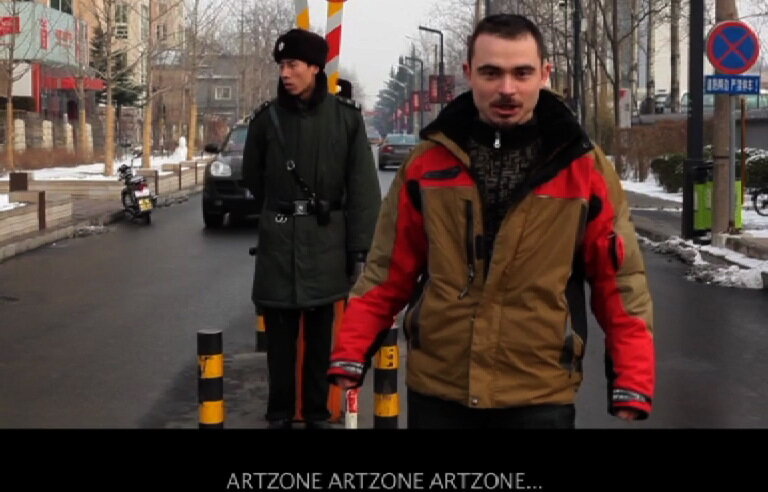
In his Artzone-Timezone project Kamen Stoyanov goes to Peking to investigate its art district – the 798 Artzone. Lying on the outskirts of the city, it is based in a former military and manufacturing plant. Thanks to its many exhibitions the neighbouring area is vibrant, but the district has nevertheless developed a somewhat artificial air. It is here that two Chinese friends of the artist have taken on the roles of gallerists; each describes an artwork they have discovered on a scouting trip. Kamen Stoyanov himself plays the collector, sitting sedentarily in the Timezone café, hauling in his information. The three communicate with each other by SMS. From these SMS-messages, they have developed a rap, based on the tradition of karaoke in China. Stoyanov understands the song’s role as a kind of advertising slogan for the district, but uses it to explore his own problematic: the thin line between art and entertainment.
…
In seinem Projekt Artzone-Timezone setzt sich Kamen Stoyanov mit der 798 Artzone auseinander, dem am Stadtrand gelegenen Pekinger Kunstdistrikt, der seit Mitte der 1990er Jahre in einer ehemaligen Militär- und Fabrikanlage entstanden ist. Aus dem Areal wurde – neben aller Lebendigkeit mit vielen Ausstellungen – kritisch betrachtet auch ein etwas künstlicher Kunstbezirk. Vor Ort übernahmen zwei chinesische Freunde des Künstlers die Rollen der Galeristen, die jeweils ein Kunstwerk beschrieben, das sie auf ihrem Streifzug durch die Artzone entdeckt hatten. Kamen Stoyanov selbst spielte den Sammler, der im im Café Timezone sitzend, seine Informationen einholte. Die drei kommunizierten per SMS miteinander. Aus diesen SMS-Texten entstand in Anlehnung an die Karaoke-Tradition in China ein Rap. Stoyanov versteht den Song als eine Art Werbeslogan für den Bezirk, greift mit dieser Umsetzung aber auch genau dessen Problematik – den schmalen Grat zwischen Kunst und Unterhaltung – auf.