Elvira Espejo Ayca is a visual artist, weaver, and storyteller of the oral tradition of her community of origin, the ayllu Qaqachaka, in the Avaroa province of the Oruro department. A speaker of Aymara, Quechua, Spanish, French, and English, she has developed a body of work deeply rooted in Andean knowledge, while engaging in dialogue with contemporary languages from an intercultural perspective.
In 2025, she was awarded the Ibero-American Prize for Indigenous Art by the Carlos III Foundation in recognition of her extensive and committed career in promoting and showcasing indigenous artistic expressions. This award adds to a series of international recognitions that consolidate the impact of her cultural work. In 2024, she was decorated as a Knight of the Order of Arts and Letters by the French Embassy in Bolivia, one of the highest cultural distinctions of the French government. Previously, in 2020, she received the prestigious Goethe Medal from the Federal Republic of Germany, becoming the first Bolivian woman – and the youngest in the history of the award – to receive this official decoration, which highlights outstanding contributions to international cultural exchange.
Her career has also been recognised with numerous literary and artistic awards: she was a finalist in the Casa de las Américas Indigenous Literature Competition in Cuba (1994); winner of the international poet award at the IV World Festival of Venezuelan Poetry (2007); she won first place in the Eduardo Avaroa Prize for the Arts, specialising in Native Textiles (La Paz, 2013); and first prize in the Promotion of Native Creation in Literature, specialising in Poetry, at the V Festival of South Andean Art Arica Barroca (Chile, 2018). In addition to her visual and textile work, Elvira has developed a prolific musical and literary output. Together with Bolivian musician Álvaro Montenegro, she produced the contemporary music DVDs Thakhi – La Senda. Canciones a los animales (2007) and Utachk kirki – Canto a las casas (2011). She is the author of Sawutuq parla (2006), the book of poems Phaqar kirki-t’ikha takiy takiy – Canto a las flores (2006) and Kaypi Jaqhaypi. Por aquí, por allá (2018). She has also co-authored fundamental works such as Hilos sueltos: Los Andes desde el textil (2007), Ciencia de las mujeres (2010), Ciencia de tejer en los Andes: Estructuras y técnicas de faz de urdimbre (2012), El textil tridimensional: Weaving as Object and Subject (2013), Weaving Life: The MUSEF Textile Collection, According to the Production Chain (2013), Dressing Memories: Perspectives on Clothing from the MUSE (2019) and Wak'añ wak's Protective and Life-Shaping Belts (2023).
From 2013 to the present, Elvira Espejo Ayca has given new impetus to the National Museum of Ethnography and Folklore (MUSEF), directing it with a critical, decolonising and intercultural vision. Under her leadership, the museum has thoroughly renovated its galleries and its museological approach, strengthening the relationship between the collections and the communities. She directed the Annual Ethnology Meeting (RAE) with themes linked to the museum's collections and promoted the production of numerous catalogues (large and small), educational material, documentary videos and animations, as well as consolidating the Portable Museum project, which has brought cultural heritage to dozens of urban and rural communities across the country. In recent years, MUSEF has achieved unprecedented national and international recognition, establishing itself as a model of innovative cultural management in the region.
Related Media
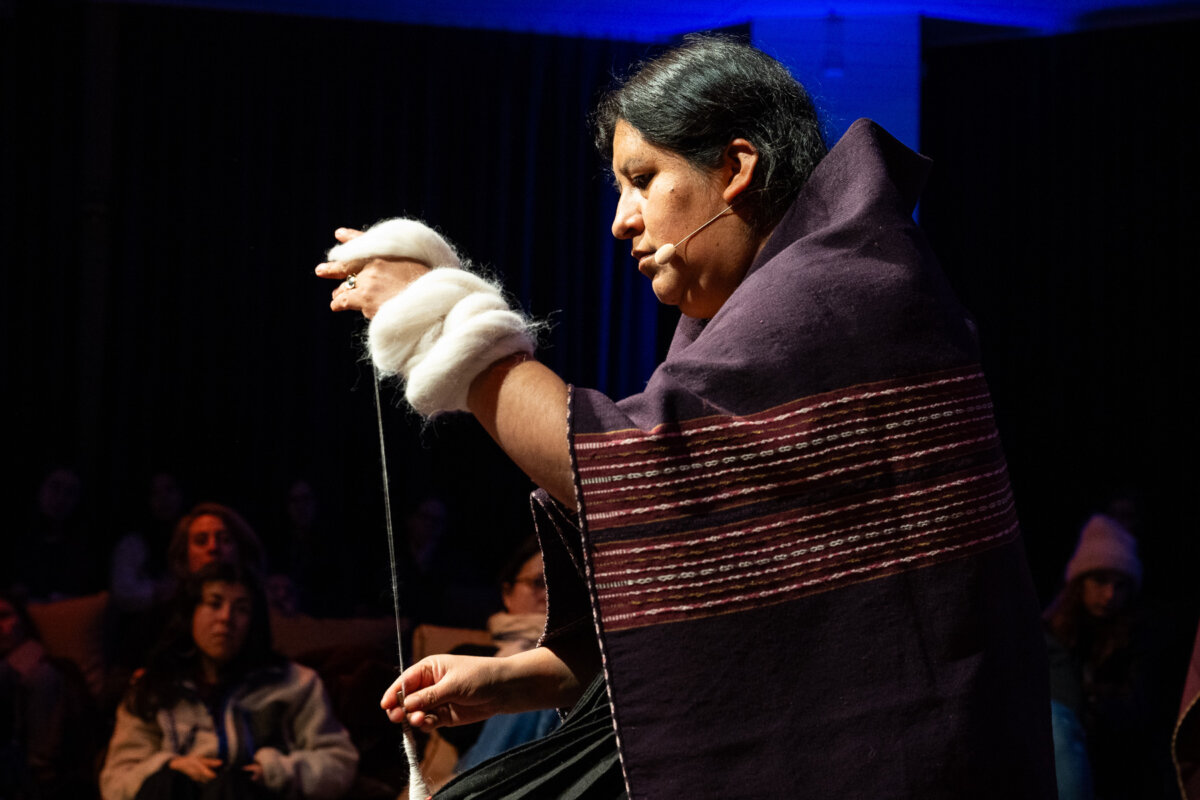 Elvira Espejo Ayca, Thinking and Seeing Through Fingertips, Lecture Performance at transmediale 2026
 Elvira Espejo Ayca, Thinking and Seeing Through Fingertips, Lecture Performance at transmediale 2026
 Elvira Espejo Ayca, Thinking and Seeing Through Fingertips, Lecture Performance at transmediale 2026
 Elvira Espejo Ayca, Thinking and Seeing Through Fingertips, Lecture Performance at transmediale 2026
 Elvira Espejo Ayca, Thinking and Seeing Through Fingertips, Lecture Performance at transmediale 2026
 Elvira Espejo Ayca, Thinking and Seeing Through Fingertips, Lecture Performance at transmediale 2026