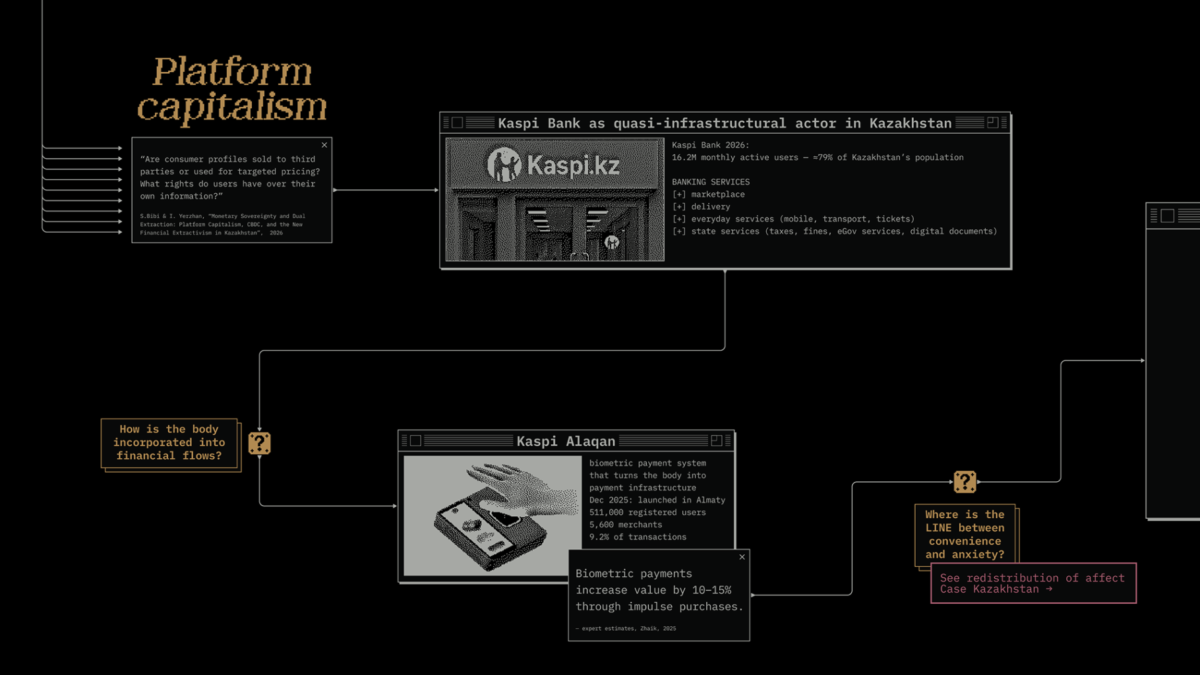
Dark Net is a map of how technology hardens into an infrastructure of power, tracing the exploitation, asymmetry, and repression that unfold around information technologies. Its title should be read literally: a dark, partially invisible map of technological exploitation and dependency, visible only in flickers. Navigated through force fields, cases, and questions, it refuses to be a monument to powerlessness and instead asks what weakens our political imagination and how the belief that this world is natural and unchangeable is
produced and sustained.
Force fields: theoretical frameworks and pulsating concepts that, like clusters of nerves or cables, gather dispersed examples together. They include ruins of infrastructure, governance, production of the subject, the military-industrial complex, and redistribution of affect, among others, and reveal the scale and direction of technology’s social and political effects.
Cases: each force field comes with a series of cases, some broad and some highly specific, showing the tactics and practices through which exploitation unfolds. All are centred on the seven geographies1 , though not limited to them.
Questions: the map is navigated through questions rather than statements. They address the reader directly and demand a response, while also pointing beyond individual cases to other places entangled in the dark net and facing repression, exploitation, and vulnerability.
Researchers: Oleksii Minko, Fernando Morales de la Peña, Antonina Stebur
Design: Andrei Stseburaka
- 1 The research of Dark Net focuses on seven geographies: Greece, Chile, Iran, Kazakhstan, the Democratic Republic of Congo, Pakistan, and Ukraine. These correspond to the seven geographies represented by the institutions participating in the Ruined Assembly Gathering, creating a direct connection between the two maps.