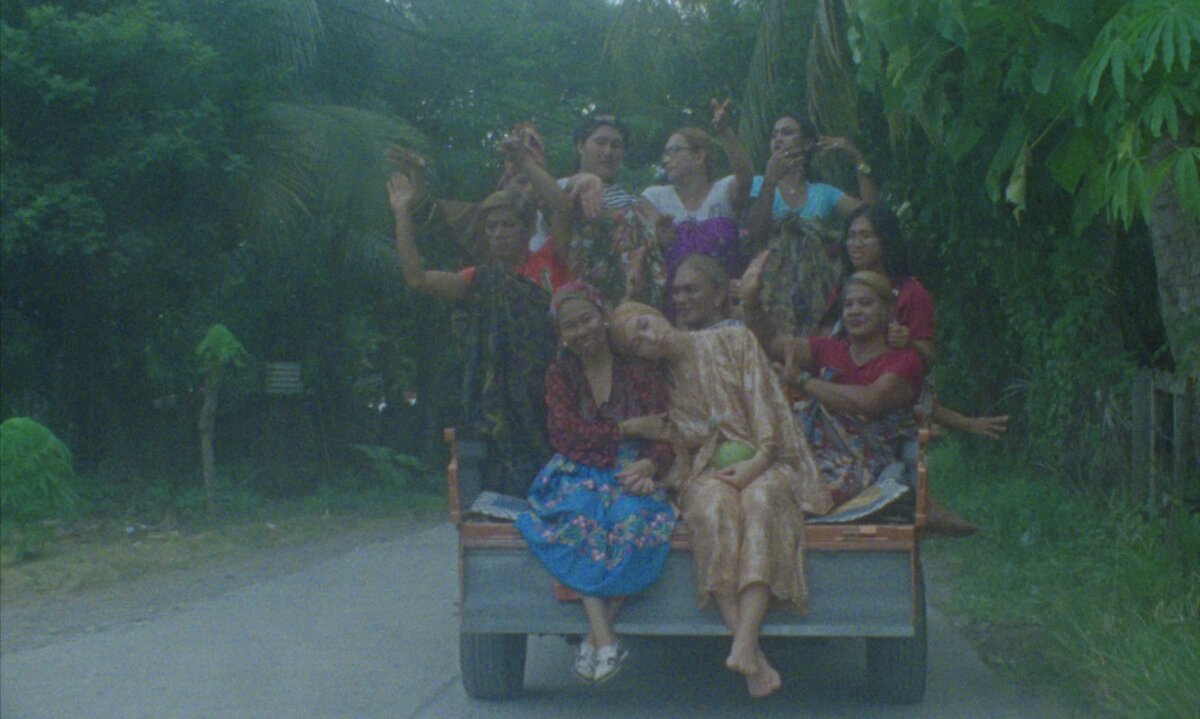
Biraddali Dancing on the Horizon documents a process of ancestral, intergenerational learning. Its starting point is a ritual journey taken by Ra with her teacher and collaborator Sitti Airia Sangkula Askalani-Obeso. Whilst relaying the history of the pangalay, Ra and Obeso explore the cultures and structures of movement practices in the Sulu Archipelago and their relationship to precolonial understandings of gender and identity, in particular the bantot or bayot relating to a trans feminine person. A fabulation unfolds in which a celestial being that resembles a woman with wings and supernatural beauty, known across the Sulu as the Biraddali, reveals itself through dialogue and dreaming. Translated from Tausug or other Samal languages as “angel” or “skymaiden” the Biraddali are believed to live in the sky and possess the power to change their form. As the imaginal passage unfolds, the dance of pangalay and the figure of the Biraddali become symbolically interrelated, with Ra interpreting the Biraddali as a trans, non-human figure and the originator of the dance. The film develops languages of movement that connect vocabularies of gender with past and present colonial realities in the Asia-Pacific region. A musical score composed by Tati au Miel accompanies the film.